Brand, Workforce and Innovation

If you’re interested in Innovation, you have to subscribe to Blogging Innovation. All posts are just worthwhile reading.

image

They also have a group on LinkedIn.

Today’s article typically resonated with me. It’s titled: “Combining Brand Management with Workforce Enablement”.

IBM-718954

It’s about the speech by Jon Iwata, SVP of communications and marketing at IBM on the future of the communications profession at the November 4th 2009 Institute for Public Relations Distinguished Lecture Series at the Yale Club in New York City. Full text of the speech is here.

Iwata says:

"One day soon, every employee, every retiree, every customer, every business partner, every investor and every neighbor associated with every company will be able to share an opinion about that company with everyone in the world, based on firsthand experience. The only way we can be comfortable in that world is if every employee of the company is truly grounded in what their company values and stands for."

IBM has developed an IBM Brand “System”:

Picture a framework with five columns. From left to right the columns are labeled what it means to look like IBM, to sound like IBM, to think like IBM, to perform like IBM and ultimately to be IBM. Simple enough. You could in 30 seconds create the same frame for J&J, Chevron or Ketchum. But of course it would — and should — take you much longer to fill in the details. Every word, every phrase and description in that framework would be painstakingly chosen. Because this is your corporate genome. It describes what makes your company unique. Developing the framework is hard work, but it’s only the foundation. Because, like a genome, the real work — and value — are in bringing it to life.

and also:

For example, we are now collaborating with our colleagues in HR to redesign IBM’s leadership competencies for the first time in many years. If this is ultimately approved by the CEO – and we’ll know in a few weeks – it will mark the first time in my 25-year career that the foundational elements of HR will not only be aligned with our brand and workforce strategies, they will be essentially the same.

I would like to see some examples on how this works in an environment where efficiency programs are run in parallel with innovation programs and (re)branding programs. What is the ideal role of HR in all of this ? Will HR be degraded to a “management” machine to deal with lay-offs only ?

I’d love to see more HR in a true leadership role. Leadership as opposite to management in its narrow definition of executing a course set out by somebody else. See also below the very important message about the role for HR in creating the eminence of our workforce.

About this, Iwata says:

But the building of constituency goes beyond the reaching of audiences. It gets to how a company establishes shared attraction and shared values: how it shapes not just common ground, but a deeper, enduring, shared idea.

They weren’t simply sending messages to audiences. They were creating audiences.

They weren’t shaping relationships with existing constituents. They were creating constituencies.

This is the basis of our Smarter Planet strategy. We are specifically and deliberately working to validate and stoke the optimism of forward-thinkers. We are saying to them – because we really believe it ourselves: “Your hopes for your industry, your city, your environment, your community are now within your grasp. This isn’t a metaphor. We can actually build a smarter planet.”

Our work of late tries to get at the real substance of change, the real issues on the table. The work is long-form. It’s argued, not pitched. It doesn’t focus on our products and services.

It purposefully invites people to

 think


Wow !


And lastly about Building the eminence of our workforce.

I believe that 2010 will be the year that corporations grapple with and ultimately accept that their employees are engaging with – and must engage with – social media. We’ll certainly go through a necessary period when people raise all sorts of objections.

The CFO worries about financial disclosure. The General Counsel fears intellectual property leakage. HR will say we’re helping competitors recruit our people. And everyone will be nervous about criticism of management. These are all legitimate.

So the answer to all this may be another set of policies and guidelines for using social media. My employer has indeed such a set of policies. They are difficult to find, but they exist. But are another set of policies and guidelines a solution. Will the fact that each employee has to sign-off the blogging policy or any other code of conduct really change our actual behavior ?

I doubt it.

Let’s say we actually do that. Then what? Policies and guidelines may keep individuals and their companies out of trouble but, by themselves, they won’t create business value.

The key is to build the eminence of our workforce.


What do I mean by “eminence”? No matter what their industry, their profession, their discipline or their job, people with eminence are acknowledged by others as expert. It’s not simply to know a lot about Tuscan villas, digital cameras or banking. You need to be recognized as an expert. And when you show up – in person, or online; in writing, or in conversation – you are both knowledgeable and persuasive. Because being an expert and being good at communications aren’t the same thing, as we all know.

Which is why


we need to make the creation

of this kind of workforce

an intentional act,

a new discipline in our function

Yes, we need guidelines and policy – but also training, resources and support for broad networks of experts.

Related to this, i found just a couple of days ago a great post from Hugh McLeod’s site titled: If your boss tells you, “our brand must speak with one voice”, quit.

I once had a boss who didn’t like the fact that I had a blog. Especially when I blogged about stuff that was relative to our industry. Yeah, “Our brand must speak with one voice” was his idea. Yes. I know.

Actually, the reality was, HE wanted to be “The One Voice”. He wanted all the credit, and all the rewards. He didn’t mind me put ting words into his mouth– stuff I had writ­ten– so long as the outside world gave him all the credit. But he didn’t want me in any other role, other than subservient, nowheresville wage slave. He fought tooth and nail to keep me from ever becoming a rainmaker inside the company, something he wanted all for himself.

And back to the end of the speech by Iwata:

To me, this is what “values” are about… and what “authenticity” means. This is about consciously choosing a unique identity. And it’s about actually being that unique thing you have chosen to be.

In other words:

Leading by Being

Brain Chips

image


All images courtesy of www.gigaom.com. found via my subscription to the fantastic spacecollective.org site. Full link here.

I somehow like #2, but get discouraged when i read the description: “The technology is basically the same as that used to treat Parkinson’s disease.”

Seriously, it’s a great post, and indicated that brain chips are getting real and that the singularity is getting nearer and nearer.

2009: the year of Darwin

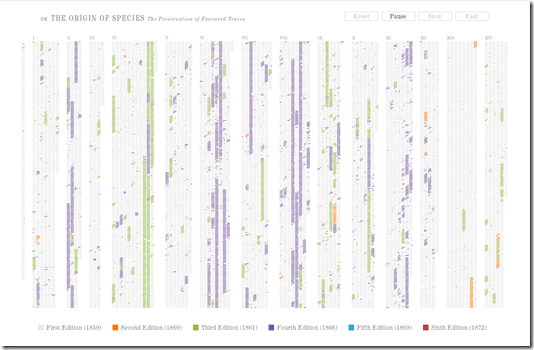
Listed as best visualization of 2009. The evolution of The Origin of Species. Link here. It takes a couple of minutes to download. Mind you, the whole thing is clickable.

image


Other great 2009 visualizations at

image

Change your worldview

My absolute #1 Book recommendation from 2009 is “The Age of the Unthinkable” from Joshua Cooper Ramo.

The essence of the book is that to be able to cope with the new game future, one has to change his worldview and look at the whole and not only the pieces.

Below is a good – completely unrelated video – that gives you an aha experience on changing your (world) views.

Nothing is what it seems to be…

Enjoy.

image

CHOP CUP from :weareom: on Vimeo.

Taste some Huge McLeod

As mentioned many times before, Huge McLeod’s book “Ignore Everybody” is an absolute recommendation.

The whole book started from a blog, the gapingvoid.com

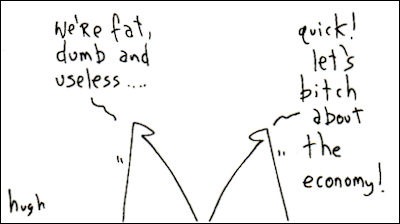
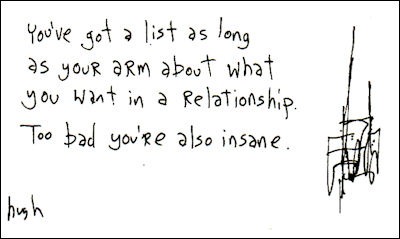
Here are some recent tapas, that give you a feel of Hugh’s work. Not exactly marry christmas poetry, but that’s the point.

All drawings from Gapingvoid by Hugh MacLeod

fatdumb insane loverslost tired

Future of e-Magazines

Great video on how e-Magazines may look like in 2010 when the iTablet gets released.

image 


I recently bought myself a Kindle, and i am VERY disappointed. 259 USD is a lot of money for a device you can only read Amazon books on. And it does not even have a zoom for it’s “built-in” Adobe reader.

For 259 USD, you get a netbook these days.

Does anybody know what the device is used in this video ?

UPDATE: Appkle iTablet planned for Jan 2010 ? Can’t wait.

http://venturebeat.com/2009/12/23/apple-tablet-january/

apple-tablet

Every morning I wake up angry

crash

It was triggered in me for the first time when I was watching the movie “Crash” featuring Sandra Bullock. She plays a rich wealthy healthy good looking woman that has everything. Has a great job, good family, fancies the better restaurants and clubs.

But she is spoiled and disconnected with the real world. She lives in an ivory tower.

It gets as bad as her saying during a morning breakfast discussion:

“Every morning I wake up angry”.


Angry

That emotion that was so present during (and after) the 18 month personal development program Leading by Being that a ended about a year ago now. The 23 Feb 2009 coming-out of that program also resulted in this blog.

My angriness this morning is basically triggered by an argument I has last night with my lovely wife about something really stupid. Nothing spectacular, but the feeling remained during the night. So, i had a bad night.

The trigger is pulled when i recognize that feeling of not living my full potential. When i feel swimming in syrup. What i feel i don’t progress anymore. Status-quo. It’s protest. It’s rebellion. It’s Anger.

In one of my previous posts i was writing about the holy fire. This time it’s maybe the devil’s fire.

This fire is also burning like hell, but the burning is one like

acid


It’s a lot of negative energy. It’s the devil inside me. The Hannibal Lector with his own (melo)-drama, showing himself as the complex persons as that suits him well, and does not force him to show his true (empty) self.

image

I went back to my notes of Leading by Being, “refreshing” what caused my angriness. This is what i found back:

image

It’s this feeling that i can do so much more but am standing in my own status-quo. Since the coming-out on 23 Feb 2009, there is not much i have done with all the nice resolutions i wrote down at that time.

It’s the feeling that you know very well what to do/change in your life to be your true self and not the self that you imagined for yourself. And being angry for not applying in any way all the great lessons you have learned in this program or in all the great books you have been reading in your life-time.

And feeling deep inside that something “big” is on your life-path, and that you seem to have missed it consistently or avoided it on purpose. The thing that Huge McLeod calls “You have to find your own shtick”

It was the fact that somehow playing around with something new, suddenly they found they were able to put their entire selves into it. Only the did it become their “shtick”, their true voice, etc. That’s what people responded to. The humanity, not the form. The voice, not the form". Put your whole self into it, and you will find your true voice. Hold back and you won’t. It’s that simple.

I have also been reflecting on this blog. I read quite a lot. Books. And I spent quite some time reading postings via my Google Reader. 2 hours per day is not uncommon (my wife loves me for this).

It really would not be difficult to post 3-4 new posts per day linking to other stuff i found interesting. And i discovered the trick that if my blog post title contains “Google”, or “Android” or… I get a lot more hits. But do those hits also mean impact ?

If so, it’s mere quantitative, not qualitative. And even when that happens, what does that do ? Make myself interesting and exposing how smart i think i am ? It is not satisfying. Anymore. Like others, I am in search for more

depth


I enjoyed much more the postings like holy fire. They’re more “authentic”. I know it is a big word. Maybe i should now share what stuff i am reading at this moment. Puts it all more in context.

I am in 4-5 books at the same time: re-read Seth Godin’s “Tribes”, devastated by Hugh McLeod’s “Ignore Everybody”, the disappointing Nick Carr’s “The Big Switch”, Howard Gardner’s “Five Minds for the Future”, Joel Garreau’s “Radical Evolution” and – in Dutch – Rik Torfs “Wie gaat er dan de wereld redden ?”  (translated: “And who is then going to save the world "?).

Those guys really inspire me.

I am inspired by what Howard Man, entrepreneur and the author of Your
Business Brickyard, has to say:

I’m continually amazed by the number of people on Twitter and on blogs, and the growth of people (and brands) on Facebook. But I’m also amazed by how so many of us are spending our time. The echo chamber we’re building is getting larger and louder.

More megaphones don’t equal a better dialogue. We’ve become slaves to our mobile devices and the glow of our screens. It used to be much more simple and, somewhere, simple turned into slow.

We walk the streets with our heads down staring into 3-inch screens while the world whisks by doing the same. And yet we’re convinced we are more connected to each other than ever before.

Multi-tasking has become a badge of honor. I want to know why.

I don’t have all the answers to these questions but I find myself thinking about them more and more.

In between tweets, blog posts and Facebook updates.

That’s why I’d like to write more about the real life. My life. Yours. My colleagues.

And not to show fear but

vulnerability


And to inspire others to dream.

What matters now

This is the time of New Year resolutions.

If you need some inspiration for your resolutions, I can recommend Seth Godin’s latest free e-book ‘”What Matters Now”

image

You can download it here.

It’s a collection of wonderful one-pagers written by smart friends of Seth Godin about noble themes such as Generosity, Fear, Passion, Compassion, etc

It also has a couple of advertisements for a fund-raising campaign for “Room to Read”, a program for providing books and education to children in developing countries.

image

In the collection of one-pages, the one that attracted immediately my attention and that really resonated with me was …

image


Have you ever wondered who’s behind that little voice in your head that tells you, “you’re in this by yourself, one person doesn’t make a difference, so why even try?” His name is Fear. Fear plays the role of antagonist in the story of your life. You must rid yourself of him using all necessary means.

We’re often impressed by those who appear to be fearless. The people who fly to the moon. Chase tornadoes. Enter dangerous war zones. Skydive. Speak in front of thousands of people. Stand up to cancer. Raise money and adopt a child that isn’t their flesh and blood.

So, why are we so inspired by them? Because deep down, we are them. We all share the same characteristics. We’re all divinely human. Until Fear is gone, (and realize he may never completely leave) make the decision to be courageous.

The world needs your story in order to be complete

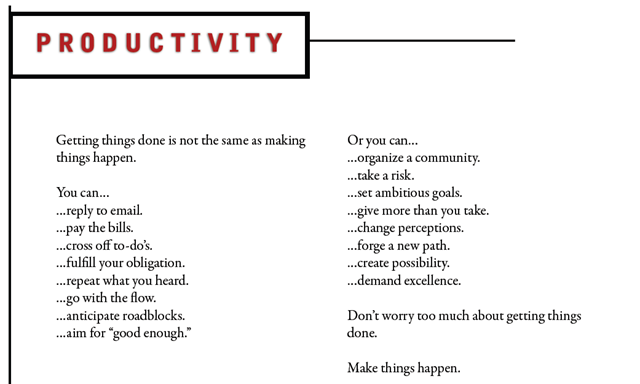
Or about Productivity:

image


Or about Gumption:

image

I want to be fear-less

I want to be productive

I want to make things happen


I am hungry


Want to flap my wings


I want it now

The holy fire

If you are in one of those dips – and who doesn’t from time to time – I’d like to recommend you some “power-reading”. It’s better than zapping in front of your television, or better than (re)tweeting 140 characters. It’s definitely better than booze or drugs. And it has some element of “depth” that you don’t get from those other media/substances.

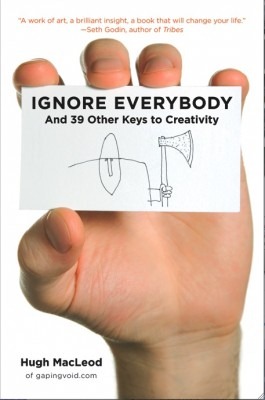
I could have titled this blog post “Ignore Everybody”, the title of a fantastic book by Hugh MacLeod of gapingvoid.com. The subtitle is ‘And 39 Other Keys to Creativity”.

ie222jpeg1-265x400

This is one of those rare books that hits you in the face. Subscribe to his blog. A drawing on a business card will wake/shake you up every day when you open your Google Reader.

091125d

Guy Kawasaki said: “Hugh’s book will kick your ass and push you out of your zone of mediocrity and stagnation”.

On one of the other cards in the book it reads:

The price of being a sheep is boredom. The price of being a wolf is loneliness. Choose one or the other with great care.

Hugh refers to the “Pissed Off Gene”. That burning fire inside that make you want to challenge the status quo.

It has something primal.

a25_17287961

So there i am with my wildfire, and now i come across a bunch of folks who feel down and ask me why we need an innovation team. They feel down because they have just gone through one of those mandatory efficiency or six sigma programs to cut fat out of the processes. Nothing wrong with that, some organizations can use a diet, and it’s in essence about being fit and going to the gym (looking at my belly it’s time for me to do so ;-). But what i think is really going on is that they feel the “Pissed Off Gene” coming alive again. It’s protest. It’s challenging where we are. It is challenging the status quo. This gene is a great source of energy. If only we could turn that negative energy in a positive one. Wouldn’t we loose less time and move forward faster ?

Sometimes however it’s getting worse. These days i believe we not only need a physical-gym, but also a mental-gym, because these days, some people already feel down in advance of the program: they start to hide, don’t dare to stick out their neck, afraid that if they become too visible or are not in line with the blueprint, they will be the first to be cut. That’s a ream shame. Come on, guys ! Don’t ignore yourselves in such a big way. Because your are worth it.

So back to the question “Why we need an innovation team ?”. Why we need innovation ? Really, reading the above i wished you did not ask. Because a company that does not have a focus on innovation does not believe in the future. Does not believe in growth. Does not believe in creating wealth. Is a dead company.

images

Dead wood.

So, what should we do ? Get rid of the innovation team ? Have no focus on innovation ? Come on !

We should probably quadruple our efforts.

But i know there is also the reality of budgets, certainly in these days. But I will keep pushing for it. So please, for once be proud that your company überhaupt has an innovation program in place (and a quite good one compared to other companies), and embrace it and help it and the company succeed, instead of complaining about it.

Our innovation team gives help. To the people who have that “Pissed Off Gene”, who have that holy fire. To help them to stand up and keep on fighting the status quo. To help them and the company make the difference. We are not measured on the ideas generated by the innovation team. We are measured on the ideas and success stories in the rest of the company and the eco-system at large. We can help those “passionate creatives” with resources (people and money).

And i hope that we also kick some ass

,and send out some wake-up calls, when we see things at the edge of our jungle that could be beneficial for our community. It is our duty to report those things, to orient/position them, to evangelize those new ideas and to help people moving from prototype into incubation.

And yes, that can be fun

Seems to be a bad thing these days to have fun. Really don’t get it. Also, they don’t see the hard work that goes on behind the scenes. They only see the fun part. Innovation is about change. People resist change.

Some days i feel like swimming in syrup

And some days it really feels good when we achieve something. But complaining seems to be the fashion of the day. And being in a good mood is these days like almost like an offense. In any case, the complainers never come to see us to see how they can be part of the fun. They complain. By preference in the gossip aisles of “radio-corridor”, hiding in the safety of anonymity.

It was probably a bad idea to call our team “the innovation team”, as we are measured on how many ideas we make the others generate and realize. But heck ! What should we have called it ? The A-Team ? The Tiger team ? The incentivators ? Cut the crap !

Print

In the end the name “InnoTribe” is right on. A tribe of innovators. Tribe as in Seth Godin’s book “Tribes”. One of those other great books if you have one of those dips.

banana_tribes

You know what all this is about ? I am going to use a big word: “leadership”. Not the leadership that you read about in McKinsey’s Newsletters. No, personal leadership. The leadership from within. From your true self. When you know damn well when something is right or wrong. Leading by Being. It is daring to follow your internal compass. It’s the difference between putting the fault on others and taking initiative yourself to fix the problem, or to come-up with something bright new. It’s daring to choose between old-game and new-game.

Old Game is being judgmental. New Game is Open Mind.

Old Game is being cynical. New Game is Open Heart

Old Game is being in control. New Game is Open Mind

In the end it’s people with passion that drive the innovation.

You can lead a horse to water but you can’t make him drink
You can’t push a string uphill
Time waits for no man

Jeffrey Philips adds one about innovation. While we like to say that everyone can innovate, its probably also safe to say that

You can’t force a disinterested person to innovate

So, what is it ? Are you the interested or the disinterested person ? If you are of the first category, join the journey. If you are the latter, come and see me. I’ll try to give you a pep-talk and try to shake/wake up that fire in you that is burning for sure in every human being. We just learned through the accidents of life/work to ignore and hide those fires. They’re too close to emotions. And emotions do not belong at work. What a crap !

Express yourself and come alive !


Do YOU have the hole fire ?

I do. And I am not ashamed to say so. And I am 52. And there is no age for it. And i am burning like hell. It’s primal. I am on a mission. “Ignore Everybody”. Don’t wait for the others to support you. GO !

And if you still feel in a dip after this, turn on Madonna’s “Jump”, volume knob on 10, and dance and listen to the following words:

The more that I wait, the more time that I waste
I haven’t got much time to waste
It’s time to make my way
I’m not afraid of what I’ll face
But I’m afraid to stay
I’m going down my road and I can make it alone
I’ll work and I’ll fight till I find a place of my own
[Chorus]
Are you ready to jump
Get ready to jump
Don’t ever look back oh baby
Yes, I’m ready to jump
Just take my hand
get ready to jump

Google Chrome: who is right and who is wrong?

All over the tech websites last week: Google previewing their Chrome OS and releasing it’s code to the open source community.

Planning, pre-viewing and releasing an OS is a big thing. Especially if everybody is looking at you as the provider of THE cloud OS.

It stroke me that some of the comments are so diverging. Some examples. Who is right and who is wrong ? With – as usual – some additional thoughts and spices by yours truly.

Negative

When the title says “Why Chrome OS will fail” you know what to expect.

However, it also inherits that platform’s (Linux) many warts, including spotty hardware compatibility.

It’s a move born of desperation. Google knows it can’t possibly establish a viable hardware ecosystem and still meet its self-imposed release deadline of "mid-2010”.

…no surprise that the primary interface to the Chrome OS is … Chrome, as in the Google browser. Unlike a traditional OS, there’s no desktop. The "applications" running under the Chrome OS are really just interactive Web pages,…

The bottom line is that while there is virtually nothing that you’ll be able to do with the Chrome OS that you won’t be able to do equally well with Windows, there are literally millions of things that you can do with Windows today that you’ll likely never be able to do with the Chrome OS.

It should come as no surprise that this is the article that is tweeted around Twitterspace with great and almost malicious pleasure by current Microsoft employees. Still loyal to their employer.

But think twice when you use the word loyalty in this context. See how fast the love can turn into competition when the company does not treat its ambassadors rightly (Don Dodges 180° love/hate turn around after being hired by Google)

See also James Gardner on the “Evidence of the (Microsoft) chip (in Microsoft employees)” and the introduction of a new term:

the Borgocrat

Fake Steve Jobs, one of my favourite blogs on the internet, summarised the whole thing very nicely I thought, in a post where he calls Don a Borgocrat (Fake Steve refers to everything Microsoft as the Borg), and compares previous posts Don has made with his new position on products for the company.

If this isn’t evidence that the “chip” still exists, I don’t know what is.

The more a read those opinions of some of head-in-the-sand Microsoft opinion makers , the more they are irritating and even not credible.

What to think of a Microsoftie making fun of Google Gmail being down, when their Hotmail has been down and hacked so many times.

But it’s a more general irritation.

What to think of traditional network vendors making fun of some cloud outages, knowing that their legacy technology is 30 years old, and the cloud players are doing relatively well, if you would add an adoption ratio of number of users and the incredible short time to market for users to take up.

That sort of arguments are so passé,

so old game

Neutral

Starting with a safe “Personally, I think it’s too early to tell.” The more interesting part in this posting is the effect that “geeks” can have on mainstream.

Yes, the "geek" audience is without a doubt a niche market. So it’s easy for Microsoft or Apple to write off Chrome OS. But that’s a mistake. As John Gruber wrote in his excellent piece, "Microsoft’s Long, Slow Decline":

People who love computers overwhelmingly prefer to use a Mac today. Microsoft’s core problem is that they have lost the hearts of computer enthusiasts. Regular people don’t think about their choice of computer platform in detail and with passion like nerds do because, duh, they are not nerds. But nerds are leading indicators.

Microsoft’s losses to Apple aren’t based on "regular people" choosing the Mac. Rather, these "regular people" were encouraged to do so by the geeks in their lives who had made the switch to a Mac years ago. Consumer technology vendors can ignore the alpha geek niche at their peril.

Positive

Louis Gray has a long term view.

Google’s preview of the Chrome OS was more than a product release. It was a milestone in a vision of a Web-centric world, one in which we are increasingly living.

For the vast majority of my own activity, I am online, not using software. I intentionally use some applications, like Microsoft’s Office suite or Adobe Photoshop, quickly, and then close them just as quickly, as to not slow down my computer’s performance. Google’s Chrome OS is the latest development in a vision that says our activity will be online, our data will be stored in the cloud, and applications that have traditionally been desktop software will make their way online.

Under no uncertain terms, I agree with their vision. This is happening and it is happening fast.

Robert Scoble (an ex-Microsoft himself) has as usual a more documented insight on his blog.

Google is playing a different game. Google Chrome OS is NOT about killing Microsoft or Apple.

What is it about? Developers, developers, developers, developers, developers.

This reminds me of the famous video where Steve Ballmer cheers up the developer’s audience in the good old days. It looks however – like pointed out in the neutral article above – that Microsoft has lost its’ “clout” with the developers at large.

It’s even getting worse: last week at PDC, Ray Ozzie was saying that apps won’t be a differentiating factor on smart phones. Sounds a bit arrogant to me when you know that iPhone Appstore has 100,000+ apps in store, and Android Marketplace building up fast.

Scobleizer continues:

I have not seen a single thing demonstrated on stage yet that won’t run on Google Chrome OS.

This is a winner, but on a new field