It was an interesting audience, with most people coming from Central and Eastern Europe, with some interesting case studies from Paolo Barbesino from UniCredit in Italy, Carlos Gomez from Activo bank in Portugal, Marcel Gajdos from Visa Europe Czech Republic/Slovakia, Efigence in Poland, and Wojciech Bolanowski from PKO Bank Polski. I made quite some notes, and if i find the time to make a post on it, i will.
Luckily, my fans are out there to help me. I planned write something about my talk as well, but Wojciech Bolanowski already did that in his great LinkedIn Post here. I have cut and pasted his post in its entirety, as it captures well what i was trying to convey in that presentation. Thank you so much, Wojciech, much appreciated 😉
+++ Start post Wojciech
Inspire other people, think differently, create spaces where people come alive, ship to customers; as well as bravery, prototyping, events, capabilities and clarity – these are ingredients for successful innovation within big organization; at least according to excellent speaker and Innotribe Co-founder Peter Vander Auwera.
How to innovate in the shadow of behemoth?
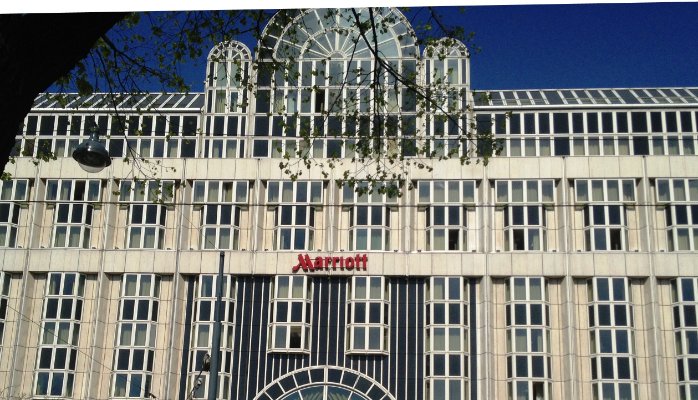
Peter spoke on the first day of 7th Annual Banking Innovation Forum by Uniglobal in Vienna Marriott Hotel (as pictured above). He was keeping the audience extremely focused and interested. The subject was complex and of great importance: how to make really BIG organization innovative. As Peter put it in an outstanding rethoric figure: “how to make babies”. I would like to add: how to make the babies when you are well-known, established, serious and successful one with huge legacy and obliging history.
The questions are (usually) much more important than particular answers, so there is not my goal to report Peters’s solution in details. What I would like to point out is the question itself. Today, in the fast-running world of fin-tech start-ups and quasi-banking innovators almost every bank is big enough to raise this question to itself. Is it enough to inspire other people with your disrutptive ideas? Is such inspiring even possible in organization too big to change itself spontaneously? What could possibly happen if you think differently from dominant thinking styles?
Obviously, being innovative within mammoth-size organization is a big challenge and requires specific attitude and social skills. As I understood one of the Peter’s suggestion is to create appropriate team which become the centre and engine of the process. The brave, capable team with clearly set culture of “rather be failing frequently than never trying new things” to quote Peter’s presentation. Some important tools to do so are special workspaces, integrating events and ways of building true alignment.
Bravery – the slide of the presentation. Source: Uniglobal
How to gain executives’ support?
The presentation was full of insider stories with some of them concerning interactions between innovators and the board members. Those were a great lesson of struggle which, I think, at least to some extend, any innovator should expect and be prepared for. The very useful take-out was about prototyping and commercial launching of innovative products. The prototype should be, according to Peter’s best practice, as vivid and identical with the final product as possible. No more “Power Point Prototypes” unless you would like to fail. What’s even more – prototyping is just a step to the real strategic goal – to deliver real, commercial product and give it to customers. “Go out of the sandbox” is another great statement I heard from the speaker. Indeed, today environment of fast growing and alternating product propositions demand being “on market”. The Grand Jury of customers has no time to screen through pilots or prototypes; every company should be ready to risk and show its innovation as soon as it is delivered. In my opinion this is extremely important to realize. Shipment to customers what is already prototyped is the crucial part of execution process in innovation. I feel it is striking and true, therefore I tweeted this immediately with hashtag #BAIF2015!
What about the reluctant middle-level-managers?
The next splendid remark is about mid-level managers’ attitude toward change. For them the main goal is “too keep any changes far away of the plan”. It is understandable and rational. For manager’s KPIs are target-related, they try to keep organization on the course to achieve them. However, any innovation process within organization creates the risk of change, which, possibly, could alternate plans and goals. This is the real challenge – to execute innovation in organization which mainly consists of medium-level managers. And execution itself is much more difficult and lasts much longer than whole creative process of gathering ideas, evangelization, internal promotion etc. What Peter stressed, and I agree fully, is thatin context of big organizationsidea management process is easier and shorter than its incubation and implementation. In start-ups world there is exactly the opposite relation.
Start-ups as indicators
Start-ups in financial sector (dubbed fintech recently) occupied a lot of Peter’s presentation as he is involved in the well-known Innotribe@Sibos program. The event has attracted more than 340 participants this year. It is quite nice sample to show what’s going on in innovation. With four continental semi-finals (NYC, London, Cape Town and Singapore) it gives global overview and prime selection of activities. This could be a useful indicator for big companies to track the start-up trends and pick up something valuable from. For example in 2014 the leading areas of start-up activity were (despite a broad category of corporates/business services) investment management, lending, big data and personal financial management. It is a clear message to banks: there is innovation coming to your core businesses and it is technology-driven.
This post is inspired by presentation shown on of 7th Annual Banking Innovation Forum ; there is another one of this category, in case you are interested:
Peter Vander Auwera on stage in Vienna. Source: Uniglobal
Linguistic disclaimer
I have written this text in English and I know my limitations. It is possible you find this post illogical, offending, unclear or too simplistic. It does not mean to be that way, so please blame it to my imperfect English skills. I am neither native nor perfect English speaking person . If you want to be helpful, do share your grammar, spelling, style and any other remarks with me. I would appreciate any contributing comment, especially if it came from native speakers.
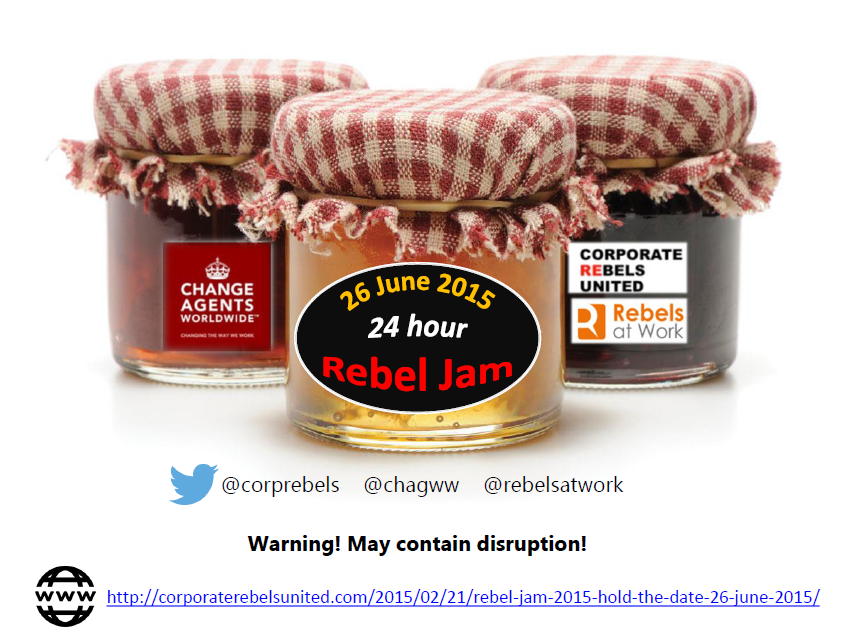
24-Hour Online Rebel Jam: Stories of Change > Friday, June 26, 2015
Calling all Corporate Rebels and Change Agents Worldwide to step forward to speak at our second edition Rebel Jam.
The intent of our second 24-hour Rebel Jam is to share what people around the globe are doing to try to create positive change at work.
Artwork by Jodi @JodiOlden
All interested are invited to speak. All we ask is that you tell a story about something you tried to do, what happened, and what you learned. (And, of course, speak as much from your heart as from your head. Folks want passion not perfection.)
You can talk, sing, rap, use slides (or not), or show a video. (Hey, we’re rebels; creative expression is encouraged.) Here’s the link to the Google spreadsheet to sign up for a 20-minute slot.
Details on dial-in numbers and logistical information to follow. Spread the word.
Week-14 of Delicacies: very rich week content-wise. Quite a challenge to select max 5 articles that i found interesting and worth re-reading. Handpicked, no robots. Minimalism in curation. Enjoy!
I am deeply emotionally touched by the beauty of Dries Van Noten’s “Inspirations” exposition at the Fashion House in Antwerp and Marc Chagall’s Retrospective in Brussels.
They brought me back in contact with a part of myself that I had neglected since my Leading-by-Being days in 2007-2009, the quest for purpose that lead to the start of this blog in April 2009 titled “Singing my own song”.
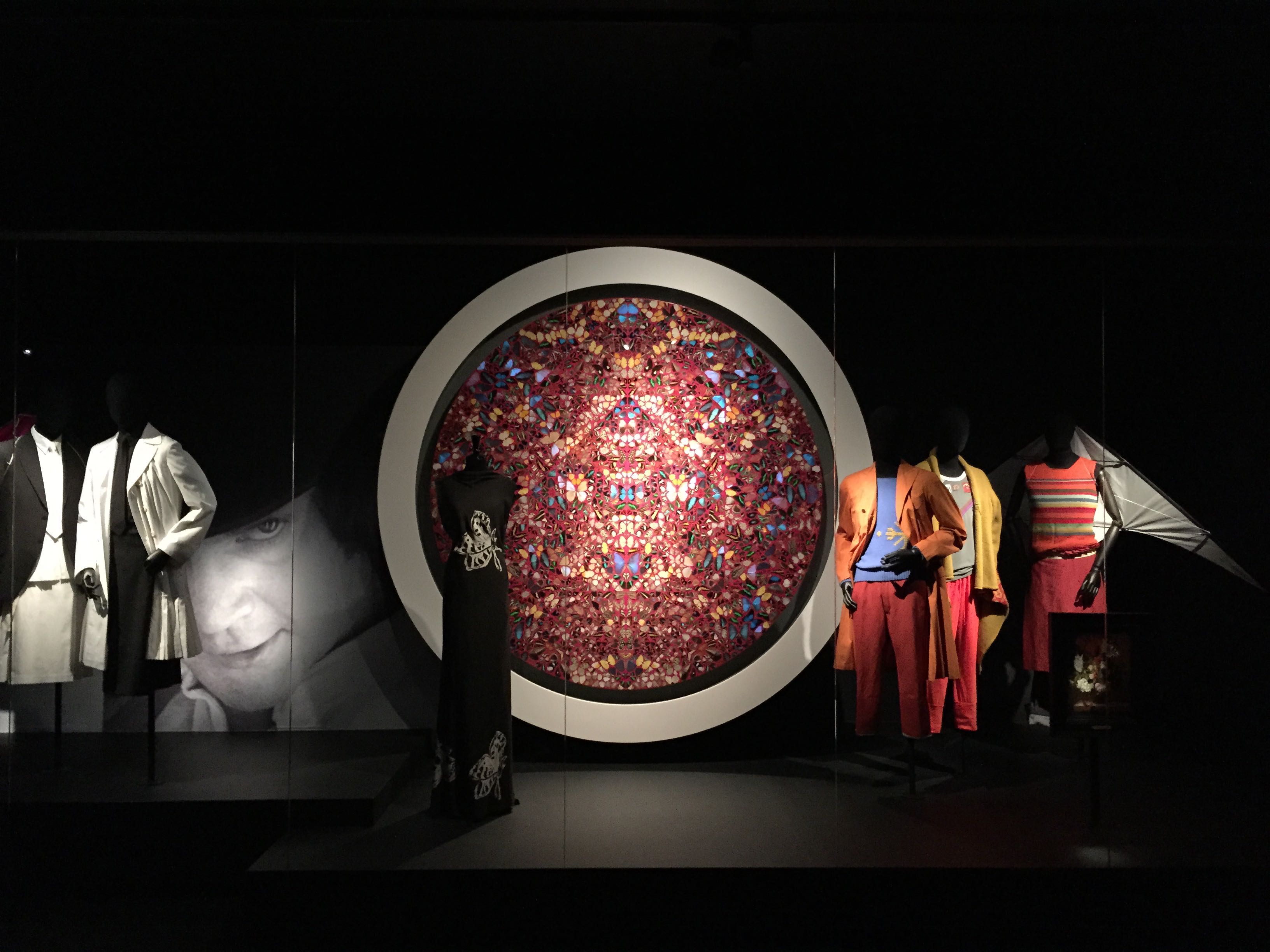
First, the fantastic Dries Van Noten expo in Antwerp. Not a retrospective: Dries is too young for that (he is about my age :-). But an amazing overview of his work since the Antwerp Six till today.
The whole expo breathes passion and perfection.
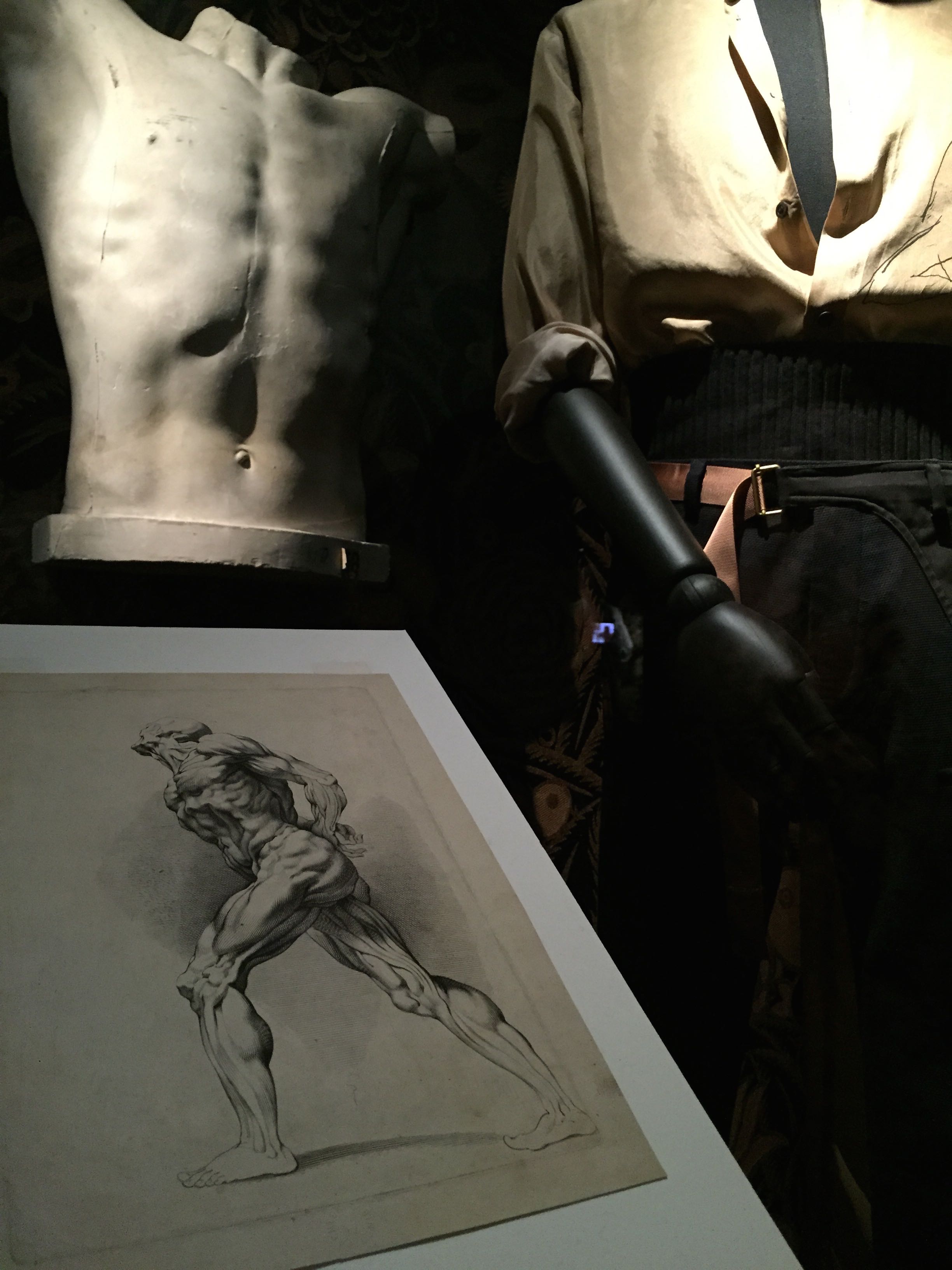
From the Rebel entry, to the unique vitrines per collection, the well documented sources of inspiration, the pancartes with beautiful texts that read like poetry, the perfection of the clothes themselves, the tissues, the lightning, the contextual artwork, the cohesion of the collections.
Here is the text of the pancarte introducing the collection inspired by The Flemish Masters:
“Framed faces and portrait necklines. Majestic understatement. A whisper of paganism underpinned by noble restraint. Opulent textures: silk velvets, silk jacquards, duchesse satins combined with leather embellishments for a modern twist. Jewel colored embroideries and encrustations translated from Jan Van Eyck’s rich palette. A sinuous and covered silhouette, at once languid and austere. The whole and its parts.”
Some more visual impressions:
It made me look into the work of Dries Van Noten. And I found this amazing video of what I call his “Chandelier Show” for his Spring/Summer collection 2005:
I found that the shows are produced by Etienne Russo from Villa Eugenie (yes that is the name of the production company)
“To capture the spirit of the times, and to enshrine it within an exceptional house and with the singularity of its team. It is also a concern for exigency and for an insatiable perfection, and a fully comprehensive pragmatism oriented towards the imaginary. No element is left to chance, because the smallest of details is not fortuitous, because the random is impossible and the unforeseen a challenge, each event becomes an exceptional moment.”
Walking out of the Antwerp Fashion House, I felt deeply touched and moved by so much beauty. Next-door was an Art-Book Store. I hang out there for an hour, dreaming away in wonderfully produced books about architecture, artists and craftsmen.
On my way back home, Klara (the Flemish Classic Music radio station) played Bach vocals. I felt the softness of my heart and the perfection of the moment at 120km/hour in the privacy and comfort of the car.
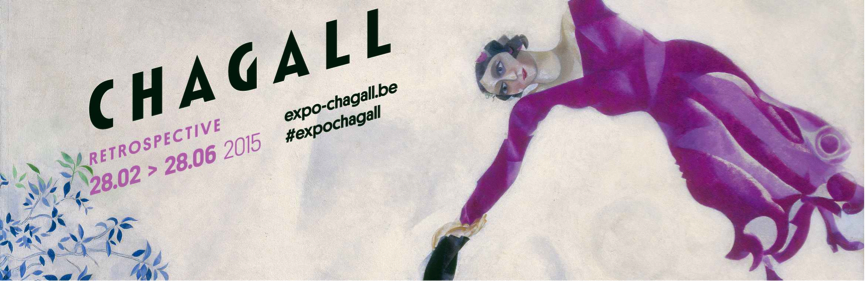
A couple of days later, I went to the Marc Chagall retrospective in Brussels. I was early, and the museum was not crowded yet. I took the audio guide and started the tour.
The first painting was a small self-portrait from 1921. The guide whispered that it were in fact two faces: the masculine and the feminine, the Yin and the Yang. I was touched by the synchronicity: why was this the first painting in my search for artistic identity?
Second painting. Adam and Eve 1921. I preferred the Dutch title “De Verleiding”, or “The Seduction”. Don’t ask me why 😉
Two big impact expos in a couple of days. It left me dazed and confused. Yes, I could do a quote from Led Zep here, but it seems I already did that in an earlier post.
I shared my confusion with some friends over a couple of calls.
One good friend introduced me to the concept of “Liminal state”, the being in-between two states. Adolescence is such a liminal state.
“Liminality (from the Latin word līmen, meaning “a threshold”[1]) is the quality of ambiguity or disorientation that occurs in the middle stage of rituals, when participants no longer hold their pre-ritual status but have not yet begun the transition to the status they will hold when the ritual is complete. During a ritual’s liminal stage, participants “stand at the threshold”[citation needed] between their previous way of structuring their identity, time, or community, and a new way, which the ritual establishes.” http://en.wikipedia.org/wiki/Liminality
I am exploding of creativity.
I have more than 60 posts in the queue. Paintings. Music compositions and soundscapes. Video trailers. Transmedia productions. Poems. Fairytales. Night stories for children. Book illustrations. It’s all sitting idle here on my hard disk and my sketchbook.
What if I’d give more space and attention to that piece of my real me? What if I’d give exclusivity space to this? Not a side activity but get it into my core? I feel an obligation to also give that part of myself as a gift. Maybe it is THE gift. Maybe this is what I was meant to be.
Bringing “events” to a level of artistic performance. Where to set the bar? Well, Dries Van Noten’s capacity to make me dazed and confused is an interesting bar to set for my own work.
What if the result of my work leads my audience in a state of enchantment, reflection, silence, a first step towards a possibly passage as well.
The bar is to put a spell on you.
To sweep and get us back to purity. To melt in symbiosis and deliver each other to the other side of the passage. That is the movement.
Own artwork “The Movement”, Petervan 2015, Soft Pastel on green paper, A2 format
My friend told me: “A passage. A rite. You get through the other side or you stay in it and acclimatize. Passagework is deeply energetic. Make sure you surround yourself with energetic help and support. Like yoga, Reiki, or other energy work.”
It brings me all back to my Leading by Being days: a transition, a passage, a rite not finished. A connection with the deep self not fully completed.
Now, I feel I am so close to passing the rite. Dries Van Noten and Chagall have unfrozen me. So much clarity now in intention, ambition and purity to jump into the warm pool of real contact, uncertainty and vulnerability.
As many of you know, my “night-job” is Corporate Rebels United, a movement to unite Corporate Rebels worldwide to ensure that true change happens virally from deep within the fabric of our organisations.
Every month we celebrate a Corporate Rebel who went the extra-mile: in helping our movement, in completing a hack, in pulling together a value practice, or doing something really awesome in the organisation they work for. “Rebel of the Month” is recognition for a Corporate Rebel exposing the sort of behaviours we would like to encourage in our movement.
Our “Rebel of the Month” for March 2015 is Steve Chapman from Esher, Surrey, United Kingdom.
Steve is fascinated by human beings, how they interact, fall out, make up, change and create stuff together. Before becoming an independent consultant, writer and coach he spent 20 years in the corporate world, his last role being Director of Leadership and Organisation Development for a large global blue chip. It was during this time that he became intrigued by the difference between what is supposed to happen in organisations versus what actually happens. He started to notice how many of the unquestioned corporate traditions (such as strategy, structure, change management, governance, meetings etc.) actually constrained the very things that organisations need to survive and thrive in the future – imagination, creativity, spontaneity and innovation. He decided to dedicate his work to making sense of all of this and thereby transformed his corporate career into creative adventure.
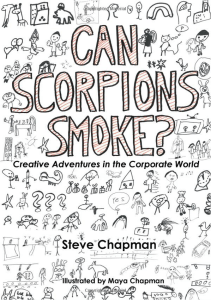
Steve’s book “Can Scorpions Smoke? Creative Adventures in the Corporate World” (Amazon Associates Link) invites those who work in these things we call organisations to pause, look around and become more curious as to what extent day to day habits, norms, behaviours and beliefs stifle our own creativity and that of others. At its heart it encourages experimentation and playfulness in the belly of corporate life and offers a number of personal and organisational practices that gently dampen the psychological and social fear that keeps everything rather stuck, dull and grey.
Six Creative Practices at the heart of “Can Scorpions Smoke?”
Mad, bad and wrong: Letting go of our need to be perpetually seen as sane, good and right.
Say “yes” (to the mess): Letting go of saying “no” to novelty and brave new experiences.
Be obvious/be altered: Letting go of a need to be perceived as clever, original and impervious to the influence of others.
Fail Happy: Letting go of our need to perpetually succeed and our habit of avoiding the unknown through fear of messing up.
Embody it: Challenging the dictatorship of the logical brain and building a deeper trust with our physical and emotional instincts.
Make others look good: Championing and nurturing the creative spirit of others.
Chapman himself endeavours to practice what he preaches and continually tries to push the boundaries of his work through experimentation on the boundaries his own comfort zone. To this end he has run masked corporate innovation workshops, delivered off the wall, highly participative keynote speeches (one dressed as a pirate for example), taken his coaching clients on spontaneous ‘inexpert’ tour guide experiences and he launched his book by going busking on the banks of the Thames.
His current research interest is “The Failure Project” which aims to deconstruct the concept of failure through studying the rich experience of screwing up in excruciating slow-motion!
Steve is Chief Adventurer at Can Scorpions Smoke Change a Creativity Ltd. He has worked with a wide range of organisations and individuals helping them through times of change by nurturing their imaginative, creative and spontaneous talents. He is a regular speaker on change, creativity and innovation and is visiting faculty at Ashridge Business School and the Metanoia Institute. He is the author of “Can Scorpions Smoke? Creative Adventures in the Corporate World” – an acclaimed book on personal and organisational creativity. He is a blogger, a runner, an improviser and Daddy to Maya, aged 8, who is his Chief of Imagination and illustrator of the book.
Week-11 of Delicacies: This was a very rich week of great content. Extra hard to stay within the limit of max 5 articles that i found interesting and worth re-reading. Minimalism in curation. Enjoy!

 Bravery – the slide of the presentation. Source: