Last week, some folks were still proudly showing 2.0 of Did you know. They did not know 4.0 was out…
Highlights:


Full video below:

Last week, some folks were still proudly showing 2.0 of Did you know. They did not know 4.0 was out…
Highlights:
Full video below:
Not that recent anymore: Morgan Stanley Research Europe published mid July 2009 a report on Media & Internet “How Teenagers Consume Media”.

What’s cool is they asked a 15 year old summer work intern, Matthew Robson, to describe how he and his friends consume media.
There is a lot to do about this report, as Twitter co-founder Stone does not care that teens are NOT interested in Twitter.

Also the New-York Times jumped on the bandwagon and said:
As the Web grows up, so do its users, and for many analysts, Twitter’s success represents a new model for Internet success. The notion that children are essential to a new technology’s success has proved to be largely a myth.
Adults have driven the growth of many perennially popular Web services. YouTube attracted young adults and then senior citizens before teenagers piled on. Blogger’s early user base was adults and LinkedIn has built a successful social network with professionals as its target.
That’s interesting, especially in the context of the Think Tank for Long Term Future we are putting together – starting up later this year from Flanders: in that Think Tank we want to include upfront young people between 15-25 years old today, who will be our future leaders in 20 years from now (2030 timeframe).
So what is all the fuss about in the Morgan Stanley report ? I took the pain to download the report and read it myself to have an unbiased opinion and share it with you.
I found the report via the site of the Financial Times. Download here.
First, it is important to understand that the report does not have any representation or statistical accuracy, as it is just the opinion of one 15 year old. It is also very UK centric referring to BBC services and Virgin Media as provider.
The paragraph where all the fuss is about is the following:
Most teenagers are heavily active on a combination of social networking sites. Facebook is the most common, with nearly everyone with an internet connection registered and visiting >4 times a week. Facebook is popular as one can interact with friends on a wide scale. On the other hand, teenagers do not use twitter. Most have signed up to the service, but then just leave it as they release that they are not going to update it (mostly because texting twitter uses up credit, and they would rather text friends with that credit). In addition, they realise that no one is viewing their profile, so their ‘tweets’ are pointless.
No wonder that Stone does not care very much. A lot to do about nothing.
The report contained however some other interesting elements. I am just picking a couple that surprised myself. I don’t have a 15 year old at home. My daughter is 3 1/2, so i guess all this is coming my way big time :-). Also, when reading those statements, i feel 15 again as sharing the same feelings. But for my age you have to invert the digits 
My personal top-10:
The summary of the report says it all:
What is Hot?
•Anything with a touch screen is desirable.
•Mobile phones with large capacities for music.
•Portable devices that can connect to the internet (iPhones)
•Really big tellies
What Is Not?
•Anything with wires
•Phones with black and white screens
•Clunky ‘brick’ phones
•Devices with less than ten-hour battery life
…
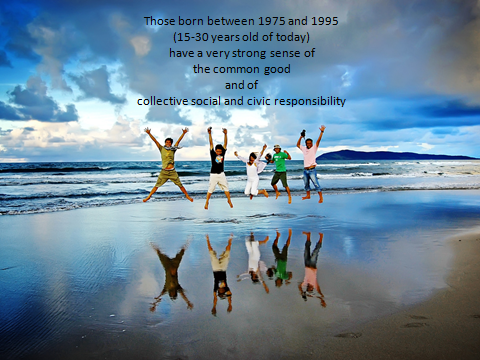
I really would be interested to find recent and statistically relevant sources of information on 15-25 years old internet behavior, and more importantly on the typical value kit of teenagers, if anything as such exists. Or are we now talking about Generation-M ?
I guess you are all familiar with mainstream on-line offerings such as Hotmail, Gmail, Skydrive, GoogleDocs, WordPress, YouTube, etc, etc. I guess you are also familiar with more advanced on-line end-user software such as Slideshare, iStockphoto and Vimeo.
These apps are getting better every day.
Recently, I really stumbled upon Issuu. Maybe i was living on another planet, but i never saw any real good coverage of this in most frequent magazines, news-sites or blogs.

Issuu (pronounced ‘issue’) is a dedicated team who strive for excellence in online publishing. They launched the first public version of their service in December 2007. Since February 2007, they are venture-backed by Sunstone Capital.
First of all, the site experience is fantastic. But then the content ! All the finest magazines, creative works, sorted and filtered by all sorts of criteria.
You can publish yourselves in basically any format, and once uploaded you have a fantastic on-line reader with Silverlight/Adobe like Rolodex experience. And of course, their site has standard Facebook, Twitter, Delicious, FriendFeed, MySpace option. Looks and feels all very very professional, including a nice press-kit.
Small detail: these guys are still in Beta ! Sets the bar for anybody planning to offer some on-line experience, and gives you an idea how fast this sort of SaaS software will become a real competitor for on-premise software.
Some people us Issuu to publish niche creative initiatives or are trying to promote new creative talents through this channel. Good example is the AddictLab, the brainchild of yet another Flemish guy Jan Van Mol, who recently re-launched LabFiles via this on-line Issue Publishing platform.
Issuu.com is also a real recommendation if you have one of those “off” days: go a stroll around on this site, and get fueled with fresh creative ideas and energy. You’ll feel revitalized !
Tim O’Reilly did a great opening keynote at Web2.0Expo about 5 technologies to watch and subsequently also commented on a related Forbes article about the emergence of a social nervous system.
Tim is saying some really profound things here. I will spend 2-3 posts to comment.
He is saying some cool stuff about identities of things. He says that meaning does not have to formalized. And that for example the identity of CD’s in the CDDB project is based on recognizing the checksum of the length of the songs on the CD. Or the energy-signature of major appliances is so unique that you can derive from that unique signal what brand and model of fridge you are using. Its all about pattern recognition.
Fine. All that is about things. But what about humans ? Do we “radiate” some sort of unique pattern that can be used to uniquely identify each of us ?
In my previous life, i was pretty deeply involved in the Belgian Electronic Identity Card project (eID). In Belgium more than 8 million citizens have a smartcard that contains 2 certificates issues by the Belgian Government. One to authenticate and one for digital signatures with legal value. Is that advanced ? Depends how you look at it. Americans and Britains for ex shiver by the idea only of an identity card, don’t even mention an electronic identity card. Now on the other hand, a smart-card is not what one would call these days “rocket science”. And of course we get biometrics mixed in all of this. But all this is about capturing something unique of our body (fingerprint, retina, voice, etc) and being able to read it and map it to a database.
And aren’t we all looking for one secure identity that we can use in many different contexts (work, private, different online services, etc,…) and across many different devices (PC, Mac, iPhone, touchwall, arm wrist devices, car, etc) ?
And that we can use in different scenarios: authentication, signature, encryption,….
But would there be something like a human unique energy-signature ? Or unique footprint ? Maybe your Twitter behaviour has a unique “twit-print” ? I don’t know. Are you aware of such initiatives ?
If you want to think about human identity from a broader then technology perspective, then I recommend www.identityblog.com by Kim Cameron. Kim is Microsoft’s Chief Architect Identity. Kim is a non-typical Microsoftie 😉 He has a high teddy-bear factor, and talks more to the open source, IBM, Sun, etc community than pure Microsoft audiences because he is convinced that digital identity will need to be solved at industry level, not as proprietary company initiatives. Kim has on his blog some interesting whitepapers on the Identity Meta-System and CardSpace implementations in both Microsoft and non-Microsoft environments. If you want to get a feel of the full scope of identity – including themes like privacy, user control, etc – then this blog is an excellent point to start.
 Petervan Studios