Farsight 2011 Highlights: what explosion of information really means

Have a look at a couple of the excellent videos on this wrap-up site about Farsight2011.

image

I could spent days and days in this space. All my favorites, including Hedge Fund Manager and PayPal co-founder Peter Thiel, Recorded Future co-founder and CEO Chris Ahlberg, journalist entrepreneur Esther Dyson, and many more in one big long session about long term future. Yammy – Yammy !

Search is no longer the simple act of typing words into a text box. New user interfaces and mobile devices are expanding the web into all aspects of daily life, and even changing the way we think. An explosion of innovation has allowed us to dream big about the role of robotics and Artificial Intelligence. And yet the future of search is fraught with challenges. The stakes can’t be higher. Is the search industry locked in a race to the bottom or are conditions ripe for a breakthrough? This question took center stage at a gathering in San Francisco on February 1, 2011 which was streamed live on BigThink.com.


image

(Peter Thiel at Farsight 2011 in “How to end the Google monopoly”)

Some quotes from Thiel:

  • You need a 35% market share in search to make break-even
  • The core problem is how to cut down the massive fixed costs
  • Until you solve the fixed cost problem, you have a natural monopoly
  • Underestimating fixed costs is a mistake that I intend not to make twice
  • I am not so much focused on the revenue side, as I am on the cost side
  • Everybody can do the front-end and the revenue with it
  • 5-10B$ yearly cost is the barrier to entry
  • Microsoft is probably the only company with the capital resources that can compete with Google at this moment in time.

Or have a look at Salim Ismail, Executive Director, Global Partnerships, Singularity University, talking about The Future of Privacy.

image

  • Computing is getting exponentially faster, smaller, cheaper, better
  • Our assumption is that these new technologies can scale at global level
  • Turning our lives more and more into an information property
  • From Discover to Aggregate to Process
  • Retrospective vs. Prospective search
  • Quantified self, Health Data, Sensor Networks, Internet of Things
  • Total explosion of information

About total explosion of information: I also invite you to watch the video of Hasan Elahi’s talk at the Lift11 Conference this Feb 2011 in Geneva, at about the same time as this BigThink Farsight 2011 Summit. The title of his talk is “Giving away your privacy to escape the US Terrorist watch list”;

he is in essence explaining that

by releasing

an explosion of information

about his where-abouts

he makes it impossible

for these authorities

to make sense

out of this massive set of data


image

The intro is a bit long (but worthwhile to set the scene) but if you are short in time, jump in as from minute 8’30…

  • To be formally cleared, you need to be formally charged
  • A very unbalanced relationship: I give and I give and I give, and I don’t get anything in return
  • They have the ultimate authority, I knew who was in power, and you turn to very animal primal instincts of survival
  • And in my case, survival meant co-operate
  • And I decided to put everything public

Here is where the video gets mind-blowing: as from minute 12’30

  • I wrote a little code that would track me all the time
  • It’s kinda bizar seeying yourself as a pixel
  • Every flight I have been on since birth
  • I am ok with giving you every bit of my data, but you have to do some work to digest it
  • My financial records are public
  • All my calls
  • There is an independent party (bank, phone company, etc) that is verifying that yes indeed I was there…
  • I have taken this to a level of absurdity, of detail, that I leave such level of detail about my life, that I live a rather private life.
  • After you do the analysis of all this detail, you actually get very little in return.
  • Having a little information about somebody is very dangerous as it can be mis-contextualized
  • You can’t delete, but you can bury it in an explosion of information
  • Or to conclude:

This is another way

of getting back into control

of your identity

Techonomy: a new philosophy of progress

image

Last week, I had the privilege to attend the first edition of Techonomy, a fantastic new conference blurring technology and economy with an optimistic balance that technology in its broadest sense (not only IT, but also gnome sequencing, bio-fuels, big history, etc) can be the driving force for a better world.

First enjoy the announcing video below.

The conference was bringing together 3/4 of Silicon Valley’s leadership, including Eric Schmidt, Jeff Bezos, Bill Joy, Bill Gates, Steward Brand, Kevin Kelly, John Hagel, Deborah Hopkins (Chairman of Venture Capital Initiatives and Chief Innovation Officer Citi), Nicolas Negroponte, Sean Parker, Padmassree Warrior CTO Cisco), Jeff Weiner (CEO LinkedIn), and the list goes on, and only a couple of non-US leaders such as Nobuyuki Idea (Founder of CEO of Quantum Leaps Corporation, working on innovation, and previous CEO of Sony Corporation), Nellie Kroes (European Commissioner for Digital Agenda), Vineet Nayar (CEO HCL Technologies, India), and Ory Okolloh (Founder/Executive Director Ushahidi, South Africa).

How to describe Techonomy conference ? I would say “a super-TED with a technology focus and with an agenda”.

The agenda is “a new philosophy for progress”.

It’s a movement

Somebody asked “a movement against which enemy, against which barriers ?”.

I believe it is a movement FOR something.

For a better world. Finding techonomic solutions to tackle the global climate challenges, feeding the world, a better health for everybody, a new value kit for the current and next generation, not based on greed but on the concepts of creative capitalism as formulated some years ago by Bill Gates in the Bill and Melinda Gates Foudation.

In that sense, it should not surprise the regular reader of this blog how much this resonated with myself. Not only the personal inspiration, but especially how we with on organization like SWIFT can adopt and promote the techonomist values and objectives.

I also came across some leaders that could be subject of SWIFT’s CSR initiatives. Take Bill Drayton, Leadership Group Member Chair and CEO of Ashoka, the global association of the world’s leading social entrepreneurs, men and women with system changing solutions for the world’s most urgent social problems, encouraging everybody to be a changemaker.

It’s impossible to describe the intensity of the content and contacts of these 3 Techonomy days.

Some highlights:

  • Evolution is incremental. Revolution is disruptive movement
  • Collective learning is what makes us human
  • The physical economy is sensoring a second economy of conversational plumbing
  • As long as we draw boundaries (for ex US vs. China, we against them, etc) we will not be able to solve the world’s problems.
  • The economy is NOT recovering, consumer is running out of money
  • Governments do not understand globalisation, businesses do.
  • Employees first, customers second.
  • Promote younger people must faster
  • Building and tapping from tacit knowledge will become core skill
  • Markets are like gardens: they need tending
  • Innovation happens outside the regulated markets
  • Banks make money on spread and opacity. They are by definition against transparency
  • Currency is “the instrument of trust in a transaction”. Unfortunately the debate focused solely on the payment transaction and money as the trust element.
  • Health agenda: from illness fixing to personal health prediction and coaching
  • Some technomists are skeptical optimists that do not take progress for granted. One has to make progress. It does not happen.
  • Recalibrating our assumption that form our perceptions. For ex we learned that world population will NOT grow indefinitely and probably max around 9 billion, and then go down.
  • Innovation at Cisco: Looking at 30 ! adjacencies as a “portfolio” like a Venture Capitalist does.
  • Computer Associates CTO: “a lot of leading edge innovation comes from financial services”
  • Innovation requires a culture of taking risk and celebrating failure
  • Change happens when the DESIRE not to change is greater than the desire to change. The power struggle to make this balance change is based on societal needs.
  • Innovation requires 1) Money, 2) Desire, 3) Need
  • There is no value in the idea, there is value in its commercialization
  • We have a moral obligation of bringing less developed regions up.
  • Cities are “intensities” that have a critical mass of people
  • In a city-“OS”, no one single company can dominate. It has to be open source by definition.
  • Generation-Y or whatever: you need the backing of 18 year olds. That’s “youth”. 25 years+ does not quite get it.
  • Companies scale like biology, and in the end they die. Cities scale like networks, and do not die. The city is the framework model for the future.
  • In the developed world, a disruptive innovation is something that can create the biggest disruption. In the developing world, innovation is a technology that is simple, reliable, and that can function as an integrated unit.
  • Success in mobile in Afghanistan is because there was no legacy. They are willing to take the risk to jump to the next curve.
  • The future is for (techonomist) entrepreneurs that are willing to work together.

The conference is so good. It cries for a European and an Asian chapter. Any European Leader should not hesitate a second to be associated with and sponsor it.

I was dreaming of hosting a European chapter of Techonomy at the fantastic SWIFT Headquarters south of Brussels.

El Jefe, do you hear me ?

The DJ with the Brainwave Helmet

Found this TED 2010 video via Kurt Vega’s tweets.

From the TED site: “Tan Le’s astonishing new computer interface reads its user’s brainwaves, making it possible to control virtual objects, and even physical electronics, with mere thoughts (and a little concentration). She demos the headset, and talks about its far-reaching applications.”

Out-of-the-box support for facial expressions and emotional experiences, with some sensitivity adjustments available for personalization.

The demo is focusing  on the “cognitive suite”: the ability to move virtual objects with your mind.

And it just costs only a few hundred dollars. Like an iPAD, but it’s a hPAH “head-PAD”

Start mixing this with the ongoing discussions on personal digital identity. As you will notice, the demo starts with making a personal profile for this headset owner. And tuning to a neutral signal, a signal where you’re doing nothing particular, your are relaxed, hanging-out: a but like my holidays at home where I basically don’t do anything particular other than hanging around.

It’s interesting to see that the test is about “pulling” an object forward instead of “pushing”. I may be too influenced by John Hagel’s latest book “The Power of Pull” 😉

The cool stuff starts when the helmet man starts visualizing something that does not exist in real life: making something disappear.

Applications are obvious in virtual reality games, domotica systems, all sort of gesture and thought based interactions, control an electric wheel-chair. In banking it would be nice is I could raise the balance on my account just by thinking about it.

What I do NOT like about it is that the “system” has some built-in leveling system. It makes me think of Jaron Renier’s fantastic rant / manifesto that I mentioned in my previous blog “you have to be somebody before you can share yourself”

Start mixing this up with some of the cool ideas like Mark Pesce’s Plexus which is a quite novel way of looking and using your social graph in a sort of

event driven pub-sub system

where you decide as a user

what you listen to and

who and what you want to share

with

Sometimes, I think of myself as a disc-jockey (which I was as a matter of fact for more than 15 years starting in the late 70’ies), and I very much like Ethan Zuckerberg’s description of a DJ in this also great TED 2010 video on our distorted world-views.

His talk is basically about

getting you out of your normal orbit, of stepping out of your usual “flock” of people you normally interact with (both on- and off-line).

Around min 15:30, he describes a DJ as a guide:

A skilled human curator, who knows what material is available to her, who is able to listen to the audience, and who is able to make a selection and push people forward in one fashion or another

Of course, I could now make jokes on Faithless “God is a DJ”, and/or refer to one of my previous posts called “We are as gods and might as well get good at it”, but I won’t do that.

Instead, I’d like to share with you the feeling of giving pleasure to my audience.

It’s something I feel while writing these blogs, and it’s a very similar feeling as being a DJ in front of an audience and pushing people forward.

Its has a same sort of stage-fright

when starting a gig,

and the same sort of excitement

when you see your crowd getting

excited

As a DJ, I was doing some quite big gigs for 3,000 people or so, and my following community is not that big yet. But the feeling is the same, and everyday there are some more folks following my tweets. Some more reacting to my blog. Some more getting inspired by what’s on these pages.

So, I just continue doing that, and hope to inspire you to dream and execute your dreams.

You have to be somebody before you can share yourself

It’s holiday time, and I have reduced significantly my blogging, reading RSS feeds, tweeting, mailing, etc

Time for hanging around, some biking, some good food, and… a good book. If you want to follow what I am reading, check-out my page on Goodreads.

For me, a good book is one that leaves you puzzled, that makes you think,


that re-calibrates your perspective,


that is a pleasant read, that has depth.

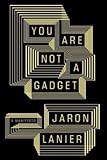
“You are not a gadget” by Jaron Larnier is such a book. I discovered it thanks to a tweet of my friend Paul, who reacted to one of my enthusiastic Singularity tweets. The title of this blog post “You have to be somebody before you can share yourself” is very early in the book, and captures its essence.

Jaron Larnier was listed on The 2010 TIME 100 in the Thinkers category. His Wikipedia entry is here.

It’s a great read if you are in your over-enthusiasm mode about  computationalism, the noosphere, the Singularity, web 2.0, the long tail, the hive mind, the global brain, crowdsourcing, collective intelligence and all the other buzzwords and trends and all the rest. It gives you some solid pushback and sound criticism.

I am not going to do a book review, but my experience of the book was like there were 3 stories interwoven:

  • How technology is limiting our potential and who we are on-line. This of course resonated a lot with my work on Digital Identity.
  • Our communication limitations. He has a great chapter on how cephalopods have the great ability to “morph” and how one could use “visual” communication and another dimension of communication, other than language. And how humans in virtual reality environments quickly adapt to a body with tentacles. Intriguing !
  • The notion of “neoteny”: humans are born as fetuses in air, and our brain is being developed during childhood. Lanier compares this to a newborn horse that can stand on its own and already possesses almost all the skills of an adult horse. Humans – in modern civilizations – have an artificial, protected space called “the classroom, the extended womb”.

Neoteny opens a window to the world before our brains can be developed under the sole influence of instinct.

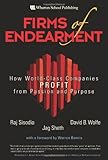
A similar concept related to neoteny – “generativity” – comes back in another great read Firms of Endearment: How World-class Companies Profit from Passion and Purpose.


This is a book about

the pragmatic role of

love in business


It’s about the epochal change into the Age of Transcendence. The dictionary defines transcendence as a "state of excelling or surpassing or going beyond usual limits."


The second event is the aging of the population. For the first time in history, people 40 and older are the adult majority. This is driving deep systemic changes in the moral foundations of culture. Higher levels of psychological maturity mean greater influence on society of what Erik Erikson called "generativity"—the disposition of older people to help incoming generations prepare for their time of stewardship of the common good

The Firms of Endearment book in essence talks about a new form of capitalism that is not only focused on profit and shareholders’ value, but on value creation for all parties in a company’s stakeholders’ ecosystem.

Joran also has an opinion on capitalism when he says:

Visiting the offices of financial cloud engines (like high-tech hedge funds) feels like visiting the Googleplex. There are software engineers all around, but few of the sorts of topical experts and analysts who usually populate investment houses. These pioneers have brought capitalism into a new phase, and I don’t think it’s working… capitalism in a digital future will require a general acceptance of a social contract

He is also calling for “so-called AI techniques to create formal versions of certain complicated or innovative contracts that define financial instruments” and that setting standards for these could be facilitated by “a cooperative international body” that

would probably have specific requirements for the formal representation, but any individual application making use of it could be created by a government, a nongovernmental organization, an individual, a school, or a for-profit company. The formal transaction-representation format would be nonproprietary, but there would be a huge market for proprietary tools that make it useful. These tools would quickly become part of the standard practice of finance

What a great potential for my employer SWIFT ! We are indeed a full-blown cooperative international organization with our roots in financial services.

In essence, Jaron Laniers’ manifesto and rant is about “The deep meaning of personhood is being reduced by illusions of bits”.

That should make us reflect deeply on how we want to engage as human beings in an on-line world, how we define digital identity in the relative and the absolute, and be very vigilant that we don’t loose our potential in our technology enthusiasm.

For me, the prospect of an entirely different notion of communication is more thrilling than a construction like the Singularity. Any gadget, even a big one like the Singularity, gets boring after a while. But a deepening of meaning is the most intense potential kind of adventure available to us

Finally, I also found some consolation to deal with my 3/4 Life Crisis. The following quote always helps:

If you are young and childless, you can run around in a van to gigs, and you can promote those gigs online. You will make barely any money, but you can crash on couches and dine with fans you meet through the web. This is a good era for that kind of musical adventure. If I were in my twenties I would be doing it. But it is a youthiness career. Very few people can raise kids with that lifestyle. It’s treacherous in the long run, as youth fades.

My blog is my “adult” way of doing gigs online.

Milo: gesture based interfaces 2.0

image


Have a look at this stunning gesture based interface with character Milo. First of all, it is more than gesture based. Milo also reacts to voice intonation, movements, etc

It is difficult to assess how much of this is a word-by-word script, or how much real interaction is going on here.

The most stunning effects are:

  • The women trying to capture goggles that thrown by Milo
  • The women moving the water with her hands
  • The women handing over a piece of paper, that gets scanned and taken over by Milo

It gives a sense where we are heading. Imagine this on your iPAD. My conservative guess is this will be real within the next 5 years.

This is very similar to what Oblong is doing with gesture based interfaces. See my previous blog on Oblong here. John Underkoffler indeed also said 5 years before this hits any PC.

Oh yes, in case I forget, Oblong will be at Innotribe at Sibos 2010 in the Smart Data track.

We are as gods and might as well get good at it

Check out Raw Dawson’s blog post of today with superb video

TURNING INTO GODS – ‘Concept Teaser’ from jason silva on Vimeo.

Indeed today it is entirely appropriate for us to be thinking in terms of human transformation, and the power we have at our disposal. The cycle has swung back, and once again there is the promise that we have what it takes to change who we are… for the better. Whether human nature will allow those changes to be fully positive we have yet to discover. But that promise is – once again – part of the zeitgeist.

Precision Information Environments

Stumbled upon this very well made video (make sure you look at the annotated version of it).

image

Found via Brainpickings. Great example on how many emerging technologies and concepts — including ubiquitous displays, crowdsourcing, pervasive sensor networks and adaptive user interfaces come together.

When you look at this, think iPAD 2.0, think Identity 3.0, think your office of tomorrow.

Let’s Prepare the Future !

image

This article is a cross-post of an essay that i prepared for The Fifth Conference and that was published this week.


image


The Fifth Conference is a forum for vision. Part publisher and part conference, The Fifth Conference tackles the ‘big issues’, the factors that drive our future. Think ten, twenty, even fifty years ahead and try to imagine how we will live and work. What will this world look like? How will we have solved the economic, social and environmental challenges that we confront today? To answer those questions we talk to entrepreneurs, policy makers and experts. We analyse the facts, the forecasts and the arguments. And most importantly, we collect vision.

As mentioned in my previous blog post “No more collateral damage”, this is so close to my idea of the Think Tank for Long Term Future that it was for me a no-brainer to passionately accept the invitation of Frank Boermeester (co-founder of The Fifth Conference) to draft an essay on Technology, with a focus on Technology Readiness in our region, and being conscientious aware of the “understream” that is driving all the changes and evolutions in Growth, Mobility, Green, Technology, Health. So here is the article:


Over the past 20 years we have witnessed a fantastic growth in and wealth of technologies. ICT technologies have started permeating our daily lives. Medical science and biotechnologies have increased longevity significantly. Other technologies (Nanotechnology, AI, Robotics, etc.) have kick-started.

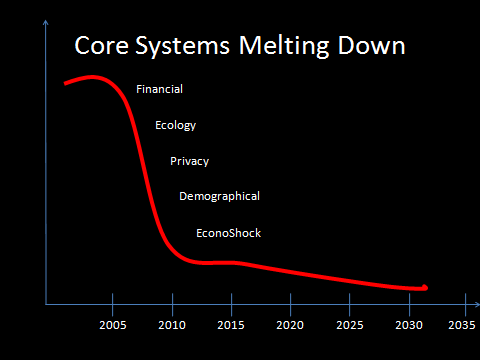
However, in the last couple of years, we have witnessed the breakdown of a number of core systems:

image

  • Our worldwide financial system is going through a “meltdown”. The old game of greed is being replaced by an all important requirement: trust.
  • Ecological, ethnological and demographical shocks (see also Geert Noels, author of Econoshock) are turning our systems upside-down: Green and Energy conservation thinking are now the mainstream.

image

  • The East-West shock: economic power is shifting from the Western world to the new economies of APAC and BRIC+ countries.
  • New forms of communication via the internet (blogs, wikis, social networks such as Facebook, Twitter, Netlog, etc.) propose a new paradigm in respect to privacy.

All these fundamental changes give us feelings of discomfort, disorientation, confusion and loss of control. Although our “collective intelligence” indicates that our old models do not apply anymore, our “hardware” seems not to have caught on. We have not adapted the way we are organized hierarchically; how we look at governance. Our traditional ‘system thinking’ got stuck and did not follow our ‘collective intelligence’.

On the other hand a new set of systems and tools are emerging:

image

  • Barack Obama describes it as the ‘audacity of hope’; innovators, planners, academics and authors are referring to ‘dreamtelligence’ as a new, vital, and visionary way to use play, fantasy, dream-thinking and innovation to kick-start ideas and stimulate community engagement.
  • A fantastic call for and revival of authenticity for ourselves and our leaders. Furthermore, having true leaders; with charisma, the power to attract, integrity and authenticity.
  • The Net-Generation (now young adults, 15-30 years old) have grown up as ‘digital natives’. They will be tomorrow’s leaders. What THEY think will co-form our future. The future will not be invented by today’s generation. This Net-Generation lives differently. They are “wired” differently. For them multitasking (multi-window chatting, gaming at the same time as listening to music, looking up information on the internet, being mobile, etc.) is very common. They also think differently (deeper and more authentically), and have a very strong sense of the common good and of collective and civic responsibility.

image

image

Our technological revolution has just started. To illustrate:

  • Today our technologists are capable of crafting a human ear in their labs. We are now in a position to create and grow cells, tissues and even bodies.
  • Artificial Intelligence is back: by 2030 our computers will be able to think, be self-learning, self-healing – some will even be able to have a consciousness.
  • Self-learning robots will soon be mainstream technology. Mercedes and BMW already have cars in the pipeline for 2012 that can drive entirely automatically, better than a human counterpart.
  • The emergence of Google brings forth the concept of the “Global Brain”. The internet today is already a tremendous source of information. Today’s search experience will pale in comparison to the mechanisms we’ll have in 20 years. All knowledge will be available anywhere, anytime, wirelessly via brain-implants.
  • Social networking is already revolutionizing the way people and companies are communicating. It is interesting to note that these technologies let us evolve from a system-to-system communication paradigm towards a human-to-human one.
  • Today you can order your personal DNA genome sequence in the USA for only $399. The company doing this is a Google backed start-up. Think of DNA in the ‘cloud’, with DNA comparisons between ancestors, relationships, etc …
  • Brain-wave helmets and chip-implants will give humans better sensory perception. By 2030 we will see the emergence of “super-humans”. In such a dramatically changed context, what will make us “human”?

A lot of these future scenarios are described by Ray Kurzweil’s “Singularity” concept. This is the moment when man and machine truly blend. Kurzweil claims this will happen around the year 2030.

And the pace of all these technological innovations is just increasing exponentially. In the next 20 years we will witness technological breakthroughs tenfold those of the same previous span of time.

All this evolution calls for a re-thinking of our value-compass for the future: We must carefully re- think how all this will influence the way we will work and live. What sort of quality of life should we aim for? What will be the socio-economic impact of all this? How will we want education to be structured? What areas of society will we still want (and be able to) influence?


How are we going to ensure that the

Technical and Value ‘Readiness’

of our region

are competitive in this new era?


Will we lead the change, as opposed to being mediocre followers? I believe it is time for action.

image

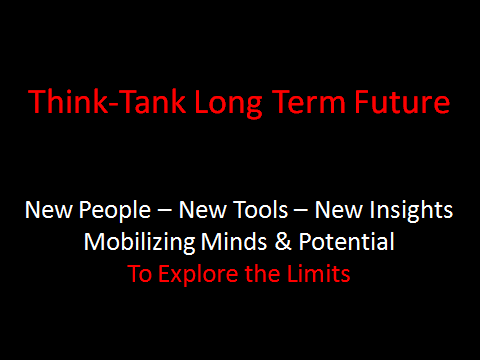
I believe The Fifth Conference and its organic network of inspiring leaders has deep within itself the embryo for a sort of “think-tank/foundation” addressing the long term future:


A movement and an energy

that prepares our Net-Generation

for the next 20 years,

with an emphasis on

our technical and value readiness


A place where “smart people” can meet. Where experts from different technological domains share their insights for 2030, cross-pollinating each other’s disciplines. Indeed, “savants” from different contexts & worldviews can act as our “eyes” and offer a perspective on how we will live and work in 2030.

image

How our education is best organized will also be addressed. We will investigate what our ideal value kit for that era should be, beyond traditional corporate culture. Moreover, with a culture of sharing and exploring – where we live committed to teams, groups, communities, regions and countries –a deep respect for the participating individual humanistic identities will nevertheless be maintained.

We don’t have to wait until our politicians have made up their minds as to whether or not they should invest more in innovation.


We can do this ourselves


I cannot accept that it would not be possible to raise private funding for such an organization/movement/tribe.

The resulting new models and scenarios will demand speed, creativity, dynamism, perseverance, courage, knowledge and working together in a multi-cultural context. This new society makes a plea for the respect for individuality, freedom, mobility and quality of life.

This paradigm is all about designing, exploring and organizing change, learning and fine-tuning as we go. Giving guidance to teams, organizations and leaders on how to surf these waves is part and parcel with this. Missing the first technology wave of speed and creativity will result in loss of economic relevance. Missing the wave of the new value kit will result in losing our Net-Generation; our brains for the future.

This is about preparing ourselves and our region for 2030.

image

Who wants to join the tribe? Who is a believer? Let’s debate this idea on- and off-line for a couple of weeks. If there is enough interest, let’s meet and make this happen.

The Medici Effect


The Medicis were a banking family in Florence who funded creators from a wide range of disciplines. Thanks to this family and a few others like it, sculptors, scientists, poets, philosophers, financiers, painters, and architects converged upon the city of Florence. There they found each other, learned from one another, and broke down barriers between disciplines and cultures.

Together they forged a new world based on new ideas—what became known as the Renaissance. As a result, the city became the epicenter of a creative explosion, one of the most innovative eras in history. The effects of the Medici family can be felt even to this day.

These introductory words come from a book “The Medici Effect: What Elephants and Epidemics Can Teach Us About Innovation: What You Can Learn from Elephants and Epidemics” by Frans Johansson (Author).

The book is not that new (it dates from 2006), but it is very relevant to today’s innovation challenges. You can find the book on Amazon.com via the links above, but there is also a free PDF summary here and a Google Book edition here. And obviously, there is the website www.themedicieffect.com .

There was also a 2004 book The Medici Effect: Breakthrough Insights at the Intersection of Ideas, Concepts, and Cultures

The core of these books is about two types of ideas:

  • Directional ideas
  • Intersectional ideas

Directional innovation improves a product in fairly predictable steps, along a well-defined dimension. Examples of directional innovation are all around us because they represent the majority of all innovations. This is what we call incremental improvements (Innovation is in my opinion a bit on the optimistic, even window-dressing side).

The goal is to evolve an established idea by using refinements and adjustments. The rewards for doing so are reasonably predictable and attained relatively quickly. People and organizations do this all the time through increasing level of expertise and specialization. It is absolutely necessary if one does not wish to squander the value of an idea. Even an intersectional idea will, once it has become established, develop and evolve along a specific direction.

Intersectional innovations, on the other hand, change the world in leaps along new directions. This is what Guy Kawasaki calls “jumping the curve”. These ideas are game changers. I am preparing a whitepaper on how NIBC (Nano, Info, Bio, Cogno)) technologies are major game changers.

Although intersectional innovations are radical, they can work in both large and small ways. They can involve the design of a large department store or the topic of a novella; they can include a special-effects technique or the product development for a multinational corporation.

In summary, intersectional innovations share the following characteristics:

  • They are surprising and fascinating.
  • They take leaps in new directions.
  • They open up entirely new fields.
  • They provide a space for a person, team, or company to call its own.
  • They generate followers, which means the creators can become leaders.
  • They provide a source of directional innovation for years or decades to come.
  • They can affect the world in unprecedented ways.

The Medici Effect is about bringing together people of different fields of expertise and

let the magic of

cross-fertilization of ideas

happen


What sort of people do we need to invite ? In essence, we are looking for people who succeeded at

breaking down

their associative barriers


because they did one or more of the following things:

  • Exposed themselves to a range of cultures
  • Learned differently
  • Reversed their assumptions
  • Took on multiple perspectives

The explosion of concept combinations at the Intersection can offer a myriad of uniquely combined, extraordinary ideas.


I have a dream


That we can turn Innotribe.com into a Medici Effect: the place where different disciplines find each other, and through that intersection come up with intersectional innovations.


I have a dream


That we can turn the SWIFT Campus into a hosting environment, where we facilitate those intersections to happen.


I have a dream


That i can blend my personal interest of creating a Think Tank on Long Term Future with my professional endeavors at SWIFT.


I have a dream


That together we can write The Readiness Manifesto. The strategies and focus areas to prepare the Net.Generation – the 20-25 years old of today – to stand up as our leaders in 20 years from now in 2030.

But NIBC technologies are not the holy grail. There was a fantastic quote in one of Fred Destin’s latest blogs on Venture Capital 2.1:

The fundamentals of the business have changed.  Technology is a quasi-commodity, the spread of ideas is instantaneous, competition is global, in other words the market is more efficient.

“Technology is a quasi-commodity”


Wow ! So what will be your differentiator ?

I believe it will be in the HOW of delivering products and services. And i can’t help re-quoting Umair Hague in his Good to Great Manifesto and my related post some days ago. Umair Hague proposes a number of new corporate principles:

  • First how, then who: “Do our people have the capacity to judge right and wrong, no matter how great they are?”
  • The Yoda/Hedgehog concept: “companies should only do what they can be great at, what makes tons of money, and what they’re passionate about.”
  • Ethical accelerators: “”transparency, openness, rules, and accountability. Most companies have not a single one of these”
  • A culture of meaning: “Production and consumption are meaningful when they actually yield durable, tangible benefits to people, communities, and society”
  • Confront reality:” Banks, for instance, confronted the “brutal fact” that selling toxic financial instruments was great for their bottom line. But they never confronted the simple reality that a classic asset bubble in housing was failing to do good.”

So, the question is not only “What will be the technical readiness kit that we will need to provide ?”.

The question really is:

What will be the value kit

that will have to underpin

this highly technological environment ?


As i mentioned in a previous post, I have accepted an opinion article/essay on technical readiness for The Fifth Conference. See also my posting “No more collateral damage”.

Below an extract of my initial input for this essay:

We must carefully analyze and think-through on how all this will influence the way we will and want to live and work in the future. What sort of life-quality we aim for? What the socio-economic impact of all this may be? How we want education to be organized? Where we still can and want to influence? How are we going to deal with the Technical and Value Readiness of our region to be competitive in this new era ? To lead the change, and not only be mediocre followers?

I believe it’s time for action. I believe The Fifth Conference and its natural network of inspiring leaders bears deep in itself the embryo for a sort of “think-tank/foundation” on long term future. A movement and an energy that prepares our Net-Generation for the next 20 years. To focus on our technical and value readiness. A place where “smart people” can meet. Where experts from different technological domains share their insights for 2030. Cross-fertilizing each other’s disciplines. With “savants” from different contexts & worldviews that can act as our “eyes” and offer a perspective on how we will live, work in 2030.

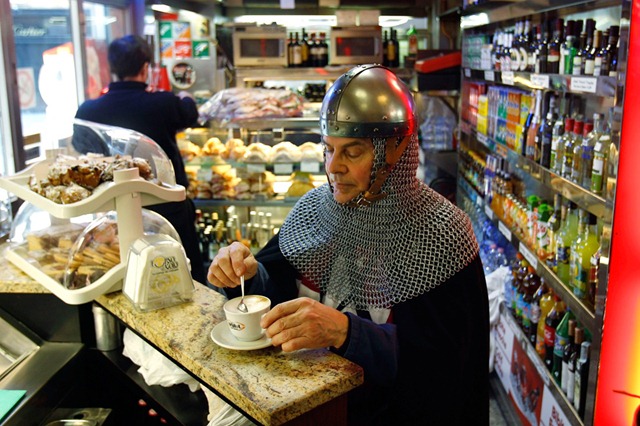
Or will we find ourselves in 2030 like this medieval knight trying to get his cup of coffee in the local deli ?


c03_22043139

No, in 2030 we want our children to be in a position to lead and not be the “behaving” followers in some old-European country that is by-passed by countries and regions that work at the speed of light, that have higher education standards, higher ethical standards, in other words who have found the “how-differentiator”.

My desire is to create

a movement

a tribe

a Medici Effect


where the dream can come true.

Who feels connected ? Who would like to join this tribe ?

Let me know via the comments of the blog, or contacting me directly. Please also let me know where the model flaws. What you would add to it ? Do you believe i am on to something or just living an illusion ? Let me know.

iPAD what’s next ? Oblong !

oblong-logo.JPG

Seen at many blogs and feeds during the last week. Of all, i like most the post of MG Siegler of Techcrunch.

MG Siegler writes:

The demo I saw a couple years ago was stunning, but it was still just a video. Apparently, at TED, the audience got to see it in action. NYT’s Bits blog detailed some of it in a post yesterday. For those not at TED, Oblong has also made a few demo videos in the past, which I’ll embed below. Again, this is Minority Report.

Oblong’s coming out party couldn’t come at a better time. Following the unveiling of Apple’s iPad, there has been a lot of talk about the future of computing at a fundamental level. That is to say, after decades of dominance by the keyboard and mouse, we’re finally talking about other, more natural, methods of input. The iPad is one step to a multi-touch gesture system (as is this 10/GUI awesome demo), but this Oblong system is the next step beyond that.

TED2010_18647_D31_5144_1280

So how does it look like ? I found 2 videos, and waiting for the video of Underkoffler when he unveils the interface, called the g-speak Spatial Operating Environment, at Friday’s annual TED conference.

g-speak overview 1828121108 from john underkoffler on Vimeo.

and

oblong’s tamper system 1801011309 from john underkoffler on Vimeo.

More cool stuff from Oblong on their home page.

Reblog this post [with Zemanta]