
Great post on “Who needs employees anyway ?”. Discovered via Fred Zimny’s Blog.

This is based on a recent “Global Workforce Survey” conducted by Towers Perrin, an HR consultancy. In an attempt to measure the extent of employee engagement around the world, the company polled more than 90,000 workers in 18 countries. The survey covered many of the key factors that determine workplace engagement, including: the ability to participate in decision-making, the encouragement given for innovative thinking, the availability of skill-enhancing job assignments and the interest shown by senior executives in employee well-being.
Barely 21%
of employees are truly engaged in their work, in the sense that they would “go the extra mile” for their employer.
Nearly 38%
are mostly or entirely disengaged, while the rest are in the tepid middle.
Surprisingly, 86%
of the employees in the Towers Perrin study said they loved or liked their job.
So, next time you evaluate your yearly employee satisfaction survey, beware of the numbers saying that the majority of employees is happy. Even if you sense in every office, corridor and corner that is not true.
Anyway, why these rather shocking results ? The article suggests a number of reasons:
Ignorance
It may be that managers don’t actually realize that most of their employees are emotional zombies
Indifference
Another explanation: managers know that a lot of employees are flatlining at work, but maybe they simply don’t care
Impotence
It could be that managers do care, but can’t imagine how they could change things for the better. After all, a lot of jobs are just plain boring.
Reputation
The company’s reputation and its commitment to making a difference in the world—is this a company that deserves the best efforts of its people;
Leaders’ Trust
Are the behaviors and values of the organization’s leaders—are they people employees respect and want to follow?
Anybody who has ever read a Dilbert strip knows that cynicism and passivity are endemic in large organizations.
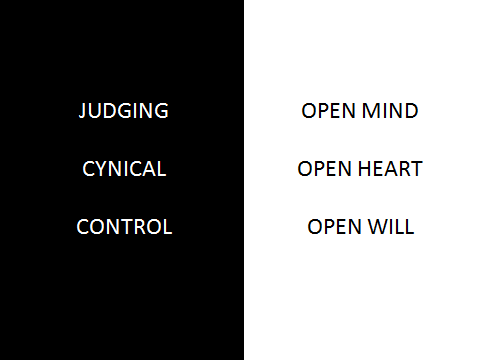
However – in my opinion – we too easily get away with joking about cynicism. In my opinion, it is the cancer of today’s organizations that seem great at the outside, but grim at the inside. They look like golden cages. They offer all the perks possible, but they ignore 3 basic attitudes for any human being to function well.
#1: To have an open mind. Companies/People who do not have an open mind tend to retract into highly judgmental.
#2: To have an open heart. The next level is that of the heart. People who do not have an open heart have developed cynicism as a defense. They have learned NOT to show their heart.
#3: To have an open will. Last but not least, when there is no room for open will, we become control freaks.
In today’s society, driven more and more by openness and transparency, these “tricks” of judging, being cynical and control don’t work anymore.
It all boils down to 3 fundamental needs for every human being:
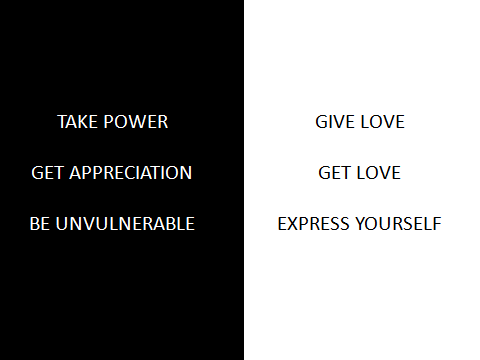
People who are not able to express themselves (anymore), position themselves as “invulnerable”. In stead of being able to receive love, they compromise on getting appreciation. And in stead of giving love, the defense mechanism becomes one of taking power. As long as we have power games between the silos, the CEO can shout “change” and “innovation” as long as he wants, at the bottom of the pyramid nothing will change.
Surprisingly, the origins of these needs – and their fulfillment or not – is formed during the first 1-3 years of your life. In other words beyond the control of the organization you work for today.
But organizations should be conscious about these facts, and offer their employees probably the most interesting perk they can give: to follow a personal development program that lets the employee explore it’s true self.
- Who am I ?
- Who am I in a group ?
- Who am I in the world ?
- Finding your true passion.
- Finding your true purpose in life.
And hopefully finding (or founding) a company that welcomes you respectfully as an employee, and gives you the chances to develop your true potential in line with your purpose.
It reminds me of Jim Collins and a 2003 blog post found back earlier today.
The start of the New Year is a perfect time to start a stop doing list and to make this the cornerstone of your New Year resolutions, be it for your company, your family or yourself. It also is a perfect time to clarify your three circles, mirroring at a personal level the three questions asked by Smith:
1) What are you deeply passionate about?
2) What are you are genetically encoded for — what activities do you feel just "made to do"?
3) What makes economic sense — what can you make a living at?
Those fortunate enough to find or create a practical intersection of the three circles have the basis for a great work life.
An to come back to the Global Workforce Survey:
- In every industry, there are huge swathes of critical knowledge that have been commoditized—and what hasn’t yet been commoditized soon will be.
- Given that, we have to wave goodbye to the “knowledge economy” and say hello to the “creative economy.”
- What matters today is how fast a company can generate new insights and build new knowledge—of the sort that enhances customer value.
- To escape the curse of commoditization, a company has to be a game-changer, and that requires employees who are proactive, inventive and zealous.
- Problem is, you can’t command people to be enthusiastic, creative and passionate.
- These critical ingredients for success in the creative economy are gifts that people will bring to work each day only if they’re truly engaged. (Eric Raymond made this point way back in 2001 when he argued that in the new economy, “enjoyment predicts productivity.”)
For passionate readers, i can recommend in this context Eric Raymond’s book The Cathedral and the Bazaar.


Or a bit an older – but still very relevant book – “The Cultural Creatives”
Must be that I am some sort of +
positive guy when i turn a title like Emotional Zombies” into something positive like “The cultural creatives”
As Seth Godin was saying in his today’s blog:

One of the most common things I hear is, "I’d like to do something remarkable like that, but my xyz won’t let me." Where xyz = my boss, my publisher, my partner, my licensor, my franchisor, etc.
Well, you can fail by going along with that and not doing it, or you can do it, cause a ruckus and work things out later.
In my experience, once it’s clear you’re willing (not just willing, but itching, moving, and yes, implementing) without them, things start to happen. People are rarely willing to step up and stop you, and often just waiting to follow someone crazy enough to actually do something.
I’m going
Come along if you like
![Reblog this post [with Zemanta]](https://i0.wp.com/img.zemanta.com/reblog_e.png)



 Petervan Studios