Principles for Open Innovation and Open Leadingship

Just found this awesome 27 min talk by Joi Ito on the 9 principles of open innovation. They are not that new – first version appeared in 2012 – but they seem to have matured, like good wine in well kept cellars. Almost every sentence he speaks is tweetable 😉

To help me concentrate on the content, I usually make a lot of notes, and before knowing I almost made the transcript of this talk, so i can as well share my notes.

So, I have no credits on the content. I just did some mix and matching with some other material from others. Like Joi, I have been a DJ, and I have fun in mixing and weaving different themes into some form of new carpet. Highlights are mine.

joi ito


Joi Ito is Director of the MIT Media Lab and many other things (check out this Wikipedia page).

https://vimeo.com/99160925

Here is the sort of transcript, more or less ordered around his 9 principles.

But in his intro, he says also loads of interesting things.

The MIT Media lab 30 years later: Media is plural for Medium, Medium is something in which you can express yourself. The Medium was hardware, screens, robots, etc. Now the medium is society, ecosystem, journalism,… Our work looks more like social science.

Before the Internet (BI) and Post the Internet (PI): Post the Internet, it is about participating responsibly in a system that you can’t predict and whose outcome to your intervention is almost random.

We are moving from “demo or die” to “deploy or die”. It just costs some “sweat equity” and some kids in a dorm room to get things done. Kids are competing with the incumbents. The innovation cost – the cost of trying something – went to nearly zero. Now you can innovate without asking permission, pushing innovation to the edges, and allow grassroots innovation.

Note: I believe “grassroots” innovation is very important in organizations. Last week I was on the judge panel of an internal innovation channel. I saw quite some things that our innovation team explored before, but never succeeded to get out there. With grassroots innovation, you have the buy-in from the fabric of the organization from day-1. It is very “swarmwise”.

Before, the guys who had the money had the power. Now, because the space of startups is so crowded, the VCs have to sell themselves.

Note: I heard something very similar recently in the context of innovation motivations: corporates looking for innovations have to sell themselves to startups.

Diminishing cost of innovation makes those having the money behave a little bit better. Who is thinking about those ideas that don’t start small? Thinking about it as a community. This is less about empowering the individual, more about empowering the community.

Note: “empowering the community”. Wow! Big ideas are usually shared ideas. In yesterday’s post, I mentioned the great Diego Miralles with his story of the Janssen Labs as a story of shared infrastructure. I believe the time is ripe – more than ever – for cooperative structures where we can form “coalitions of the willing” to solve the big community challenges.

Twitter was not a company, it was a feature. It only became useful when linked, when in a system. Can the ecosystem solve the big problems, a complex system with nobody really in charge? In stead of designing that one thing, in a system design is more like growing, giving birth to a child, you don’t know exactly where that child is going, it has your DNA, but hopefully turns into something that you are going to be proud of. Think of it like a gardener: the open internet is the water, the openness, the air that you need, and all of us are the organism that live in that system, to make this thing vibrant.

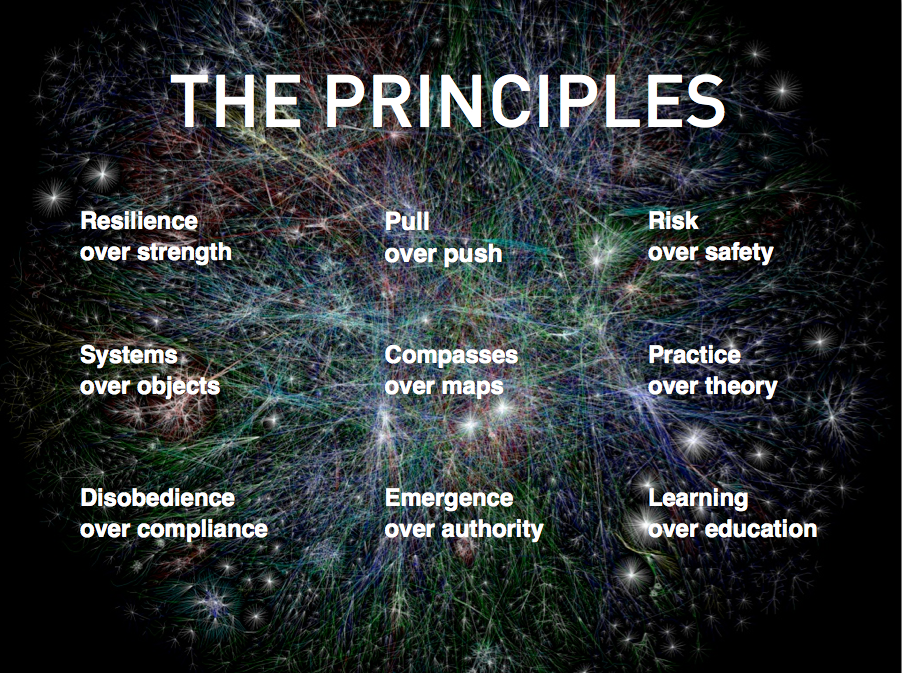
Then Joi started introducing and commenting some of the 9 principles.

A lot of people disagree with them, but I don’t care. I care about the arguments, I don’t care that they are disagreeing.
Joi Ito 9 Principles2

Pull over push

You pull from the network as you need it, rather than stocking it and centrally and control it. And agility is what comes out of that. If you have printing presses, and lines of code, and IP, those are all reasons not to shift course, to stick to your map, rather than the compass. All the things we think are assets are in fact liabilities, if you think about it from the perspective of agility.

Compasses over map

Often the map costs more to build than it is worth, because the complexity is so high and it is so unpredictable. Dependence on planning is a weakness.

Practice over theory

When I was looking for funding my first ISP, the investor spent 3M USD for consultants to advise not to invest 600K dollars. If it costs you more money to think about it than to do it, it’s better to do it. And if you do it, it turns out that you get a fact, not a theory. It is important to do things, especially if the cost of doing things is cheaper than talk about it. A lot of times it works in practice and not in theory, you can figure out the theory later. Most of the world deals with things that work in theory, but not in practice, and they try to discredit reality in order to fit with their theory. But “in theory” they say, “theory and practice are the same”

Disobedience over compliance

You don’t win a Nobel price by doing what you are told. You win a Nobel price by questioning authority and thinking for yourself. You want to build an organization that is resilient to disobedience

Emergence over authority

In communities, authority seems to be emergent. Open Source project leaders, tend to be somewhat quite people, with a lot of EQ, how are not naturally trying to grasp power, but end up in power because the followers (@petervan: I would say the fellowers) push them there. In an investment firm with a hierarchy that is based on function and title, you just need a stick to keep the troops aligned. But when you are in a system where you are paying to participate, then you want emerging authority.

Learning over education

Education is what people do to you, learning is what you do to yourself. About degrees and “finalizing my eduction”. I don’t want you to be at the media lab, because you want to get out.

Resilience over strength (part of the Q&A)

In stead of bulk-up and resist failure, invest the same money on recovery and resilience. You tend to try to minimize failure, rather than trying to work on resilience. It’s also kind of a Zen thing too. If you are extremely present and ready for anything, your are in an extremely resilient state. And it you are not present, you are always focused on the future, or the past, you try to build up walls and trying to make sure that you don’t get choved. And it is hard when you are surrounded by other planners in an institution like this (Knite Foundation) you tend to focus on structure, strength versus resilience, the structure vs this bounciness. Again on the Internet, a lot of the pieces are very resilient, when you are in an institution that uses a lot of planning; it is hard to create that interface

Also the Q&A part of this talk was interesting.

On how to share knowledge:

The conference model is a great system. A lot of people have experimented with ways to try to share knowledge, but it seems to be one of the hardest problems because everybody has a day-job, they are very busy, and people are talking sort of different languages, and when you are face to face you can coordinate your language in real-time

On how to you get people who are working on things coordinated?

At the Media Lab we have several approaches: we have this sort of big data, data mining, machine learning, predicting things through causalities and patterns vs something where people are more in charge and people are more active.

There is another version of this talk at TED talks:

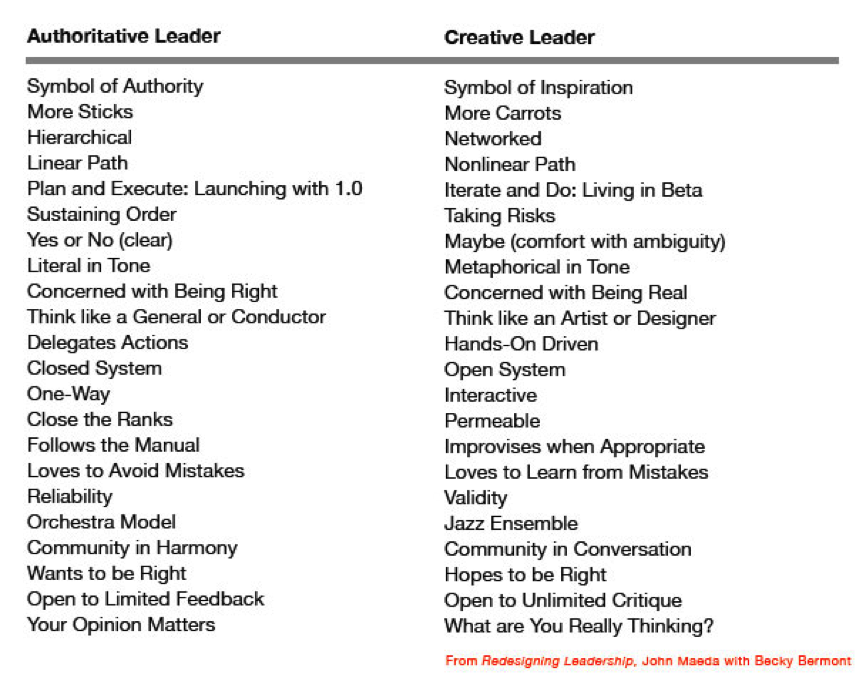
The more I listen to Joi, the more I become aware that he is talking about leadership features to navigate our companies in this more then ever unpredictable fast moving world. It was a pure coincidence; right after Joi’s talk, I spotted this great post from John Maeda, about Creative Leaders versus Authoritative LeadersJohn Maeda was the President of the Rhode Island School of Design from 2008 to 2013. He is currently a Design Partner at Kleiner Perkins Caufield & Byers.

This chart represents a summary of the kind of creative leadership that is rising — and needed — in the face of our increasing interconnectedness due to global economies, mobile devices, and social media. In an age where anyone can “friend” the CEO, and where complexity and volatility are the only constants, what should leadership look like? I often say we are now operating within a “heterarchy” though I’ve also cleverly seen it called the “wirearchy.” In any case, it’s a world where I believe the natural perspective of artists and designers — who thrive in ambiguity, fail productively, and rebound naturally — will be become more and more useful in leadership contexts.

The chart was originally created for a workshop at the Davos World Economic Forum in 2009 and became the basis of my book Redesigning Leadership, written with Becky Bermont. In my own observation, there are authoritative leaders and creative leaders everywhere — it’s not something wholly determined by industry, generation, or position. And every leader will need, on any given day, a little bit of both types of leadership.
John Maeda principles

Makes me think about principles for Leadingship vs. Leadership. See also my post “The End of Leadership” of 1 ½ year ago. Like Joi’s talk makes us reflect on the openness of innovation, Maeda adds the openness of leadingship.
A Conceptology of Learning and Leading at Work – Guest post by Rune Kvist Olsen

Since about a year now, i have been intrigued by the work of Rune Kvist Olsen from Norway. It’s a pleasure to give room and space for his thinking on my personal blog. His previous contributions were the best read posts on my blog ever: they include “The End of Leadership” and “Leading from The Edge”. Now, Rune has compiled and added a new piece of work that he introduces himself below (Colored highlights by myself):

Hi You All!

The paper “A Conceptology of  Learning and Leading at Work” is now completed and ready for reviewing/announcing/posting/publishing.

The purpose with the “Conceptology of Learning and Leading at Work” is to construct and establish an alternative belief system that would entitle everyone in the workplace the same conditions and access of mutual trust and personal freedom. The intention is to advocate the values and standards of health, liberty, dignity and equality as common principles applied for all the people involved. In challenging the mainstream and contemporary belief system in organizing, leading and managing work and people (granting only a few and someone these principles exclusively), the effort behind this new attempt of intervention was aimed at developing a real alternative option of choice by creating an entirely new way of structuring power in organizing, leading and managing the process of work.

An appropriate perspective in reviewing the significance of the “Conceptology of Learning and Leading at Work”, could be by assessing the article “The Myth of Executive Stress” by Keith Payne. This article is presenting relevant research studies within the field of leading and managing people. Some of the core findings reported is that leaders are showing substantially lower levels of stress than non-leaders caused by their superior position and supreme power in managing other people and leading people below. The implication of being managed and led from others above is the lack of control. The result of being controlled is higher blood pressure, lowered immune function and stress-related diseases. When the stress response is activated for months at a time, it is toxic as Payne is stating. The concluding statement is; “Control is the essence of power, the linchpin binding status to stress”. In this perspective the alternative “Conceptology of Learning and Leading at Work” is raised as the counterpart to the belief system of leadership with leaders above and non-leaders below, and represents an alternative option of choice in moving from the mantra of “leadership for someone” to “leadingship for everyone”.

Everyone in the workplace should be entitled the principles of trust and freedom as common privileges concerning health, liberty, equality and dignity at work. In the history of management the Conceptology of “Humanology” and “Humanability” is granting everyone the equal access to personal control with none above and below in a chain of command and none in charge of anyone else.

The links to the articles and the research studies are:

http://www.scientificamerican.com/article.cfm?id=the-myth-of-executive-str&page=2

http://www.pnas.org/content/early/2012/09/19/1207042109.full.pdf+html

https://faculty.fuqua.duke.edu/~ack23/Publications%20PDFs/Compensatory%20Control%20Current%20Directions%202009.pdf (PDF File)

Please enjoy the attached paper (A conceptology in Learning and Leading _short version_– PDF File) and let the Conceptology make a difference and become a real option of choice in organizational life! Feel free to pass this message around.


All the best

Rune Kvist Olsen

Inventor and facilitator

Student Summer Job: making meaning and sense

A couple of weeks ago, I was taking a short break and chatting with a new young guy I never had seen before at the company.

We had some chit-chat discussions about the weather and other small talk, until i asked him in what group he was working. "I am a summer student and i am working in the A-department”.

"And what are you doing there ?", I asked.

Student: "I am filling spreadsheets. They document the discussions of the daily whiteboard discussions, and that is needed to report back to the different management layers in the company."

Me: "And that keeps you busy for the whole day ?" I replied.

S: "Yep, sort of"

"And do you think that’s useful ?"

S: "No, not at all, but it is just a summer student job for a month, but

it pays well

and with the money I will be able to afford a holiday trip to Australia."

A couple of observations here:

  • how many times do you/we do things we profoundly think are useless, but still do them as "it pays well" and we are not prepared to go through the pain of challenging THAT status-quo ?
  • how many of these useless things have anything to do with adding value to the customer, and have all to do with internal policies ?
  • when is the last time you did something that really made a positive difference to your customer ?

We can have all sorts of theoretical debates about company culture, but as long as we don’t start focusing exclusively on the value zone – there where value is created at the interfaces of our company – all these efforts will only continue to add to the numerous sets of policies and initiatives.

These keep on existing and having a life of their own, even long after the crowdsourced intelligence of your company has acknowledged they have been bypassed by the events and only are alive because some senior manager identified him/herself so much with the initiative that giving-in would cause irreparable damage to his/her ego.

When are we going to stop and refuse doing things that don’t make sense anymore, only because the circumstances when these practices were created have changed dramatically ? Or even worse, have proven to have has counterproductive effect ?

Keep on searching for meaning and sense in everything you do. Refuse to do useless tasks.

Techonomy: a new philosophy of progress

image

Last week, I had the privilege to attend the first edition of Techonomy, a fantastic new conference blurring technology and economy with an optimistic balance that technology in its broadest sense (not only IT, but also gnome sequencing, bio-fuels, big history, etc) can be the driving force for a better world.

First enjoy the announcing video below.

The conference was bringing together 3/4 of Silicon Valley’s leadership, including Eric Schmidt, Jeff Bezos, Bill Joy, Bill Gates, Steward Brand, Kevin Kelly, John Hagel, Deborah Hopkins (Chairman of Venture Capital Initiatives and Chief Innovation Officer Citi), Nicolas Negroponte, Sean Parker, Padmassree Warrior CTO Cisco), Jeff Weiner (CEO LinkedIn), and the list goes on, and only a couple of non-US leaders such as Nobuyuki Idea (Founder of CEO of Quantum Leaps Corporation, working on innovation, and previous CEO of Sony Corporation), Nellie Kroes (European Commissioner for Digital Agenda), Vineet Nayar (CEO HCL Technologies, India), and Ory Okolloh (Founder/Executive Director Ushahidi, South Africa).

How to describe Techonomy conference ? I would say “a super-TED with a technology focus and with an agenda”.

The agenda is “a new philosophy for progress”.

It’s a movement

Somebody asked “a movement against which enemy, against which barriers ?”.

I believe it is a movement FOR something.

For a better world. Finding techonomic solutions to tackle the global climate challenges, feeding the world, a better health for everybody, a new value kit for the current and next generation, not based on greed but on the concepts of creative capitalism as formulated some years ago by Bill Gates in the Bill and Melinda Gates Foudation.

In that sense, it should not surprise the regular reader of this blog how much this resonated with myself. Not only the personal inspiration, but especially how we with on organization like SWIFT can adopt and promote the techonomist values and objectives.

I also came across some leaders that could be subject of SWIFT’s CSR initiatives. Take Bill Drayton, Leadership Group Member Chair and CEO of Ashoka, the global association of the world’s leading social entrepreneurs, men and women with system changing solutions for the world’s most urgent social problems, encouraging everybody to be a changemaker.

It’s impossible to describe the intensity of the content and contacts of these 3 Techonomy days.

Some highlights:

  • Evolution is incremental. Revolution is disruptive movement
  • Collective learning is what makes us human
  • The physical economy is sensoring a second economy of conversational plumbing
  • As long as we draw boundaries (for ex US vs. China, we against them, etc) we will not be able to solve the world’s problems.
  • The economy is NOT recovering, consumer is running out of money
  • Governments do not understand globalisation, businesses do.
  • Employees first, customers second.
  • Promote younger people must faster
  • Building and tapping from tacit knowledge will become core skill
  • Markets are like gardens: they need tending
  • Innovation happens outside the regulated markets
  • Banks make money on spread and opacity. They are by definition against transparency
  • Currency is “the instrument of trust in a transaction”. Unfortunately the debate focused solely on the payment transaction and money as the trust element.
  • Health agenda: from illness fixing to personal health prediction and coaching
  • Some technomists are skeptical optimists that do not take progress for granted. One has to make progress. It does not happen.
  • Recalibrating our assumption that form our perceptions. For ex we learned that world population will NOT grow indefinitely and probably max around 9 billion, and then go down.
  • Innovation at Cisco: Looking at 30 ! adjacencies as a “portfolio” like a Venture Capitalist does.
  • Computer Associates CTO: “a lot of leading edge innovation comes from financial services”
  • Innovation requires a culture of taking risk and celebrating failure
  • Change happens when the DESIRE not to change is greater than the desire to change. The power struggle to make this balance change is based on societal needs.
  • Innovation requires 1) Money, 2) Desire, 3) Need
  • There is no value in the idea, there is value in its commercialization
  • We have a moral obligation of bringing less developed regions up.
  • Cities are “intensities” that have a critical mass of people
  • In a city-“OS”, no one single company can dominate. It has to be open source by definition.
  • Generation-Y or whatever: you need the backing of 18 year olds. That’s “youth”. 25 years+ does not quite get it.
  • Companies scale like biology, and in the end they die. Cities scale like networks, and do not die. The city is the framework model for the future.
  • In the developed world, a disruptive innovation is something that can create the biggest disruption. In the developing world, innovation is a technology that is simple, reliable, and that can function as an integrated unit.
  • Success in mobile in Afghanistan is because there was no legacy. They are willing to take the risk to jump to the next curve.
  • The future is for (techonomist) entrepreneurs that are willing to work together.

The conference is so good. It cries for a European and an Asian chapter. Any European Leader should not hesitate a second to be associated with and sponsor it.

I was dreaming of hosting a European chapter of Techonomy at the fantastic SWIFT Headquarters south of Brussels.

El Jefe, do you hear me ?

His Purple Highness and Innovation

There has been a lot of coverage on the net about Prince’s statement “The Internet is Dead” and the responses “Prince is dead”. For me, Prince is never dead, as he left me with memories to the best concert I have ever seen during his Purple Rain tour, indeed quite some time ago ;-/

The master of funk – aka His Purple Highness – just has a new CD “20TEN”, and it seems to be a good one, and it is btw given away today for free with Newspapers in Europe.

I found this review of 20TEN in the Belgian Newspaper De Standaard. It’s in Dutch, but if you turn on Google translation, it’s quite readable in English.

Prince

I blog about it for the following (auto-translated) paragraphs:

We give Prince creative freedom and we understand that he does not want to live in the past. The most pressing question that loomed when we 20Ten in the CD-changer was explained: the album will be as good as Sign O The Times or Parade? Equally exciting as 1999 or as viciously as Controversy?

Well … (Drum roll) … No. Not really. More importantly, we find that bad? Because let’s be honest: you really expect the 52-year-old Prince a plate opinions so urgent, as controversial and as innovative as his work from the 1980s?

Maybe we should ask whether it is the responsibility of someone like Prince to remain the major role of innovator to take on. That role he has not already played out with fervor when it was needed? Charts when artists do not dare to take risks, but only when blacks were allowed to play funk and disco, when explicit sex or gay and bisexuality have been stashed away in the bright pop music?

The question – or statement if you want – was already raised by Guillaume Van der Stighelen during an interview with business TV Channel Kanaal-Z some years ago at the occasion of the launch of his book “Heldenmerk” (the brand as a hero) somewhere end 2008, begin 2009.

He said something along the lines that creativity (and innovation) should be left to the young generation, and that he – as a 50+ year old – should give room to the young generation where the real creativity sits, and that his role should be one of mentorship.

I am 50+, so that quite resonated with me. But I think he is right. Since then, I try to make others win, younger people than me, who still have to proof something.

It is actually fun to disappear backstage, and enjoy the show being delivered by others, and knowing you were a substantial part of getting it where it is right now.

That’s a different – and in my view “better” – type of satisfaction, fulfillment and motivation.

Heretic Team Glue

Last week we had a great team off-site.

We arrived late afternoon in the fantastic location of Chateau de la Poste, close to Namur, Belgium. Built in 1895, the Château de la Poste was the residence, for more than forty years, of Princess Clementine, daughter of King Léopold II. It later was sold to the postal services, who used it as a vacation resort for the children of the employees of the Belgian Post (times have changed). It recently was refurbished completely by a French wine maker, and it houses now a wonderful hotel, meeting centre and quality restaurant.

The amazing landscape, the silence and the soft welcome on the summer terrace set us all in the right mood. We all felt our physical and mental muscles relaxing, winding down.

Don’t know where I read it anymore, but I recently found a quote: “If you are not able anymore to take some time out for an off-site team gathering, you’re cooked”

For once, we did NOT have a packed agenda, and plenty of time for  real Quality Time Sessions.

We even made an acronym for it (QTS) to joke a bit with the “acronymitis” of the lean methodology.

More seriously, we invented QTS because we felt that the pure lean method was too much focused on a problem-mindset, and not enough on an opportunity-mindset, opportunities to develop some deeper quality thinking on subjects relevant to our business and team.

One of the items on the agenda was about “how to tell bad news”. In the subsequent discussion, one team member reflected on some sort of “fear” and “If I do this, then this and that may happen, and then…” thinking. Being in the acronym mode, we had a good discussion on


FEAR = Fantasy Experienced As Real


and how such behavior leads to blocking, status-quo situations.

Almost “emergent by design” our team culture principles unfolded, and we articulated them along the themes of “old” and “new” game.


  • Old game = fear, tricks, manipulation, raising stinky fish, machiavelism, creating and maintaining negative energy in general

  • New game = solution oriented, integrity and authenticity, fast correction (like Guy Kawasaki used to say”churn baby churn” a variation on the famous 1976 disco song “Disco Inferno” by the The Tramps), the holy fire, positive energy, who is the owner of the idea, who cares ? It’s about focusing on believers, and investing heavily in those VIP followers that will help us create a viral innovation infection/storm, like a raging holy fire that cannot be stopped anymore. Burn baby Burn…


We replaced “raising stinky fish” by regular update and feedback sessions, focusing on polishing rough idea diamonds, focusing on what works vs. what does not work, focusing solutions vs. problems.


If you think deeply about it, all this is about

the major cultural shift

from pushing towards pulling your ideas,

it’s about a strengths based society and team,

it’s about connecting ideas

and excel in making them real.


Another correction we made to lean was our understanding of a skills matrix.

We were very inspired by Venessa Miemis’ blog post “Framework for a Strengths Based Society” that included following diagram.

We decided to add these skills to our existing lean skills matrix that was too focused on identifying and solving problems and tools mastery. “We are not the tools, the builders are us” is another quote from one of Venessa’s presentations.

The subtle nuance is that we did NOT implement these skills as comparative/ competitive skills of different team members but


in terms of personal areas of

strength and potential

for each team member individually.


Our little team is SWIFT’s “Innovation Team”. Some time ago, we shared the details of the mission here and in summary it goes like this:

Build the Skills , Tools , Processes, Metrics , Values , Network , required to support collaborative innovation and transform SWIFT in an agile company, able to succeed in a changing environment.

I often make reflections on how real our innovation work really is. And although we are having lots of fun and some sizeable impact on how the company little by little opens up for innovative behavior, I always seem to be in search for that little extra in life and work.

Too many of our innovation experiments and proof-of-concepts remain just that: proof-of-concepts and prototypes. They never get into production. Worse, some outcome are just ‘filed vertically” or even never get the any executive attention.

I would like to hear from other innovators what is the secret sauce to get beyond the prototype stage. Because staying in prototype stage sometimes makes me wonder if I am in some sort of “busyness” therapy.

And I have come at an age where I cannot content myself with busyness.

I could sit here till my pension, having a good pay, and living honestly speaking in a quite luxurious working environment. But I am in search for more. I am in search for


meaning and significance


With the couple of years still to go, I still have the arrogant (?) ambition that I want to leave a legacy. On a personal level in my family. On a professional level that my passing in this company has substantially changed something. It’s about a deep sense of motivation, beyond pay and perks.

There is something heroic, even heretic about all this. That’s why the title of this post is Heretic Team Glue.

See full size image

Heretics are the ones that were expulsed from the Catholic Church because they did not follow the rules and challenged faith and established dogmas.

There are several dictionary definitions of “heretic”. The one I have in mind here is “anyone who does not conform to an established attitude,doctrine, or principle”.

I think we in our team are all some sort of heretics in the castle. It’s something very special in our team, that creates a very strong bonding.

At times it even has some masochistic flavor. Why on earth do we keep on trying again and again ? Even if the odds are against us. Why are we prepared to go time after time through the innovation pains over and over again ?

I truly believe it is because we do it for the right reason. Not for the pay. Not for the glory.


Because we believe there is a chance

we can succeed 


And believe we can create a tribe of followers in the same belief. It’s for some of us the only reason why we stay !

Are the above reflections caused by my age and my 3/4 life contemplations ?  Don’t think so. We invited some GEN-Y colleagues to join our off-site. And see: they too are driven by honesty, they too want promises to be kept, they too look for meaning and fulfillment in their lives.

But it was shocking to hear how some of them have been seduced to join a company based on huge expectations and promises that they would work soon for 3 years in the US, and have rapid accelerated career paths, and deep young graduate immersion programs. It’s unacceptable to make such promises if you know you can’t realize them.

And this is their first contact with corporate life !

How can we ever correct this ? How on earth can we regain the trust of these young people ? Our generation has planted the seeds of suspicion in these long lives. Big mistake.

Me too I have been mislead several times in my life, and I recognize the power-less emotion of trust that was betrayed. Lessons of life ? Normal life injuries ? The way it is ? Why do we need to accept that ? Why do we repeat the same errors over and over again ? Sooner or later, these young people will present us the invoice.

These folks actually think. Think deeply. Some GEN-Y people are for example  insulted when calling them “GEN-Y”. Because they see themselves as individual human beings, with their own identities and values systems, not prepared to be tagged as a category. And they have great ideas. We organized some sort of Innotribe Lab with them: more than 20 ideas on how to improve quality of work came out. I am honored that I can channel these ideas into the People & Culture “movement” team of the company.

Last but not least, we had a great discussion about “reverse mentorship”.

Instead of older experienced professionals mentoring new young people joining the company, why not letting young people mentor the already older – sometimes (mis)formatted – generation, and teach them how to use new technologies and apply 21st value systems ?

We had a fierce debate: how can one say that the young generation is the future, and five minutes later challenge reverse mentorship by not accepting that one can learn an awful lot from these fresh and well trained minds.

Maybe that’s where my future is ? In being mentored by a GEN-Y ? It will ask of course an attitude of

vulnerability


It’s also part of a give-ànd-take culture that includes transparency and openness. Especially give. Like a gift, where you don’t expect something in return.


When is the last time you made a Gift ?


How can we create an environment where we encourage learning from each other (in normal and reverse mentoring mode) ? An environment where we celebrate confidence building on your own rhythm, dare to be vulnerable, asking for feedback that is clarifying, supporting, challenging.

I am convinced I can learn something from every human being. Especially young people who have a renewed and fresh sense of civic responsibility, transparency, honesty, openness.

I have committed to take the challenge and invite one of our GEN-Y’s to monitor me during 6 months and give me feedback on my behavior and to keep me honest.

So that I walk the talk. Every manager should do this.

No more collateral damage

There was this week a really interesting article in Trends Magazine about “The Blue Economy”, about a guy called Gunter Pauli, and his ZERI foundation.

I started googling this stuff, and was amazed about what i found.

Apparently, Gunter Pauli is busy doing what he does for quite some time, as can be seen in the Fastcompany article dating back 1993 !

Surprise, surprise: Gunter is from Flanders, Belgium. He was co-founder of Ecover. In 1991, Pauli launched the concept of zero waste and zero emissions for industry through the clustering of activities at his detergent factory in Belgium.

image

Gunter Pauli is Member of the Club of Rome, a Fellow of the World Academy of Arts and Sciences, a Creative Fellow of the Club of Budapest and a long term advisor to the Japanese Government and the United Nations. He is professor at the Politecnico di Torino in charge of “systems design” at the Faculty of Architecture and the School of Design.

“The Blue Economy” is introduced as:

a new business model to inspire entrepreneurs to shape a new economy based on competitive innovations, creating JOBS and SOCIAL CAPITAL”

“The Blue Economy: Cultivating a New Business Model for a Time of Crisis” is based on the new book “The Blue Economy: 10 years, 100 Innovations. 100 Million Jobs”, published by Paradigm Publications (New Mexico, USA) with the support of UNEP and IUCN.

I could not yet find the book on Amazon, but the paper that was input to the Club of Rome can be downloaded here.

From the intro:

The form of capitalism that has dominated world societies is entirely disconnected from peoples’ real needs. Some two billion people struggle to get by on less than two dollars a day, lacking access to food, water, health, and energy, the most basic requirements for survival. Over 25% of the world’s youth are unemployed. Yet one billion of us are over nourished and swim in 400 million tons of electronic waste with higher metal concentrations than the ores extracted from the earth. Conservatively, the top 70% of the world’s wealth is concentrated in the top 10% of the population.

Fortunately, times are changing. This book is about that change. As the second decade of the 21st century sets the stage for a new economy, the core question we answer is, “What is the business
framework we really need?”

And the Zero Emissions Research & Initiatives (ZERI) is introduced as:

a global network of creative minds seeking solutions to world challenges. The common vision shared by the members of the ZERI family is to view waste as resource and seek solutions using nature’s design principles as inspiration.

I continued clicking through the different ZERI sites, and was thrilled by the ZERI Education Initiative:

The opening song is


“I want to live in a better world”


This is about an innovative learning project for children, developed by Gunter Pauli and a team from ZERI Network of scientists, scholars, pedagogues and artists.

It’s about learning children to ask the right questions.

It’s about teaching children

the 5 intelligences

  • Academic Knowledge
  • Emotional Intelligence
  • Artistic Expression
  • Eco-Literacy
  • Capacity to implement change

image

Apparently Pauli and friends published a whole series of books “Gunter’s Fables”. And yes, you can buy them at Amazon 😉

image

Also check-out this fantastic talk "How Can We Use Finite Resources To Propel Ourselves In The Future?" of TEDxTokyo 2009, held on May 22 at National Museum of Emerging Science and Innovation.

It all makes me think very much about the book “Cradle to Cradle” by William McDonough (Author), Michael Braungart (Author), a book that was a real eye-opener for me at the time, and a book that i already mentioned several times in this blog.

“Let the future emerge” is the tagline for this blog. And things seem to emerge with an astounding sense for synchronicity. Just last week, i discovered The Fifth Conference.

image

The Fifth Conference is a forum for vision. Part publisher and part conference, The Fifth Conference tackles the ‘big issues’, the factors that drive our future. Think ten, twenty, even fifty years ahead and try to imagine how we will live and work. What will this world look like? How will we have solved the economic, social and environmental challenges that we confront today? To answer those questions we talk to entrepreneurs, policy makers and experts. We analyse the facts, the forecasts and the arguments. And most importantly, we collect vision.

It is so close to my idea of the Think Tank for Long Term Future !

So, last week, i had a chat with Frank Boermeester, co-founder of The Fifth Conference.

Lots of synergies!


Frank invited me to draft an essay on Technology, with a focus on Technology Readiness in our region, for the next publication. Will certainly do so, and cross-post on this blog.

However, as we were chatting, we suddenly became aware of

the “understream”

that is driving all the changes and evolutions in Growth, Mobility, Green, Technology, Health.

Its about the theme of Cradle-to-Cradle that “reducing waste” is not good enough anymore, we need to “add value”. Its about the notion that Google’s “Don’t do evil” is not good enough anymore, and we need to “Do Good”.

It’s about what keeps Gunter Pauli going, and what he refers to in his video as


“no more

collateral damage”


And not anymore

image

and yes, create a sustainable society.

image

See also some related blog posts on this site on:

Reblog this post [with Zemanta]

Broken Will

Good morning, Vietnam !

Bad start of the day. Have a terrible cold. Did not sleep well. Outside; it’s 1°C, windy, humid, and dark. Again, i woke up angry.

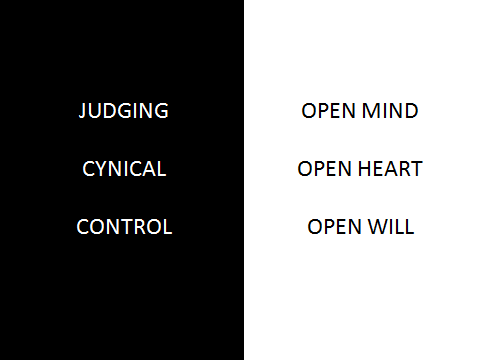
Was thinking about my previous post “Emotional Zombies”, where i wrote about Open Mind, Open Heart, and Open Will.

image

Open Mind, Heart, Will is based on the work of about Theory “U” by Otto Scharmer.

It’s a book about presence, and how – if you dive deep to the level at the bottom of the “U” – you will discover your true purpose. The subtitle is “Leading from the future as it emerges”. Now you know where i got the title of this blog.

In “Emotional Zombies”, I also wrote about the golden cages.

I recently discovered it can get worse. Much worse.

It can get to the stage of BROKEN Mind, BROKEN Heart, and BROKEN Will.

It remember somebody quoting about education just 50 years or so.

In the family instruction books of that time, the general sense was that the parent had to break the will of the child as early as possible in the education of the child, to ensure that the child would be fully under the parents’ and teachers’ control. Luckily, education has evolved, but you get a sense what it means to break somebody’s will.

To further explain that feeling of Broken Will, i will tell a true story. When i was studying architecture (yes, building houses and so) at the art school in Brussels, one year we had to design an art exposition space. We also needed to make a maquette of it.

I worked on mine for days and nights. It was made of the finest balsa wood, and the construction was made of hundreds of mini balsa pillars. Oh boy, was i proud !

Then the jury comes along. The judging was a session in full public where the other 200 students could follow the judgment of the pros.

Professor Jonckers – i even remember his name after 30 years ! – looked at my piece of art. He smiled dangerously and said: “Let’s see if this thing is also as solid from a construction point of view as it looks like” and then he demolished the whole thing by shooting with his fingers all 100 pillars into pieces. I could have kicked him in the face (i should have done it).

That hurts. It hurts when your piece of work gets demolished. It hurts when your contribution gets ignored. It brings me in my state of “Broken will”. Its an emotion beyond broken heart. It cuts deep.

This week, i mourned my broken will.

And what about the cage ? I suddenly remember a line of a poem: “she smiled gently when she discovered that the door of the jail was already open for some days”

Body Part Maker

In the current economic climate, one restructuring follows the other. In my country there are some notable examples like AB Inbev, Opel (GM) Antwerp, HP, etc.

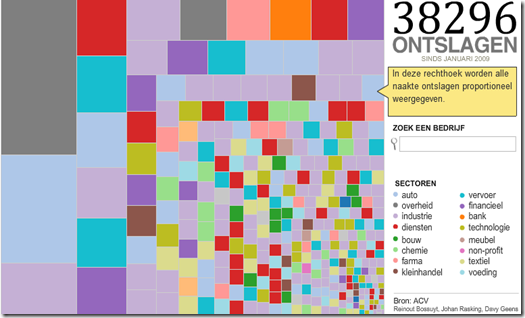
At the time of writing this post, the counter of lost jobs in Belgium since January 2009 stood at


38,296


lost jobs


And this is “only” from structured and collective redundancies. The following table comes from quality newspaper De Standaard. The visualization also represents what sectors “contribute” most to these redundancies.

image

It’s therefore “normal” that i see/meet/mail more and more friends and (now ex-) colleagues being hit by the recession, crisis, or whatever you prefer to call the current economic climate and resulting restructuring or transformation programs. It happens everywhere. Except at the one employer i ever had that still today shows double digit growth.

However, some of these friends were living in Golden Cages for years but were bored to hell. The shame is that they let this happen over them. Others indulged all sorts of manipulations, political maneuvers, and other techniques that did not take them for full or were just ignoring them and their ideas. Others just had the courage of sticking out there neck, but not being appreciated by the blueprint and/or differing too much with the “normal way of doing things here”.

Indeed, it seems recurring many companies that diversity in thoughts is not always welcome, despite all the window dressing about values etc. That is of course a pity, because this diversity in thoughts and ideas is fundamental to being innovative.

And it happens everywhere. Except at that one record retailer. They seem to be some kind of Tribe. Have always been since the 60’ies, with self-development programs and alike. They also continuously innovate. With green IT and own windmills etc already 10 years ago. “Cradle-To-Cradle – Remaking the Way We Make Things” applied before the book was written.


So it’s all about sustainability, made possible through R&D and Innovation in new sciences and technologies. And being part of a tribe that has innovation in its DNA. See also later in this post when we discuss the jobs and trends of the future: science and technology are at the heart of the sustainable development debate.

However, if you’re not part of such a tribe, and you get fired where you were bored, then there is light at the end of the tunnel. Getting fired could really be a fresh start of your professional life, although somebody else made the decision for you.

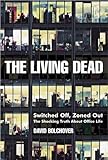
Have a read at “The Living Dead: Switched Off, Zoned Out – The Shocking Thruth about Office Life” by David Bolchover.

Joe read the book and here is his review:

This book is about – the millions of talented and bored to tears people rotting away in large offices, completely disconnected, disenchanted, disengaged, shuffling papers away, staring at screens, writing memos and Powerpoints, sitting in meetings deliberating in jargon that means nothing, and generating serious pretend-work….

and how our world and organizations have made this a taboo topic, refuse to recognize its existence and aggravate this problem through inadequate structure and processes (specialized business jargon, office politics, hierarchy, etc).

image


This is one of the most blunt books I’ve ever read – a Dilbert with the sharp facts substantiated! And you will not find one business jargon word that can qualify for a b-sh**t bingo in there.

The most interesting part is that the book is written already 5 years ago – and looking at Peter Van’s blog and the book gives a clear indication of a very alarming trend. Not for the weak-hearted! Contains some seriously ego-busting words on our Great Leaders ( the big companies CEOs) and Even Greater Gurus (the Management book writers).

What would you do if you got fired ? What would be the one thing that you would like to do for free for the next 10 years ?


Could give you a real good indication

of where your true

passion and purpose is.


But where to look first ? The report FastFuture.com report “The Shape of Jobs to Come” (Final Version January 2010, you can download the PDF here) would be a good starting point.

image

The report lists the 100 most likely jobs to emerge and be successful by 2030. Some of these jobs will already see the light as soon as this year 2010.

And if you have the luxury to take first take a couple of months sabbatical, then the report has in Appendix-3 an excellent time-line on what will happen when, what skills you need to master by when, and what the most probable and most looked after jobs of the future may be.

The outcome may be that you may want to follow some course on NIBC convergence technologies. (NIBC = nanotechnology-biotechnology-information technology-cognitive science) or to study Chinese, Spanish and Portuguese if you want to mean anything in the economies of growth of 2015.

Some extracts with – as usual – some personal comments.

For the longer term, the centrality of science and technology in helping to tackle the most pressing planetary challenges from poverty to clean water, environment to human health, climate change to energy supply and housing to transport are ensuring that science and technology are at the heart of the sustainable development debate

Finally they are expected to help us survive and thrive in the cyber world, whether through legal protection, counseling or management of our virtual data and ‘personal brand image‘. As a result, the survey suggests that many of these roles will be popular, well-rewarded and aspirational.

The ten key patterns of change identified in the report are:

1. Demographic Shifts

2. Economic Turbulence

3. Politics Gets Complex

4. Business 3.0 – An Expanding Agenda

5. Science and Technology go Mainstream

6. Generational Crossroads

7. Rethinking Talent, Education and Training

8. Global Expansion of Electronic Media

9. A Society in Transition

0. Natural Resource Challenges


Looks like the list we suggested for our Think Tank on Long Term Future 😉

Under “economic turbulence, we find:

Further economic turbulence and potential downturns between 2010 – 2020, followed by a more stable period to 2030 as excessive risks have been removed from the financial markets and most economies have repaired their finances

Out of the list of 100 future jobs, i personally liked very much: the body part maker, the teleportation specialist, the currency designer, the non-military defense specialist, the director of responsible investments, the mind reading specialist,

Take the Body Part Maker (possible emergence as a profession: 2020, that’s only 10 years from now !):

Due to the huge advances being made in bio-tissues, robotics and plastics, the creation of high performing body parts – from organs to limbs – will soon be possible, requiring body part makers, body part stores and body part repair shops.

While a typical organ such as a liver or kidney might be grown, other parts such as an arm would involve the complex integration of a nano-engineered skeleton, high performance robotic joints, fibre-optic nerves, artificially grown skin, synthetic flesh and muscles.

Or the Memory Augmentation Surgeon (emerging profession in 2030). It really reads like Ray Kurzweil’s “The Singularity is Near” (book written in 2005 !)

This is a new category of surgeons whose role is to add extra memory to people who want to increase their memory capacity. A key service would be helping those who have literally been overloaded with information in the course of their life and simply can no longer take on any more data – thus leading to


sensory shutdown


Although the job descriptions are somewhat funny and even “cute”, the real value of the report is in its Appendices: they hide a wealth of trends for 2030.

Truly amazing. If only 10% of this becomes true, the world in 2030 will look quite different from 2010. Especially Appendix-2 is a summary of all things you should be aware of as 2015 approaches. Appendix-3 shows a very comprehensive timeline per trend.

It is in these Appendices that you can learn for example about Generational Cross-Roads:

The challenge for employers will be to create an environment where each group can feel valued and be effective. Indeed, a Randstad USA survey found that 51% of baby boomers and 66% of the generation that preceded them reported having little to no interaction with colleagues from Generation Y.

What is your company doing to get these young generations

deeply into your workforce’s DNA ?

And about Society in Transition:

Higher ethical standards and a sense of the greater good are two of these evolving trends. Increasing expectations are concurrent with a decline in trust of key institutions.

“Higher ethical standards…”  See also my previous blog post on Ethical Re-Boot.

About Evolving Technological Ecosystem, the appendices reveal that:

Handheld devices expected to become the control centre of a rapidly expanding personal ecosystem – where projection / pullout screens and keyboards could accelerate laptop replacement. Key enablers include augmented reality, intuitive interfaces, semantic computing and the increasing embedding of intelligence in a range of devices – often known as ambient intelligence or IP Everywhere.

What is your company doing to get these technologies

deeply into your innovation DNA ?

And about Quantum Cryptography that:

In “traditional cryptography” the data itself is encrypted using complicated mathematical functions. In “quantum encrypted communications”, a key is sent by beaming a string of photons, representing a code, from the source to the target. If it gets to the other end and matches what the target expects, then the data gets unencrypted. The Guardian notes that if anyone tries to intercept or break it, thanks to the laws of quantum physics, the mere act of observing the stream of photons changes it – and so it fails

If you company is doing something related to internet security

your strategy for the next 5-10 years

should have some bullets and focus on this.


And it is not always about throwing another GUI at your application. Have a look at this article that suggest that Mind and Square are NOT innovative and the true meaning of innovation in financial services lies in the plumbing, not the UI.

Remember my discourse about Innovation at the Core vs. Innovation beyond the Core ?

And then there is a section on R&D and Innovation trends. Most countries and regions seem to invest more in Innovation:

R&D Takes Centre Stage: Germany is investing EUR900M by 2010 to fund R&D projects commissioned by medium-sized business and EUR65M to expand and develop research infrastructure. Norway is set to increase its Research and Innovation Fund capital by EUR685M and create over 200 new research positions each with EUR90,000 funding. France is committing EUR731M in 2009-10 to refurbish universities and research institutions. China’s 10Tn Yuan 2009-11stimulus package includes major investments in science and technology, including "key research projects related to enlarging the domestic market.‖ (University World News).

And where is Flanders ? The Flemish Government decided to REDUCE the budgets for Innovation and R&D for the next couple of years ! And some companies plan to do the same in reaction to the economic climate.


Reducing your innovation budgets

means the beginning of the end

It means that you don’t believe

in the future

of your region, company or project.


Calling in a bus of consultants to tell you how to innovate will not work. First check out How real your Innovation is. And start from there. Especially if your company has a culture of incremental innovation.

image

We have to invest now. As mentioned before, i believe this requires a private (non-public) initiative. Many public – government driven – initiatives seem to lead to lots of consensus and compromise, often leading to a watered down vision, or no vision at all.

I was – and still am – hoping that our Think Tank on Long Term future can kick-start this private process.

Let’s also watch-out for the Belgian Presidency of the EU for the second half of 2010. I heard they bring on board some really smart people that can make the difference. Hopefully we get in the news because we really could make that difference, rather than through scandals about drunk MP’s.

If not, we may have to start imagining a miserable future in 2030 where we will be feeling like in 2010 without Internet (kicked into our lives around 1995 for most of us).

So, if you are/get fired, the next best thing to do is probably to look into the direction of your purpose and to surround you by the people of the right tribe. Those that make you live longer not shorter. Those that truly bind not seek conflict. Those that want you to succeed, not fail. Those that are capable of saying yes, and have not been trained to find the “no”.

For further inspiration about being mentally healthy and finding the right tribe, have a look at this TED talk by Dan Buettner on “How to live to be 100+”. With thanks to the friends in Iceland for spotting this one.

Or you may just not even make it to 2030 !

image


Reblog this post [with Zemanta]

If you can’t manage, measure

I was just reading my Sunday newspaper online,

image

and found this great summary by Gilbert Roox about Matthew Stewart’s book “The Management Myth: Why the Experts Keep Getting it Wrong”

The article is in Dutch, so i decided to use Google Chrome’s Translation extension.

image

So, here are some translated extracts, SLIGHTLY edited as the Google translate result was quite accurate. Impressive.

The management myth is a hilarious review of ten years in the Belly of the Beast. All the tricks of the fair will pass in review. For a client to win, you hunt him the fright. Then make themselves so indispensable that you no longer can think independently, and then they press the lemon patiently. “You should compare consultants with parasites” says Stewart. "I talked and talked, and meantime the meter ran,"

In all these years, the sensation that I sucked everything from my thumb never left me." Bruce Henderson, founder of the Boston Consulting Group, once described the consultant business as "the most incredible business on earth:"

Successful and leading companies hire school leavers to tell them how they should be run. And those companies are also prepared for those millions of opinions count down? "

Stewart called the pundits of McKinsey & Co “Modern shamans” : in the highly uncertain world of global competition drive them to fear the magic of their spreadsheets and charts. "If you can not manage, measure it," writes Stewart – a sneer to the home of McKinsey motto: "If you can measure, you can also manage".

Among the most successful CEO’s of Fortune 500 does not have an MBA fourth title. Success in business is simply not a hard science. Roughly revolves around three things: luck, you work hard and seize opportunities. Even then it can go wrong. But with such wisdom farmer earns a living not a management expert.

Management gurus such as Peters and Jim Collins(Good to Great) posing as prophets like, but after closer inspection they appear mainly to be the specialists of the past. They promote experimentation and out of the box thinking, while their best sellers but only document worn paths. A good advice: if you want money, then do just the opposite of what management gurus say, advises Stewart.

Management gurus seem more like religious preachers. The world they paint is invariably chaotic and uncertain, because fear sells. Bureaucracy is the great evil, and they call for a white collar revolution to overthrow that. Repetitively, they tell the poor middle class to thunder, because "you have the power".


Success is about passion;

imagination

and perseverance


With his plea for excellence the guru paves the path of a crazy work ethic that “starts with the notion that work can be meaningful, and that thought is stretched to the point where outside work is no longer significant”.

While most people only work

for a good bit to live

Hence the remarkable opinion of Matthew Stewart to youth who want to get an MBA:

"Stay away from the business schools

to study philosophy rather

to know the real life"

"In business, experience is the great teacher. We deceive ourselves if we think that an MBA makes you an energetic manager. Managers learn to manage not very different from teaching people how to live in a civilized world.

Managers do not need training,

they have educational needs

I just ordered the book. Looks like some good counter-weight for the other stuff i am reading, and will prepare me for the Lean exercise that our Innovation Team will go through as from begin February 2010.

The balance is probably somewhere in between.