Seven Ways Organizations Can Survive Until 2100

Last week, I was attending my third Techonomy conference.

Techonomy explores “the role of technology in business and social progress.”

I love the word “progress.”

It has that gentle flavor of positivism; in the direction of better. I am more and more convinced that we don’t need innovation; we need progress.

How is progress reflected in a modern company? What does a 21st century company look like? Or maybe we should start thinking about what a 22nd century company would look like. (22nd century indeed: somebody born in 2012 will only be 88 years old in 2100. If Ray Kurzweil’s predictions are realized, it will be a piece of cake by then.)

People might grow older, but companies will die younger.

John Hagel proves with the Shift Index that the firm performance (based on Return on Assets) has declined systemically over the last 50 years.
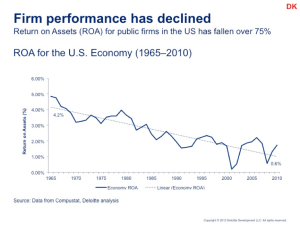
Most companies don’t last longer than 40 years. Most of today’s companies will not exist in 2100.

The question is: What are the characteristics of sustainable companies?

Here is a list of some memes I’ve come across in recent months: the Adaptable Company, the Decentralized Company, the Sharing Company, the Participating Company, the Collaborative Company, the Connected Company, the Connecting Company, the Coherent Enterprise, the Elastic Company, the Human Company, the Learning Company, the Living Company. I could go on.

I propose that there are at least seven characteristics that will be typical in the 22ndcentury company:

1. Peer-to-Peer Networks

Decentralized organizations with peer-to-peer networks of highly skilled knowledge workers will best create and sustain knowledge flows and enable employees to self-organize. The jury is still out on whether knowledge workers will most often be hyper-specialists or hyper-generalists, but the successful company of the future will behave as a living organism where peers organize themselves in “cells.”
In The Connected Company (Amazon Associates Link) Dave Gray calls such organizations “pods”: Hyper-connected cells building relations with other cells based on a common principles, a common set of values, a common pattern language.

2. Architects of Serendipity

Being an architect of serendipity is about creating connections and providing opportunities for collisions between nodes in a network that learn from the collisions and continually adapt. The collisions are not random. Instead, this is designed serendipity, which might sound like an oxymoron.

Tony Hsieh, CEO of Zappos, the shoe company acquired by Amazon last year, is setting the scene for architected serendipity with his Downtownproject.

Instead of venturing in yet another luxury corporate campus with everything on-site from shops, restaurants, doctors, and central idea-incubation, Hsieh sees the value in integrating the Las Vegas fabric to catalyze collisions. He is investing about $350 million in local startups, small businesses, education, arts, culture, and residential and commercial real estate.


This campus of the future

starts to look more and more

like a complex living organism


Forget the old alliteration, the 4 P’s and 5 C’s of Kottler and Drucker. The C’s of this new era are those of hyper-connected learning organizations: Curated content, Community, Culture of openness, Collaboration, Creativity and optimism, Co-Learning, Co-Working, Co-Creation, Collisions, Connections. 

3. Empowered Radicals Instigating a Corporate Spring

Some call them Corporate Catalysts, Catalyst Peers, or Corporate Rebels. Steve Johnson described these instigators in his excellent new book Future Perfect: The Case For Progress in the Networked Age (Amazon Associates Link):


the most striking thing about these new activists and entrepreneurs was the personal chord that reverberated in me when I listened to them talk about their projects and collaborations—and their vision of the progress that would come from all that work.”

In September, I wrote a blog post called Companies Are Movements of Greatness. Catalyst peers in our organizations instigate these movements, whether these organizations are hierarchies or peer-to-peer networks.

The point is we have to unleash the energy of these “positive deviants.” I joined with a group of enthusiasts around the globe to put together a Corporate Rebels Manifesto. It’s all about a common set of principles, a pattern language for helping our companies succeed in the Hyper-Connected economy. It’s about creating a new global practice for value creation. It’s about progress.

4. Empowered Platforms

Amazon, Google, Apple, and Facebook are celebrated for their platform approach, exposing their core functionality through application program interfaces (APIs) so that other players in their networks–customers, partners, developers–can create new value on top of their platform.

We are only at the beginning of this trend, which will encompass all trade and commerce supply chains. In the end, I believe a wide variety of entities, including people, businesses, devices, and programs will have their own clouds and APIs.

What should come next in this evolution is an interoperability among clouds, a layer of services, protocols, and standards that let a Cambrian Explosion of Everything share data in real time, securely and with the appropriate governance and trust.


Every company may have to carve out

a role as a platform player


5. Empowered and participative customers

Doc Searls has written extensively about The Intention Economy (Amazon Associated Link) and customers taking back control of their data. Many organizations have implemented Open Innovation techniques, calling upon the intelligence in their networks to discover and develop new ideas.

The motto “We know more than me” applies the principles of Crowdsourcing. Barclays Bank recently launched BarclayCardRing, a crowdsourced credit card that empowers customers with highly transparent services and shares the program’s profits and losses and monthly financial statistics. In simple language, the data explain how the program is performing. Customers become producers, in partnership with the companies that serve them. 

6. Deeply Digital and Human

It’s been almost 20 years since Techonomist Nicholas Negroponte wrote Being Digital.

We now swim in a sea of data and the sea level, so to speak, is rising rapidly. Billions of connected people, far more billions of sensors, and trillions of transactions now add up to create unimaginable amounts of information. This new environment will require extraordinary adaptability: It is as if we are a species from dry land that has to learn to live in the ocean.

The digital age environment requires a new design for companies, which presents both threats and opportunities. Companies will be disintermediated, will see the erosion of their market share as new entrants muscle in, and technology companies will threaten the position of incumbents in more and more industries, threatening profitability.

But there are also opportunities: sources of rich information are multiplying, and more information is being digitized all the time. Every business is becoming a digital business.

However, the potential benefits of the explosion in number of nodes and the volume of data is being squandered due to low levels of trust, concerns about security, and barriers to monetization. That’s why my employer, SWIFT, has launched a project called the “Digital Asset Grid.” The Grid is a research initiated by Innotribe, SWIFT’s Innovation initiative for collaborative innovation.

With the Grid, Innotribe proposesa new infrastructure for banks to provide a platform for secure peer-to-peer data sharing between trusted people, business, and devices.

7. Diverse Contribution and Leadingship in the Social Era

My initial post on Techonomy only included six ways organizations can survive. Nilofer Merchant kindly drew my attention to the diversity aspect. What follows is an edited version of an e-mail she sent me:

We are all talking about thriving, being more deeply connected in community and thus allowing our organizations to be more adaptive. And my question is… is this system of change more about the same or about something fundamentally shifted in who is allowed to contribute.

I hope our future economy is also about including the people who are unseen today. Those who are right in front of us, creating value but then ignored when it comes to be included as leaders, or thinkers to shape the future. No one does this out of bad intent, but out of blindness. Few people will realize that while Hagel and Kelly and Gray etc are mentioned, many well-respected best-selling women management thinkers were not. Our thriving systems HAVE to be open enough to include those that are currently blocked out.

And we will be surprised by what we create. I remember the story of Fold It. The original inventors of that “game” imagined Phd students more like them than not would be the ones creating value. But in the end, it was a woman who was an admin during the day and the best protein folder at night. If the system had first vetted, she would have been screened out, but when all the rules are evened out… she contributed valuable stuff because she could. (http://blogs.hbr.org/cs/2012/04/just_how_powerful_are_you.html).

Blindness shifts when we start to be more conscious. In stead of perpetuating talking about the change, we have to embodying the change. 

Nilofer stroke a cord.
Her new book “11 Rules for Creating Value in the #SocialEra” (Amazon Associates link) indeed offers new rules for creating value, leading, and innovating in our rapidly changing world. These social era rules are both provocative and grounded in reality—they cover thorny challenges like forsaking hierarchy and control for collaboration; getting the most out of all talent; allowing your customers to become co-creators in your organization; inspiring employees through purpose in a world where money alone no longer wields power; and soliciting community investment in an idea so that it can take hold and grow.


The Industrial Era and the Information Age are over

and their governing rule are passé


Leading in the Social Era requires a rethink and re-imagination of what can be.

During the same period, I discovered Rune Kvist Olsen in the following YouTube video (1 hour video, you need to be present to fully appreciate the message from Rune)

There is also the excellent article “Leading-Ship: reshaping relationships at work” His thinking blew me away in rethinking leadership into “leadingship”. It cuts deep in what motivates people. There is also an associated slide deck here http://goo.gl/Ds1Qd . Rune   challenges big time all our preconceptions about leaders and followers. I feel deeply inspired by it.

I really enjoyed the 2012 edition of Techonomy. The conference convenes discussions among leaders focusing on the implications of technology change. Kevin Kelly put technology “in charge” in his seminal work What Technology Wants (Amazon Associates Link) challenging the notion that humans control the direction of technology. I look at it more and more as a form of symbiosis.

It happens that I met Kevin Kelly face-to-face later that week at Defrag 2012, where he delivered an awesome talk on “The Emerging Technological Superorganism” but that is the subject for a future blog.

The Internet – with it’s built-in peer-to-peer network architecture – made new forms of peer-to-peer collaboration possible. The creative energy unleashed by the edges of our network represent a transformative change and challenge in how we organize our intelligences in a mix of peer-to-peer intensities, supplemented with some structured “companies” that orchestrate some of the overarching memes in our society.

The rules have changed. To quote Robert Safian (Editor-in-Chief, Fast Company) in his Oct 15 blog post “The Secrets of Generation Flux”:

“Business today is nothing if not as paradoxical. We require efficiency and openness, thrift and mind-blowing ambition, nimbleness and a workplace that fosters creativity. Organizational systems based on the Newtonian model are not equipped for these dualities.”

Corporate Rebels United – A New Global Practice for Value Creation

Since my initial post “Corporate Rebels United – the start of a corporate spring?” of 17 March 2012, a lot of exciting things happened.

I’d like to share with you where we are, and what’s the plan for the upcoming weeks and months. When most of you will be on the beaches, we’ll do some digging and set the basis for some of our infrastructure needs 😉

What happened?

The 17 March post was without any doubt the most viewed post ever on my personal blog. I got loads of comments. I got in contact with some very high profile people who offered their mentorship, coaching and mindshare in their communities. Many very cool people contacted me and wanted to know how they could be part of the movement. Clearly, something strong and positive resonated with you.

We now have a “core” group of +/- 30 Corporate Rebels: it’s a cross-industry group, with folks from the Americas, EMEA, and APAC. All the way from San Francisco to Sydney, with Europe in-between. Maybe still a bit weak in South-America, Africa, and Asia. We’re getting there 😉

We had several calls and Skypes, and we had our first face-to-face meeting in London on 22 June 2012. We had about 10 core rebels attending physically and 15-20 via call: one call for the Americas and one for APAC. It was a great experience, refreshing, and reinvigorating. With thanks to SWIFT for the meeting facilities.

We have worked hard with that “core” group to articulate why and how we want to create this movement. We also looked in detail into the “what”, the deliverables. We wanted to ensure that the message we sent out was “right” before we throw into the open.

I now want to share with all of you the progress we have made so far. With deep gratitude to the core group of Corporate Rebels United: as all this is obviously the result of teamwork. I also would like to talk everybody who took the time and effort to listen to me and give feedback.

Our mission, vision, and strategy

“To transform our companies into hyper-organizations and create new value for the people they serve.”

We love our companies and want them to succeed in this high-velocity, hyper-connected world. We want to reboot our corporate and organizational culture to install a 21st century, digitally native version. We want to accelerate positive viral change from deep within the fabric of our organizations. We want to enable and empower the rest of our organizations to move at rapid pace, but room for patience and reflection. We want to unleash the enormous potential that lies within every human being within our organizations. We want to re-ignite the passion in our organizations. We are actionable.”

“We are building a global network of change catalysts that act from their true selves. Our actions will lead to new product and services and new global practices for value creation, agility and velocity. Our community acts from deep personal awareness and presence, and an irresistible enthusiasm opening up old rusty structured. We are architects and scouts into the future, and we want to guide our organizations in navigating a safe path from now to then.”

“We are making and holding a space where everybody can have a voice in service of value creation. “

Our game plan

We are making and holding a space where everybody can have a voice in service of value creation.

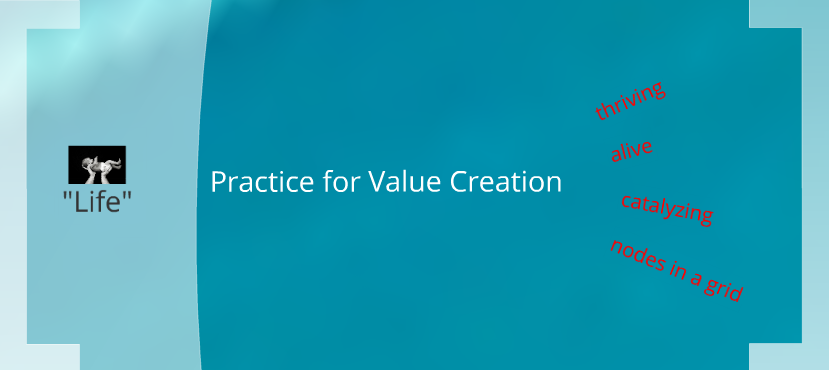
  • This space is called “Life”. This is where the new practices for value creation exist.
  • A community of cells upholds the space. These communities are self-organizing. These cells are built on the DNA of our movement.
  • The DNA of our movement is the platform of core principles that are the basis for us to connect, to practice, to embrace, and to inspire other to dream and make their dreams come true

DNA: A core (the common practice, the “commons” practices that cannot change, everything else can change. The DNA gives birth to cells. The cells can organize themselves.

They decide upon their own activities, their own resources, and their own relationships. And they always connect back to the mothership, the DNA of common core principles. Together, the cells create “Life” – our new global practice for value creation.

Our deliverables

We plan 8 types of deliverables:

  • Our manifesto
  • A common language
  • The 20 core principles of our DNA
  • A New Global Practice for Value Creation
  • A Belonging and Support program
  • A Discovery program
  • An Exchange program
  • A series of Events

I would like to summarize some of these deliverables:

The Manifesto

It has not changed really, but I’ll share it once more, as it, especially the “relentless” part of it, inspired so many people 😉

Relentlessly

Challenging the status quo

Breaking the rules

Saying the unsaid

Spreading the innovation virus

Seeding Tribal energy

With No fear

With a cause to do good

Leading by Being from our True Selves

Going after the un-named quality

Relentlessly

Common language, lexicon

It is our ambition to get buy-in and support from our corporate leaders for our proposed company transformations. We also want to articulate the direction. In a language clearly indicating the road from where we are today towards the destination we aim for. More specifically, we want to show the safe path and help our companies navigate from here to there.

This above is just a summary of some from-to destinations. The core group worked out a quite detailed and compelling list.

The 20 Core Principles of our DNA

We don’t want to be an exclusive club or so. It’s just in these early days we keep the group to 30 to be able to hack-out a first solid foundation. We will then throw it fully into the open.

But something needs to hold us together. These are the DNA principles of our practice. In the language section above you’ve seen that one of the to-from destinations is the journey from “Distrust as a default” to “Trust as a default”. Networks only work when there is trust. We want to walk the talk. When we will open-up our movement, everybody how signs-up is “in” by default. You will be “trusted” by default as long as you act in line with our 20 core principles:

  • Principle-1: We love our companies and want them to succeed in this high-velocity, hyper-connected world
  • Principle-2: We dare to be great
  • Principle-3: We have the mandate to be brave and to challenge the status quo
  • Principle-4: We reboot our corporate and organizational culture to install a 21st century, digitally native version.
  • Principle-5: We accelerate positive viral change from deep within the fabric of our organizations.
  • Principle-6: We enable and empower the rest of our organizations to move at rapid pace, but with room for patience and reflection.
  • Principle-7: We unleash the enormous potential that lies within every human being within our organizations.
  • Principle-8: We re-ignite the passion in our organizations.
  • Principle-9: We are actionable
  • Principle-10: We are building a global network of change catalysts that act from their true selves.
  • Principle-11: Our actions lead to new product and services and new global practices for value creation, agility and velocity.
  • Principle-12: Our community acts from deep personal awareness and presence, and an irresistible enthusiasm opening up old rusty structured.
  • Principle-13: We are architects and scouts into the future,
  • Principle-14: and we want to guide our organizations in navigating a safe path from now to then
  • Principle-15: We are very well intended individuals
  • Principle-16: We are united people with shared purpose starting with your own being
  • Principle-17: We maintain integrity and relevance of the reason.
  • Principle-18: We keep our community a safe environment, where you can become who you want to become. Where you are not alone in being a catalyst
  • Principle-19: Our core values are integrity, clarity of reason, brightness and great positive energy
  • Principle-20: Reflection, reporting back and adding-on to each others input and opinions is our natural way of collecting and discussing opinions.

New Global Practices for Value Creation

The core of our ambition is to create/let emerge a new Global Practice for Value Creation.

It’s “practice” like in Lean “practice” and SixSigma “practice”. However these are  for increasing efficiency in our organizations. We are on the innovation side. Innovation is less about “optimizing” the core engine; it’s more about new value creation.

Imagine having “black-belts”, “champions” in value creation and deep transformation of our companies based on our mission and principles. In the end, a company should be proud and outspoken of having x number of “black-belt Rebels” on board!

We want it to be global. From a meta-story perspective, wanting it to be something “global” that holds the values is probably one of the strongest thoughts of our movement.

We would like that these practices develop in a self-emerging way through the activities of the cells. Our expectation is that these practices are grounded in following principles:

  • Practice of Courage, Fear-is-not-an-Option, No fear to jump
  • Behavior/attitude: “Shift Makers”, “Accelerating Purposeful Innovation”, “Inside and Outside the company”, “Accelerators”, “Catalysts”, “Igniters”, carrying “The soul of Innovation”, “Re-Build”, “Re-Work, “Corporate Activists”, “Positive Deviants”
  • Emergent from the cells
  • Includes stealth approaches etc
  • Practices that lead to mastery
  • Focus on what works
  • Be part of curriculum
  • Certification levels vs. Reputation system
  • To be added as program to universities etc

In writing this blog post, it suddenly becomes clear to me that we found the sweet spot between “singing my own song”,  my loosely defined concept of a “New Value Movement”, and the irresistible enthusiasm of corporate rebels who want their companies to succeed in the 21st century by creating viral change from within.

What’s next?

I just sent a much more detailed consolidation of the 22 June London meeting to the core team. Given the summer holiday period we gave ourselves time till Mid August to co-edit all that material.

By somewhere mid-September our web site should be done.

We have planned our next face to face on 22 Sep 2012 in Providence, Rhode Island (USA), back to back with the BIF8 Summit.

Now in its eighth year, the BIF Summit has earned it reputation as “one of the top 7 places to watch great minds in action” (according to Mashable). The BIF Summit is an annual gathering of innovation junkies and transformation artists all in service of better – across industry, sector, and community. Eighty percent of Summit participants are senior executives; all are designing next generation business models. The summit provides participants with the space to be curious and crazy, get inspired, and collide with unusual collaborators. A shoe designer learns innovation processes from a car designer. A police officer teaches a business guru about transforming industries. This year’s storyteller line up features diverse system thinkers like Intel’s Brandon Barnett and ZipCar’s Robin Chase, Zappos CEO Tony Hsieh and the Food Network’s Simon Majumdar, GE Healthcare CTO Michael Harsh and Drupal Creator Dries Buytaert.

BIF8 is September 19th and 20th in Providence, Rhode Island. For those who want to move their inspiration into action, there is a third day, post-Summit Workshop on Business Model Innovation. This workshop is hosted and facilitated by BIF Founder and author Saul Kaplan and the creator of the Business Canvas, Alex Osterwalder.

Many BIF Summit participants come as teams from the same organization or affiliated group – using the BIF magic to challenge norms, inspire creativity, and think across disciplines. Recognizing how hard it is to bottle the magic, and harder still to operationalize it upon the return to business as usual, BIF offered us an interesting Team Package, helping us prepare for and act on insights and random collisions experienced at the Summit. Thank you BIF for your generosity.

The BIF8 conference is on 19-20 Sep 2012 http://www.businessinnovationfactory.com/bif-8

It’s probably around that time we will throw it into the open.

And in November, we’ll do some solid campaigning in the heavy event season with Innotribe at Sibos, Techonomy, Defrag and Blur. And back-to-back to that week, we plan our 3rd face to face on 17 Nov 2012 in Boulder, Colorado (USA).

For 2013, we already received a generous offer from the Australian AMPlify Festival to host one of our next coming together.

Hopefully by then, we’ll find some sponsors to cover some of the basic costs for keeping this going.

Some resources:

  • Prezi: some of the visuals is this post were created in Prezi. I did a talk at the EU Marie-Curie event in Brussels on 3 July that included our rebels story. That talk has 3 sections:
  • I am still maintaining a Scoop.it curation on Corporate Rebels United. As I am doing my daily RSS Feed reading, tweeting, etc, I am reading them with a specific “Corporate Rebels”-lens and put them all together in one place: http://www.scoop.it/t/corporate-rebels-united > check it out

Feel free to use and share it with anybody who can help and support our cause. Let’s rock this place together and let’s get a life / get alive ! And feel free to post events on this blog or contact me via mail or twitter.

“Corporate Rebels United” – the start of a corporate spring?

People call you an instigator, a protagonist, a renegade, a pirate, a mercenary, a rebel, or an empowered employee. We know you for what you really are: a change agent who sees speed, change and innovation as the new corporate norm. We know because we are you. We know the challenges – and the excitement – of driving change in an incumbent or start-up company. We know what it means to go for “The Innovator’s Risk”

We call ourselves “Corporate Rebels United”.

The concept of Corporate Rebels is not new. Many people have written about or have alluded to it:

John Hagel referred to the concept of the “Empowered Employee” in one of his recent Forbes posts.

The key answer that defines the post-digital enterprise is to shift attention from the cost side to the value side. Rather than treating employees as cost items that need to be managed wherever possible, why not view them as assets capable of delivering ever-increasing value to the marketplace? This is a profound shift in focus. For one thing, it moves us from a game of diminishing returns to an opportunity for increasing returns. There is little, if any, limit to the additional value that people can deliver if given the appropriate tools and skill development.

and

The post-digital divide will force them to choose sides – on the side of employee empowerment, or on the side of tactical cost cutting, job cutting, and diminishing returns. If not, the divide will choose for them.

But a Corporate Rebel has something extra. It is about daring to stick out your neck. It is about taking personal leadership.

Nilofer Merchant differentiated between a rebel and a leader

So perhaps we could use a more neutral word: protagonist. A protagonist is a principal champion of a cause or program or action. The protagonist does not wait for permission to lead, innovate, or strategize. They do what is right for the firm, without regard to status. Their goal is to do what’s good for the whole.

Lois Kelly (@loiskelly) from Foghound and Mike Maney (@the_spinmd) from Alcatel-Lucent also discussed recently whether the word “rebel” is not too negative. Mike made some very deep reflections why the hard dividing line between good and bad rebels does not always make sense.

Argument aside, we believe that – positioned well – the word “corporate rebel” exactly reflects who we are.

The aim of “Corporate Rebels United” is to create a global community of extraordinary corporate change agents. It is not an academic exercise or research effort. It’s something deeply actionable.

Our mission is to build the most amazing community of corporate rebels worldwide to ensure that true change and innovation happens virally

The initial idea for Corporate Rebels United emerged when innovation teams of Alcatel-Lucent and Swift met and worked closely in the context of Swift’s Innotribe program. We were excited by the exchange of ideas and energy that emerged when like-minded folks came together. And that got us thinking about some big “what if’s”:

  • What if we could create a tribe of the best and most exceptional corporate rebels worldwide – people like us, people like you?
  • What if we could start leveraging each other’s ideas, energy and best practices?
  • What if we could design a movement to support each other when the going gets tough?
  • What if we could cross-fertilize and infect our organizations with the change-virus from within?

We want to identify exceptional people worldwide that already have an impressive impact on change and innovation in their corporations, no matter in what field or industry. The movers and the shakers. The do-ers of today. The ones who take initiative. Who create deep change from within. People who energize their organizations by leading from their true selves. The crazy ones. The rebels. The troublemakers. The ones who see things differently, and who are crazy enough to think they can change the world. People like you.

Our plan is to start small – 15 founding rebels cross-industry – because we want to ensure quality and resilience in the initial starters group. We’d like to get the spirit right from the start. We have scheduled a kickoff call on March 30, 2012 with 15 founding rebels. We will follow that call with an off-site meeting where we’ll jointly build a set of agreed upon principles and a longer-term action plan to open and expand Corporate Rebels United to a wider audience.

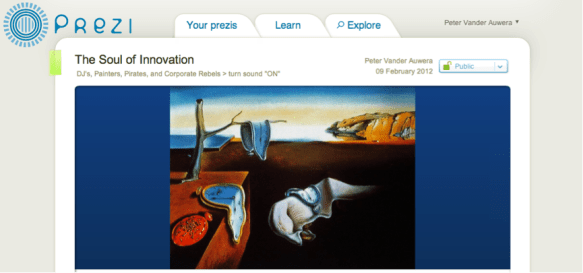
A lot of “getting the spirit right” was already included in one of my latest prezi’s on the “Soul of Innovation”. Without any publicity, this prezi already generated more than 3,000 hits in less than one month. We seem to have touched something that resonates. Some of it was withheld for my TEDxNewWallStreet talk last week in Mountain-View. Innovation is more than a set of tools and processes. Innovation is an attitude with tribal energy!

For viewing this prezi, turn audio “on”, as I experimented a lot with sound and visual landscapes.

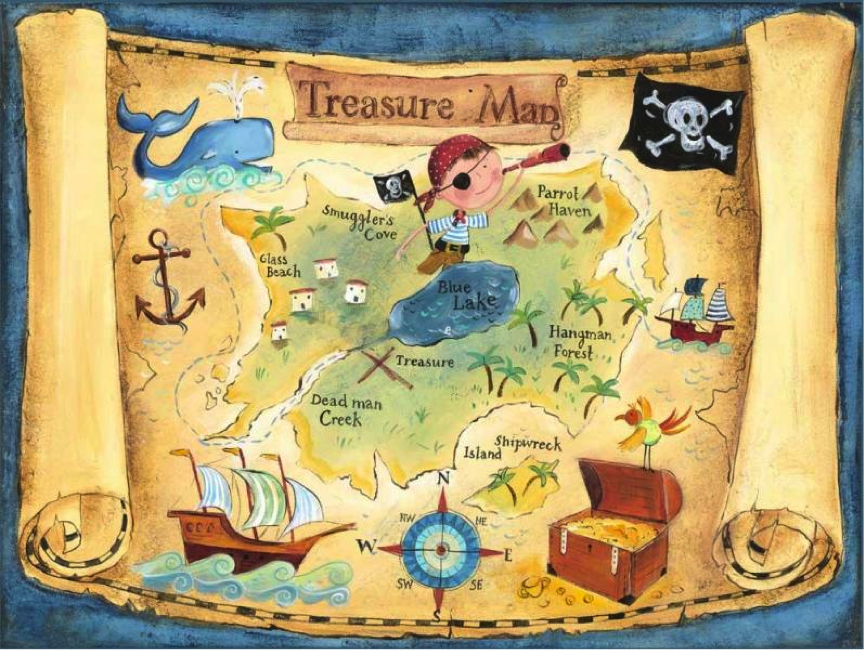
Somewhere halfway in that prezi, you will discover the Rebels Manifesto in the Pirates Treasure Map

Rebels Manifesto

Relentlessly

Challenging the status quo

Breaking the rules

Saying the unsaid

Spreading the innovation virus

Seeding Tribal energy

With No fear

With a cause to do good

Leading by Being from our True Selves

Going after the un-named quality

Relentlessly

What exactly Corporate Rebels United will do is the essence of our discussion at our kick-off call and event. Initial ideas include:

  • We want to build an action-driven community.
  • We want to create an incredible energy bomb of corporate change.
  • We aim for a very high level of integrity and authenticity. We want this to be morally, intellectually, and artistically right
  • We want to re-enforce the energy of known rebels in a non-zero sum community.
  • We want to identify and unleash the energy from the hidden rebels and the hidden pearls in our organizations and give them a voice
  • We want to create exchange programs between our corporations
  • We want to have deep positive business impact on the corporations and organizations that host and pay our salaries.
  • We want to create a culture in our corporations where change is the norm.
  • We want to measure the progress and propulsionwe make/create:
    • Individually
    • The folks we influence
    • The corporate change heartbeat
  • We want to evolve our corporations into places of constant change, resilience, responsiveness, reflection and vibrant energy.
  • We want to create a place for play, fun, rock, and rich personal expression

At the start, Corporate Rebels United will be a closed community: we’re looking for atypical people who make us go WOW!

Because they act from their true self and without fear, and make amazing change happen within their organizations and the ecosystems they are part of.

People with a moral, architectural, almost artistic integrity. People with a BIG innovation heart in the right place.

We’re looking for people who inspire us as human beings. With open mind, open heart, and open will.

Like Seth Godin said in his last book (We are all Weird):

“they have to be a bit weird”.

We plan to go full-steam as from our Kick-Off call on 30 March 2012, right after the start of the 2012 spring. Our ambition is to be able to shine and radiate as a strong community with first results by end October – Mid November, not co-incidentally the busy conference season with Innotribe at Sibos, Techonomy, Defrag and Blur.

Like Bill Gates wanted to see a PC on every desktop, and Eric Schmidt wants to see an (Android) mobile in every pocket, we want to see a corporate rebel in every company. That’s a lot of corporate rebels 😉

Of course, I am not Bill Gates, nor Eric Schmidt. But there is still enough room for a normal human being like me to create significant impact. And although I am 55 years old now,  I still want to change the world. And yes – at 55 – I still would like to instigate a Corporate Spring. There is no age for Corporate Rebels.

We jump and want to feel the daily adrenaline of being and coaching Corporate Rebels every day of our life.

As we get started up, get some inspiration on our curated site for Corporate Rebels United on Scoop-it.

If you are interested to join Corporate Rebels United, leave a note and some argumentation on why you’d like to join in the comments section of this blog post. And/or let us know what you can bring to the table to make this a big success.

As the Corporate Rebels United get up-to-speed, they will start blogging on http://corporaterebelsunited.wordpress.com and we will soon open our website at http://www.corporaterebelsunited.com

Let’s 21 March 2012 be the start of our Corporate Spring! Because we believe it matters to infect our organizations with “change-as-the-norm” from the bottom-up!

@petervan of the Innotribe team

Laura Merling (@magicmerl) and Mike Maney (@the_spinmd) from the Alcatel-Lucent team

Defrag2011: Mercenaries with a Soul

This was my second Defrag.

I attended Defrag for the first time last year in 2010, and it helped me spot 6 excellent speakers for Innotribe at Sibos: Jeff Jonas, Mark Dowds, Laura Merling, Dion Hinchcliffe, Doc Searls, and Stowe Boyd.  I contacted more Defrag speakers, but or they couldn’t make it, or I just couldn’t fit them in the already packed Innotribe agenda.

It’s a dream for me in my role as content curator for Innotribe events. But it is also one of the conferences that really helps me identifying trends in tech industry.

I tweeted the one-liner “once Defrag always Defrag”. Life permitting, I want to go every year.

Defrag is not a conference like any other. It’s a 2-day encounter of tech enthusiasts in Broomfield, close to Boulder, Colorado. It’s capped in number of participants: 325 max. The quality of the speakers, content and participants is excellent. Always a place to have great conversations.

It’s perfectly organized by Eric Norlin and his spouse Kim, and tuned for a modern tech audience: super quality video projection, awesome sound system (the organizers love playing lots of hard rock and metal music), power plugs on all tables, and a Wi-Fi system that is tuned to deal with 3 devices per participant. How good how good was Defrag’s Wi-Fi? Well, they had people downloading the new iPhone/iPAD iOS *in* the keynote room, and we did not notice any drop in quality! And everybody got a goodies bag so big that you have to buy a separate suitcase to get it all home. Eric’s super curation skills, his no-frills introductions of the speakers and his humble no-hero attitude completed the pack.

As usual, I will not make a chronological report of my impressions, but zoom into some of the highlights of this year’s conference.

  • For a very detailed twitter stream, check-out the tweet tsunami with hashtag #defragcon:  https://twitter.com/#!/search/%23defragcon
  • or even better, Matt Groeninger (@mgroeninger) compiled tweets for hashtag #defragcon during Defrag 2011 (11-3 to 11-11), cleaned it up for double entries, time-zone adjusted them and posted the whole lot as an *.CSV file here: http://bit.ly/u8Xppi . Thx, Matt! It helped me writing this blog!

Like last year, the conference opened with an awesome energizing video trailer. This year – the 5th edition – was no different.

Defrag Video: http://vimeo.com/31903004

That was great as a kick-start. Eric and team had decided not to have a specific overall theme for the conference, and I believe that’s a good change. However, after the 2 days, I saw some themes lurking behind all the great content: big data, APIs, the race against the machine, and inspiring new ways of work were recurring.

Opening by nobody less than Tim Bray from Google with a talk on “Mysteries of the Internet”

He was one of the speakers who did live coding as part of his talk, and it was the second time in 3 weeks that I heard the message that nobody really understands the Internet (first time was at Compass11 from Danny Hills from Applied Minds). “Don’t try to predict the future from the past” and “I want to be an explorer (of unknown territories)” were typical one-liners of this talk.

I have organized this blog under following themes:

  • Check your assumptions
  • Machines in charge
  • When presentations become art
  • How to run your company like a start-up
  • Philanthropy
  • Great conversations
  • Big Data
  • Pitch Alert

Check your assumptions

Sam Arbesman from The Kauffman Foundation pointed out that most facts change over time. There are few absolute truths. He introduced the notion of “mesofacts”, warning that “your reality is out of date” and that “whatever period we are born in we view as the state of affairs”. Facts (averages of facts) obey (mathematical) rules: half of scientific data changes in about two generations. Many of our decisions are based on outdated facts. “Are your facts up-to-date?” was the appropriate call for action for this talk.

Duncan Watts, author of “Everything is obvious, once you know the answer” explained that common sense is hat we rely on to navigate concrete, everyday situations. Unfortunately, we try to apply common sense or gut feeling for complex longer-term situations. In complex systems history never really repeats, history doesn’t repeat deterministically, so generalizations based on the past have limited utility. “Is the Internet to sociology what the telescope was to physics?” is a good summary.

Aneesh Chopra, CTO to the White House gave a passionate talk. The assumption that he challenged was that government officials are boring and non-inspirational. Oh boy, I was impressed by his in-depth knowledge on a broad set of technology matters, and the contagious energy he was spreading. Governments need more people like @aneeshchopra in public service. Do, don’t talk, innovate, don’t legislate, open government using big data, API’s, and crowd sourcing to stimulate innovation and entrepreneurship. Cool stuff.

Machines in charge

Robert Stephens was founder and CEO of Geek Squad until Best Buy bought it. Robert is now CTO Best Buy. “Every company should have a Robert Scoble” and “where is the AppStore for home automation?” were some good openers. He made clear that there is a whole market out there for repairing/supporting robotics, home automation, fitness, the Internet of things. On social media, his dream is to have NO social media response team, that every employee is connected and empowered. He also showed some “wireless hygiene stats”: how much noise devices cause in a Best -Buy shop. Towards the end, he made a shutout for #singly > VRM and locker project, and defended that bringing your own device to work (BYOD) works better than giving an employee their own corporate device.

Brad Felds (managing director at Foundry Group) opened his talk with an awesome scary app on Facebook http://www.takethislollipop.com/ > try it and make sure your Facebook locations are “on”.

For Brad, the machines have already taken over: they are very patient, come in many disguises. Machines don’t have to kill us; they are patient and can wait till we die. Still, he is an optimist and thinks that machines will like us and will help us. He urged us to change our mindset about who is controlling whom. Regarding the singularity, he does not care anymore when it happens, it’s happening already, and very fast. To my question “what values to we have to give our children to prepare for the age of the machines?” he answered to my surprise “nothing”. Kids younger than 15 years have grown up symbiotically with being connected, and will solve it themselves. Therefore, Brad remains optimistic.

When presentations become art

Lili Cheng from Microsoft Research surprised everybody with a beautiful presentation inspired by architecture, going back to her education roots: why did I like this talk so much? ;-). She was using the architecture metaphors to refer to the ideal structure of a city, and how that is inspirational to build social software that is flexible and creative enough to optimize big data. “Dance like no 1’s watching. Sing like no 1’s listening. Tweet like no algorithm is coldly deciding your social worth” or a modern implementation of “Why do we loose our child’s innocence along the journey of life ?” was a fantastic quote to make the transition to a great demo of Montage, a document editing package based on search and mixing all kinds of content: pretty cool. It is the first demo in many years that I see from Microsoft where they prove they are finally getting the web.

Already last year, Paul Kedrosky seduced me with his talk on “Ladders”, a great presentation on big data correlations. With Kedrosky, you never know where he is leading you till 10 min in the talk. This year was no different. He started by live coding in game ZORK, trying to get into the White House through the backdoor. At a certain moment in the game, he hits a location that is labeled “this page is intentionally left blank”, btw also the title of his presentation. You must be brave to drop the word “vacansopapurosophobia” (fear of a blank page) into an early-afternoon keynote 😉 In essence, his talk was about transparency and about vulnerability in being open: “I want to play a game but I don’t want to be gamed”. The blank page is a way to reassure us we are missing out something.

How to run your company like a start-up

There were some really cool presentations on new methods of work.

Jay Simmons, President of Atlassian had a talk on “Hack your company”. Some salient approaches included scoring based on performance and stretch, come up with an idea and ship it in 24 hours (yes, 24 hours!) and iPads at the entrance of work to survey employee satisfaction, instead of boring long surveys.

T.A. McCann, Founder and CEO of GIST charmed everybody with “A startup Start to Finish”. In his opinion great people, aligned passions, and complementary skills are the secret sauce for startups. The HOW is as important as what: he suggested to operate your start-up like clockwork: 18 month horizon, 6 month goals, 3 month plan, 1 month themes, 2 week sprints.

Adrian Cockcroft, Cloud Architect from Netflix blew everybody away. In essence this was a great talk on innovation and on Netflix’s corporate culture. He made clear that the one R&D or Innovation center does not work, is not taken serious by the rest of the company and how incredible hard it is to change corporate culture in a big organization: he implied it’s impossible. I loved his quote “For innovation to happen, you have to get out of its way”. His list of corporate culture attributes was mind-blowing: they only hire senior people, have no coding standards (peer pressure works fine). They don’t have a CIO and their IT staff only supports employees. They push out code, as needed, several times a day, and not “the old way”, the 2-week train like at eBay. One and the same persons now do project manager, line manager, and architect. Prima donna’s are expelled by group pressure. There are no bonuses, just flat and very competitive salaries. And they have monthly stock options at the current price with instant vesting. Fascinating. With his grand-finale “we only hire rockstars: do you want to be in the audience on part of the band on stage?”, any professional should be attracted to check out the open positions at Netflix 😉 Post event @matthixson posted a link to a slideshare about the Netflix culture. It’s great and I recommend it to all, especially if your company is reviewing motivation, appraisals, etc.

I was trying to invite Adrian to Innotribe at Sibos 2012, but could not yet convince him. A couple of days after Defrag, I had a call with Kaliya Hamlin @identitywomen on an unrelated subject, and she asked me how Defrag went. She said that the people who know Innotribe should make a invitation blurb to help us convincing folks who do not immediately see what’s in for them to talk to senior banking executives: Innotribe is different, cool, engaging, and no better ambassadors then those who experienced. Great idea, Kaliya! Thx!

Laura Merling from Alcatel-Lucent was brilliantly comparing the aspects of a business to 5″” stilettos and making a plea for women in business and tech: “it’s not about whether you’re male or female, it’s about whether you’re the right person for the job” almost got a standing ovation. “Build a culture, create a business tribe” sounded as music in my Innotribe-ears. Her presentation used a strong metaphor of boots/shoes, and it was not just a gimmick: the boots have a sole/soul, and mentioned innotribe as a role model. Slides here. http://www.slideshare.net/llm007/five-inches-of-fabulous-defrag2011

Sam Ramji was great during one of the API break-outs: “I am a mercenary, not a missionary” on question whether API intermediaries should refuse non-standard OAuth.

And Dion Hinchcliffe joined JP Rangaswami @jobsworth when he stated “design for change, design for loss of control”

Philantrophy

Matt Galligan showed how even start-ups can contribute to a better world via philanthropy.

His initiative “1% of nothing” lets start-ups engage with 1% of their equity. It is called “1% of nothing” where nothing is equity of a startup that us not (yet) worth anything

Great conversations

I had some great conversations with Sam Ramji and Anant Jhingran from Apigee. I have invited them to do a brown-bag session for all staff, next time Sam is over in Europe. This setting is btw possible for any company that has something innovative to offer that falls within our strategic objectives.

I also had some in-depth chats with digital identity folks Ian Glazer (Gartner Research), John Fontana (Ping Identity), and Drummond Reed (Connect.me). The day after, I was already invited to the Cloud Identity Summit in July 2012 to talk about our Digital Asset Grid (DAG).

And it is always fun to brainstorm with Laura Merling and Mike Maney from Alcatel Lucent. We believe there is some fertile ground to join forces, and to do something around a crazy idea of “Rebels United”. More about that for sure in one of my subsequent posts

Big Data

Last but not least, almost all talks had “big data” in them somewhere. It became almost annoying at some moment in time, especially when there was a presentation specifically trying to prove that this was the latest buzzword, and becoming as generic and meaningless as “social media”.

Pitch Alert

On a very few occasions, there was “pitch alert”. And one of the sessions on policy really could not inspire me. The last talk was – at least in my appreciation – a bit “thin” in content (speaker was ok), and I would have preferred to end on a real high, like the conference started.

Post conference, I had some great chats with Eric Norlin. Maybe I’ll get a chance myself as a Defrag speaker next year: I am working on a brand new prez on “the soul of innovation” based on the attributes of DJ’s, Painters, Pirates and Corporate Rebels”. It’s work in progress, and I am experimenting with sound, video and image landscapes as part of that presentation. Would be nice having a European flavor into the Defrag conference 😉

Two days after the conference, I saw a tweet from Eric Norlin: “had a break-thru moment last night about how to improve the defrag agenda/structure in a discussion w/ kim. can’t wait for 2012.”

Same here. Can’t wait for 2012. Already note down the dates for next year’s edition: 14-15 November 2012. If you go, you will not be disappointed. See you there!