Broken Will

Good morning, Vietnam !

Bad start of the day. Have a terrible cold. Did not sleep well. Outside; it’s 1°C, windy, humid, and dark. Again, i woke up angry.

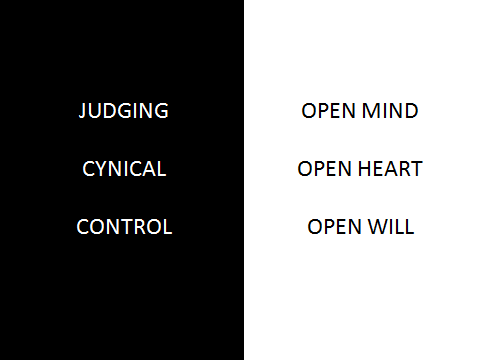
Was thinking about my previous post “Emotional Zombies”, where i wrote about Open Mind, Open Heart, and Open Will.

image

Open Mind, Heart, Will is based on the work of about Theory “U” by Otto Scharmer.

It’s a book about presence, and how – if you dive deep to the level at the bottom of the “U” – you will discover your true purpose. The subtitle is “Leading from the future as it emerges”. Now you know where i got the title of this blog.

In “Emotional Zombies”, I also wrote about the golden cages.

I recently discovered it can get worse. Much worse.

It can get to the stage of BROKEN Mind, BROKEN Heart, and BROKEN Will.

It remember somebody quoting about education just 50 years or so.

In the family instruction books of that time, the general sense was that the parent had to break the will of the child as early as possible in the education of the child, to ensure that the child would be fully under the parents’ and teachers’ control. Luckily, education has evolved, but you get a sense what it means to break somebody’s will.

To further explain that feeling of Broken Will, i will tell a true story. When i was studying architecture (yes, building houses and so) at the art school in Brussels, one year we had to design an art exposition space. We also needed to make a maquette of it.

I worked on mine for days and nights. It was made of the finest balsa wood, and the construction was made of hundreds of mini balsa pillars. Oh boy, was i proud !

Then the jury comes along. The judging was a session in full public where the other 200 students could follow the judgment of the pros.

Professor Jonckers – i even remember his name after 30 years ! – looked at my piece of art. He smiled dangerously and said: “Let’s see if this thing is also as solid from a construction point of view as it looks like” and then he demolished the whole thing by shooting with his fingers all 100 pillars into pieces. I could have kicked him in the face (i should have done it).

That hurts. It hurts when your piece of work gets demolished. It hurts when your contribution gets ignored. It brings me in my state of “Broken will”. Its an emotion beyond broken heart. It cuts deep.

This week, i mourned my broken will.

And what about the cage ? I suddenly remember a line of a poem: “she smiled gently when she discovered that the door of the jail was already open for some days”

Body Part Maker

In the current economic climate, one restructuring follows the other. In my country there are some notable examples like AB Inbev, Opel (GM) Antwerp, HP, etc.

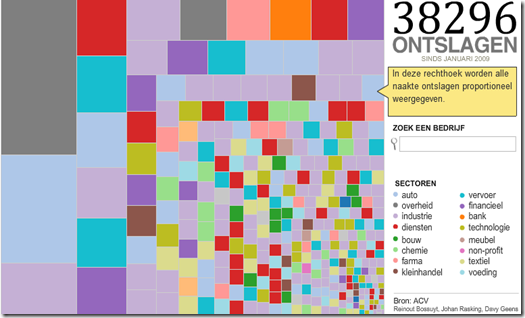
At the time of writing this post, the counter of lost jobs in Belgium since January 2009 stood at


38,296


lost jobs


And this is “only” from structured and collective redundancies. The following table comes from quality newspaper De Standaard. The visualization also represents what sectors “contribute” most to these redundancies.
image

It’s therefore “normal” that i see/meet/mail more and more friends and (now ex-) colleagues being hit by the recession, crisis, or whatever you prefer to call the current economic climate and resulting restructuring or transformation programs. It happens everywhere. Except at the one employer i ever had that still today shows double digit growth.

However, some of these friends were living in Golden Cages for years but were bored to hell. The shame is that they let this happen over them. Others indulged all sorts of manipulations, political maneuvers, and other techniques that did not take them for full or were just ignoring them and their ideas. Others just had the courage of sticking out there neck, but not being appreciated by the blueprint and/or differing too much with the “normal way of doing things here”.

Indeed, it seems recurring many companies that diversity in thoughts is not always welcome, despite all the window dressing about values etc. That is of course a pity, because this diversity in thoughts and ideas is fundamental to being innovative.

And it happens everywhere. Except at that one record retailer. They seem to be some kind of Tribe. Have always been since the 60’ies, with self-development programs and alike. They also continuously innovate. With green IT and own windmills etc already 10 years ago. “Cradle-To-Cradle – Remaking the Way We Make Things” applied before the book was written.


So it’s all about sustainability, made possible through R&D and Innovation in new sciences and technologies. And being part of a tribe that has innovation in its DNA. See also later in this post when we discuss the jobs and trends of the future: science and technology are at the heart of the sustainable development debate.

However, if you’re not part of such a tribe, and you get fired where you were bored, then there is light at the end of the tunnel. Getting fired could really be a fresh start of your professional life, although somebody else made the decision for you.

Have a read at “The Living Dead: Switched Off, Zoned Out – The Shocking Thruth about Office Life” by David Bolchover.
Joe read the book and here is his review:

This book is about – the millions of talented and bored to tears people rotting away in large offices, completely disconnected, disenchanted, disengaged, shuffling papers away, staring at screens, writing memos and Powerpoints, sitting in meetings deliberating in jargon that means nothing, and generating serious pretend-work….

and how our world and organizations have made this a taboo topic, refuse to recognize its existence and aggravate this problem through inadequate structure and processes (specialized business jargon, office politics, hierarchy, etc).
image


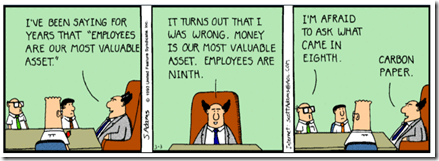
This is one of the most blunt books I’ve ever read – a Dilbert with the sharp facts substantiated! And you will not find one business jargon word that can qualify for a b-sh**t bingo in there.

The most interesting part is that the book is written already 5 years ago – and looking at Peter Van’s blog and the book gives a clear indication of a very alarming trend. Not for the weak-hearted! Contains some seriously ego-busting words on our Great Leaders ( the big companies CEOs) and Even Greater Gurus (the Management book writers).

What would you do if you got fired ? What would be the one thing that you would like to do for free for the next 10 years ?


Could give you a real good indication

of where your true

passion and purpose is.


But where to look first ? The report FastFuture.com report “The Shape of Jobs to Come” (Final Version January 2010, you can download the PDF here) would be a good starting point.

image

The report lists the 100 most likely jobs to emerge and be successful by 2030. Some of these jobs will already see the light as soon as this year 2010.

And if you have the luxury to take first take a couple of months sabbatical, then the report has in Appendix-3 an excellent time-line on what will happen when, what skills you need to master by when, and what the most probable and most looked after jobs of the future may be.

The outcome may be that you may want to follow some course on NIBC convergence technologies. (NIBC = nanotechnology-biotechnology-information technology-cognitive science) or to study Chinese, Spanish and Portuguese if you want to mean anything in the economies of growth of 2015.

Some extracts with – as usual – some personal comments.

For the longer term, the centrality of science and technology in helping to tackle the most pressing planetary challenges from poverty to clean water, environment to human health, climate change to energy supply and housing to transport are ensuring that science and technology are at the heart of the sustainable development debate

Finally they are expected to help us survive and thrive in the cyber world, whether through legal protection, counseling or management of our virtual data and ‘personal brand image‘. As a result, the survey suggests that many of these roles will be popular, well-rewarded and aspirational.

The ten key patterns of change identified in the report are:

1. Demographic Shifts

2. Economic Turbulence

3. Politics Gets Complex

4. Business 3.0 – An Expanding Agenda

5. Science and Technology go Mainstream

6. Generational Crossroads

7. Rethinking Talent, Education and Training

8. Global Expansion of Electronic Media

9. A Society in Transition

0. Natural Resource Challenges


Looks like the list we suggested for our Think Tank on Long Term Future 😉

Under “economic turbulence, we find:

Further economic turbulence and potential downturns between 2010 – 2020, followed by a more stable period to 2030 as excessive risks have been removed from the financial markets and most economies have repaired their finances

Out of the list of 100 future jobs, i personally liked very much: the body part maker, the teleportation specialist, the currency designer, the non-military defense specialist, the director of responsible investments, the mind reading specialist,

Take the Body Part Maker (possible emergence as a profession: 2020, that’s only 10 years from now !):

Due to the huge advances being made in bio-tissues, robotics and plastics, the creation of high performing body parts – from organs to limbs – will soon be possible, requiring body part makers, body part stores and body part repair shops.

While a typical organ such as a liver or kidney might be grown, other parts such as an arm would involve the complex integration of a nano-engineered skeleton, high performance robotic joints, fibre-optic nerves, artificially grown skin, synthetic flesh and muscles.

Or the Memory Augmentation Surgeon (emerging profession in 2030). It really reads like Ray Kurzweil’s “The Singularity is Near” (book written in 2005 !)

This is a new category of surgeons whose role is to add extra memory to people who want to increase their memory capacity. A key service would be helping those who have literally been overloaded with information in the course of their life and simply can no longer take on any more data – thus leading to


sensory shutdown


Although the job descriptions are somewhat funny and even “cute”, the real value of the report is in its Appendices: they hide a wealth of trends for 2030.

Truly amazing. If only 10% of this becomes true, the world in 2030 will look quite different from 2010. Especially Appendix-2 is a summary of all things you should be aware of as 2015 approaches. Appendix-3 shows a very comprehensive timeline per trend.

It is in these Appendices that you can learn for example about Generational Cross-Roads:

The challenge for employers will be to create an environment where each group can feel valued and be effective. Indeed, a Randstad USA survey found that 51% of baby boomers and 66% of the generation that preceded them reported having little to no interaction with colleagues from Generation Y.

What is your company doing to get these young generations

deeply into your workforce’s DNA ?

And about Society in Transition:

Higher ethical standards and a sense of the greater good are two of these evolving trends. Increasing expectations are concurrent with a decline in trust of key institutions.

“Higher ethical standards…”  See also my previous blog post on Ethical Re-Boot.

About Evolving Technological Ecosystem, the appendices reveal that:

Handheld devices expected to become the control centre of a rapidly expanding personal ecosystem – where projection / pullout screens and keyboards could accelerate laptop replacement. Key enablers include augmented reality, intuitive interfaces, semantic computing and the increasing embedding of intelligence in a range of devices – often known as ambient intelligence or IP Everywhere.

What is your company doing to get these technologies

deeply into your innovation DNA ?

And about Quantum Cryptography that:

In “traditional cryptography” the data itself is encrypted using complicated mathematical functions. In “quantum encrypted communications”, a key is sent by beaming a string of photons, representing a code, from the source to the target. If it gets to the other end and matches what the target expects, then the data gets unencrypted. The Guardian notes that if anyone tries to intercept or break it, thanks to the laws of quantum physics, the mere act of observing the stream of photons changes it – and so it fails

If you company is doing something related to internet security

your strategy for the next 5-10 years

should have some bullets and focus on this.


And it is not always about throwing another GUI at your application. Have a look at this article that suggest that Mind and Square are NOT innovative and the true meaning of innovation in financial services lies in the plumbing, not the UI.

Remember my discourse about Innovation at the Core vs. Innovation beyond the Core ?

And then there is a section on R&D and Innovation trends. Most countries and regions seem to invest more in Innovation:

R&D Takes Centre Stage: Germany is investing EUR900M by 2010 to fund R&D projects commissioned by medium-sized business and EUR65M to expand and develop research infrastructure. Norway is set to increase its Research and Innovation Fund capital by EUR685M and create over 200 new research positions each with EUR90,000 funding. France is committing EUR731M in 2009-10 to refurbish universities and research institutions. China’s 10Tn Yuan 2009-11stimulus package includes major investments in science and technology, including "key research projects related to enlarging the domestic market.‖ (University World News).

And where is Flanders ? The Flemish Government decided to REDUCE the budgets for Innovation and R&D for the next couple of years ! And some companies plan to do the same in reaction to the economic climate.


Reducing your innovation budgets

means the beginning of the end

It means that you don’t believe

in the future

of your region, company or project.


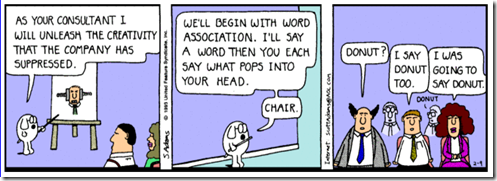
Calling in a bus of consultants to tell you how to innovate will not work. First check out How real your Innovation is. And start from there. Especially if your company has a culture of incremental innovation.
image

We have to invest now. As mentioned before, i believe this requires a private (non-public) initiative. Many public – government driven – initiatives seem to lead to lots of consensus and compromise, often leading to a watered down vision, or no vision at all.

I was – and still am – hoping that our Think Tank on Long Term future can kick-start this private process.

Let’s also watch-out for the Belgian Presidency of the EU for the second half of 2010. I heard they bring on board some really smart people that can make the difference. Hopefully we get in the news because we really could make that difference, rather than through scandals about drunk MP’s.

If not, we may have to start imagining a miserable future in 2030 where we will be feeling like in 2010 without Internet (kicked into our lives around 1995 for most of us).

So, if you are/get fired, the next best thing to do is probably to look into the direction of your purpose and to surround you by the people of the right tribe. Those that make you live longer not shorter. Those that truly bind not seek conflict. Those that want you to succeed, not fail. Those that are capable of saying yes, and have not been trained to find the “no”.

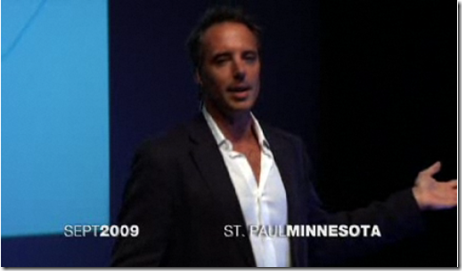
For further inspiration about being mentally healthy and finding the right tribe, have a look at this TED talk by Dan Buettner on “How to live to be 100+”. With thanks to the friends in Iceland for spotting this one.

Or you may just not even make it to 2030 !
image


Reblog this post [with Zemanta]

Cubicle 3B23: Our company is infected !

image

This week, our small innovation team got the opportunity to design and animate the department’s “All Hands”. In stead of doing the boring “we-tell-you-and-you-listen death by PowerPoint” session, we split the group in 8 break-out sessions. Each team was randomly selected, and the managers were NOT allowed to lead the discussion.

Each team had 45 min to come up with a 5 minute pitch of one of the 2010 priorities of the department. As if they would have to sell that opportunity/idea to a Venture Capitalist. A bit like a short version of the Innotribe Labs at Sibos last year.

Before this meeting, some managers were skeptical whether all folks would be able to fully participate, contribute and let their creative juices flow.

But – as you all know – creativity is a bug that is implanted from birth in every human being. And getting back to this feeling of “playfulness” is oh so important and enjoyable.

There is playfulness and there is purity.

It’s the purity of my 4 old year daughter. Full of energy, creativity and fantasy and anything is possible.

It’s the purity of your true self. If we can tap into that energy, unbelievable things happen.

It’s all about passion and drive, and what motivates us

“Drive” is btw the title of Daniel Pink’s latest book.


It’s about “the surprising truth about what motivates us”. And Daniel Pink explains it’s NOT measurement, KPI’s, bonuses, perks, etc. It’s about belief and being believed. And knowing that management does never doubt people’s abilities.

So, we got 8 idea pitches of 5 minutes followed by a Q&A of 2 minutes by the audience (not by the managers). I can assure you, i saw a lot of fun and smiling faces, and people getting energized.

And it is something very infectious.

image

The day after, I got a chat from another Cubicle on the other floor:

It feels good to be able to think out of the box. Really refreshing ! If you guys succeed in changing only a little but the “sub-culture” of the company, and wake up gently the people from their winter-sleep, that alone would be a big success ! And that will be needed, if we want to keep our company relevant on the long term.

Yes, this is about passion. Yes, this is about enthusiasm. Combined with purity, this is a very contagious, irresistible cocktail.

image

This is not new. It’s off all ages. It works for young and older humans. Have a look at this TED Talk from November 2009 TED India, just posted on the TED web-site. Kiran Bir Sethi from the Riverside schools explains how contagious the “i can” bug is.


image


It’s about children taking charge of their own destiny.


image


Its about


being aware and feeling the change


enable to be changed


empower and lead the change


leading by being


At the end of the TED Talk you see how children teach their parents to read and write. In professional life this is called


reverse mentorship


All this is VERY relevant to Innovation and how “real” your company is about innovation. You need to inject the purity of young people. New blood. Let them rethink the strategy for the next 5 years. And then take it to the next step. And let those young people reverse mentor the older generation.

Next time check out the average age of your employees. And ask yourself the question: do we have the open mind, open heart, and playfulness to indeed radically innovate this company ?

  • It’s about maturing from the stage where “the teacher told me” to “i can lead this myself”
  • It’s about not waiting anymore and following your own compass.

Like Joe told me after the meeting:


“I am not waiting anymore


to be called”


m01_16895561


When are you going to wake up and recognize your full potential ? Your potential, your team’s potential, your company’s potential ?

When will you start protesting, because you know your company sits on a goldmine, and every day that passes, it gets suffocated in end-less political debates with many off-sites leading to no conclusions.

How much longer are you going to waste your time ?

How much longer are you going to take this ?

Open your hearts and minds to the purity of the children and go ! Who will follow ?

Are you ready ?


image


If  not now, then when ?


If not us, then who ?


The bug has landed. It has infected our company and the infection spreads.

Big time, i believe this time

Reblog this post [with Zemanta]

If you can’t manage, measure

I was just reading my Sunday newspaper online,

image

and found this great summary by Gilbert Roox about Matthew Stewart’s book “The Management Myth: Why the Experts Keep Getting it Wrong”

The article is in Dutch, so i decided to use Google Chrome’s Translation extension.

image

So, here are some translated extracts, SLIGHTLY edited as the Google translate result was quite accurate. Impressive.

The management myth is a hilarious review of ten years in the Belly of the Beast. All the tricks of the fair will pass in review. For a client to win, you hunt him the fright. Then make themselves so indispensable that you no longer can think independently, and then they press the lemon patiently. “You should compare consultants with parasites” says Stewart. "I talked and talked, and meantime the meter ran,"

In all these years, the sensation that I sucked everything from my thumb never left me." Bruce Henderson, founder of the Boston Consulting Group, once described the consultant business as "the most incredible business on earth:"

Successful and leading companies hire school leavers to tell them how they should be run. And those companies are also prepared for those millions of opinions count down? "

Stewart called the pundits of McKinsey & Co “Modern shamans” : in the highly uncertain world of global competition drive them to fear the magic of their spreadsheets and charts. "If you can not manage, measure it," writes Stewart – a sneer to the home of McKinsey motto: "If you can measure, you can also manage".

Among the most successful CEO’s of Fortune 500 does not have an MBA fourth title. Success in business is simply not a hard science. Roughly revolves around three things: luck, you work hard and seize opportunities. Even then it can go wrong. But with such wisdom farmer earns a living not a management expert.

Management gurus such as Peters and Jim Collins(Good to Great) posing as prophets like, but after closer inspection they appear mainly to be the specialists of the past. They promote experimentation and out of the box thinking, while their best sellers but only document worn paths. A good advice: if you want money, then do just the opposite of what management gurus say, advises Stewart.

Management gurus seem more like religious preachers. The world they paint is invariably chaotic and uncertain, because fear sells. Bureaucracy is the great evil, and they call for a white collar revolution to overthrow that. Repetitively, they tell the poor middle class to thunder, because "you have the power".


Success is about passion;

imagination

and perseverance


With his plea for excellence the guru paves the path of a crazy work ethic that “starts with the notion that work can be meaningful, and that thought is stretched to the point where outside work is no longer significant”.

While most people only work

for a good bit to live

Hence the remarkable opinion of Matthew Stewart to youth who want to get an MBA:

"Stay away from the business schools

to study philosophy rather

to know the real life"

"In business, experience is the great teacher. We deceive ourselves if we think that an MBA makes you an energetic manager. Managers learn to manage not very different from teaching people how to live in a civilized world.

Managers do not need training,

they have educational needs

I just ordered the book. Looks like some good counter-weight for the other stuff i am reading, and will prepare me for the Lean exercise that our Innovation Team will go through as from begin February 2010.

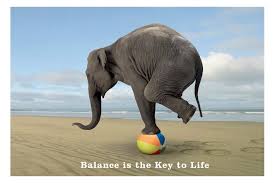
The balance is probably somewhere in between.

Blogging Innovation’s Top Ten Innovation Articles of 2009

Hurray !

I am one of the 3 winners of Blogging Innovation’s contest to identify the Blogging Innovation’s Top Ten Innovation Articles of 2009.

Good start of the year: I will get a copy of Gary Hamel‘s latest book "The Future of Management" 😉


Thanks Guys !


The least i can do is share with you the results of the vote for the best articles, and once more recommend you to subscribe to this great innovation blog.

image

Here in no particular order are Blogging Innovation’s Top Ten Innovation Articles of 2009:

Happy reading and innovating in 2010 !

Reblog this post [with Zemanta]

HR and Innovation

In my previous blog “Brand, Workforce and Innovation”, i started making a case for a leadership role for HR in Innovation.

I wrote:

I’d love to see more HR in a true leadership role. Leadership as opposite to management in its narrow definition of executing a course set out by somebody else. See also below the very important message about the role for HR in creating the eminence of our workforce.

Checkout my previous post on what is meant with “eminence of our workforce”.

Rowan-blue-background124

I would like to mix this with some thoughts from Rowan Gibson recently on Blogging Innovation. His full posting can be found here but i will explore some key findings below. Rowan Gibson is the author of “Innovation to the Core”.

UPDATE: what a co-incidence. Just today, Rowan Gibson did a new post in essence giving a one-page summary of his book. Here is the link to “Do you have a Corporate Innovation System?”


Innovation to the core” is about putting

radical innovation in the core of

your organization 


and is not to be confused with the discussing

Innovation in the core or beyond the core

of your product portfolio

UPDATE: “Beyond the Core” is a book by Chris Zook, and is based on the principle of adjacencies. It seems to be the bible for anybody not wanting to do anything beyond the core. It dates back from begin 2005, and is in my opinion completely outdated as a guide for innovation.

Rowan says in his blog:

In essence, that means developing a particular mix of resources, processes and values that makes it hard for rivals to match what the company does.

This has to do – amongst others – to create this eminence in the work-force.

But it is much more.

Lastly, i was attending one of our company meetings, and our CEO was doing a pitch on the focus of innovation in 2010. Great to have your CEO on board to get innovation rolling ! Really, it makes a big difference. But at the same time, the company runs a 2-year lean-program to build greater efficiencies in the company processes.

In French, we call this “Le grand écart”.

kim

It’s difficult, but not impossible if you’re fit and trained.

People do not understand this, cannot digest, don’t see the big picture, as the efficiency programs are much closer to their daily lives and – most of all – their jobs.

You could see the glaze in the eyes of some folks when we were talking innovation after having explained the lean-part.


As long as we do not succeed as positioning innovation as “buying our future”, as essential to building the greatest workforce on earth and giving the people the possibility of being part of that – with reward mechanisms – we won’t succeed in those apparent conflicting objectives.


Rowan Gibson goes on:

Making innovation a systemic organizational capability is a complex and multifaceted challenge. It simply cannot be solved with some Band-Aid or silver bullet. Instead, it requires deep and enduring changes to leadership focus, performance metrics, organization charts, management processes, IT systems, training programs, incentive and reward structures, cultural environment and values.

It’s not “good enough” to have your CEO on board. You need the full buy-in of your full Executive Committee, and – in a more complex co-operative organization like SWIFT – the buy-in of your Members, represented by the Board. We still have a lot of work to do, but i believe we are getting there. Innovation is now getting at the agenda of those deciding constituencies.

What i have not yet seen is a focus on how HR can help and be instrumental for innovation.

What companies need is not merely a pro-innovation mindset, or better brainstorming techniques, or "hot teams". It’s about making innovation a new organizational way of life; something that permeates everything a company does, in every corner of its business, every single day. It’s about infusing the entire lifeblood of an organization with the tools, skills, methods and processes of radical innovation. That’s the true imperative for rethinking the role of Human Resources. As soon as we recognize the strategic value and the immense organizational transition that’s involved in building a corporate-wide innovation capability, HR automatically moves to center stage.

And what would be the role of HR in such an Innovation context ?

Who else but HR leaders would be capable of turning a company’s strategic intent with regard to innovation into tangible everyday action? Who else could make the necessary changes to executive roles and goals, political infrastructures, recruitment strategy, broad-based training, performance appraisals, awards and incentives, employee contribution and commitment, value systems, and so on? Who else could build and foster the cultural and constitutional conditions – such as a discretionary time allowance for innovation projects, maximum diversity in the composition of innovation teams, and rampant connection and conversation across the organization – that serve as catalysts for breakthrough innovation? Who else could ensure that each employee understands the link between his or her own performance (as well as compensation) and the attainment of the company’s innovation strategy?

In short, who else but HR

leaders could create a company

where everyone, everywhere,

is responsible for innovation

every day whether as an

innovator, mentor, manager, or

team member?


I have become a big believer that companies need an innovation system where


everybody in the company

becomes an innovator


It’s almost a human right of any employee in a company, i would even venture it is a moral obligation for any employee in a company to be an innovator himself. It is NOT the sole privilege of the innovation team to come up with ideas, on the contrary. See in this context my previous blog on The Holy Fire.

Rowan Gibson has a great closing in his blog post:

The sad reality is that too many CEOs overlook HR’s potential in this regard. They still think of HR solely in terms of regulatory compliance, hiring and firing, employee comfort, compensation and benefits. Notably, Jack Welch, illustrious ex-CEO of GE and arguably one of the greatest corporate leaders of our times, sees things differently. In a recent column in BusinessWeek, he writes that


"every CEO should elevate his

head of HR to the same stature

as the CFO."


Hope somebody reads this.

2009: the year of Darwin

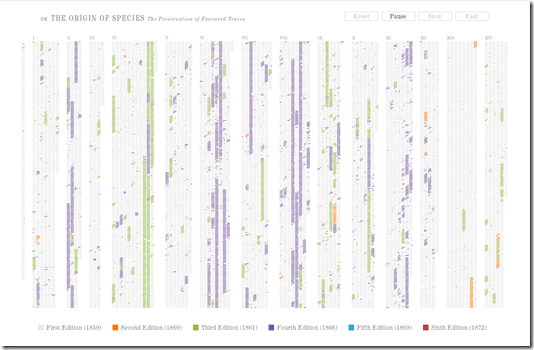
Listed as best visualization of 2009. The evolution of The Origin of Species. Link here. It takes a couple of minutes to download. Mind you, the whole thing is clickable.

image


Other great 2009 visualizations at

image

Change your worldview

My absolute #1 Book recommendation from 2009 is “The Age of the Unthinkable” from Joshua Cooper Ramo.

The essence of the book is that to be able to cope with the new game future, one has to change his worldview and look at the whole and not only the pieces.

Below is a good – completely unrelated video – that gives you an aha experience on changing your (world) views.

Nothing is what it seems to be…

Enjoy.

image

CHOP CUP from :weareom: on Vimeo.