Sometimes, the silence of the sacred and the touch of chance awaken something deep within.
This is what happened to me when I once again found myself confused by beauty, when visiting the Stefan Vanfleteren exhibition “Transcripts of a Sea” in the Museum of Fine Arts in Ghent.
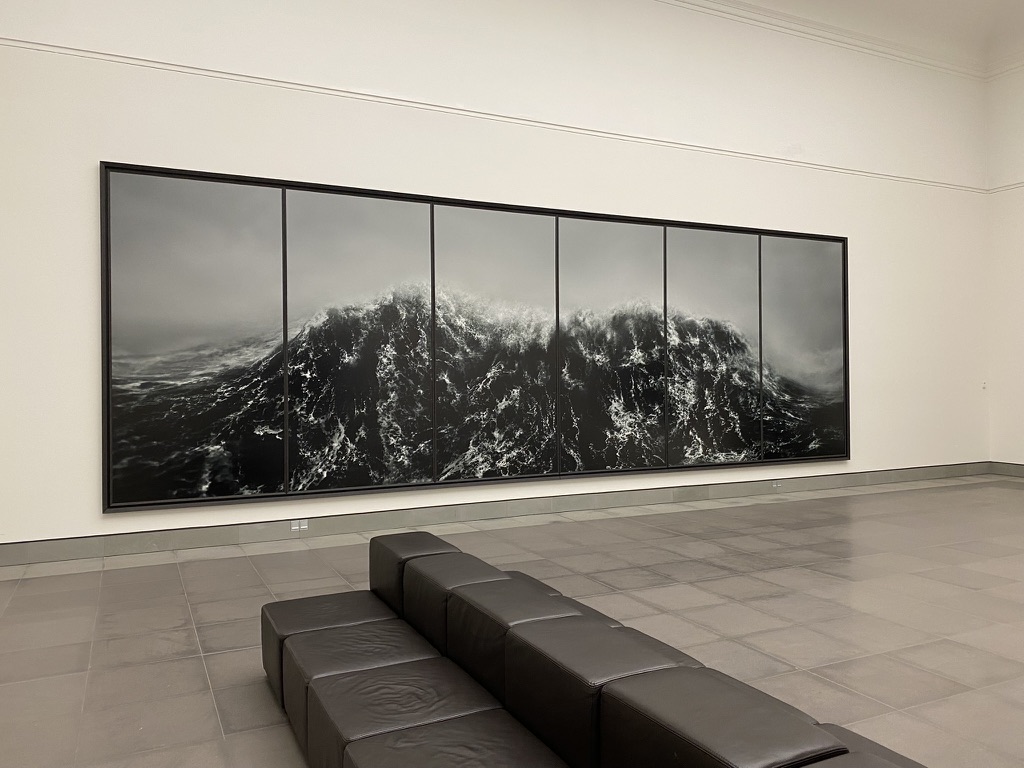
“In 2020, photographer Stephan Vanfleteren embarked on a challenging project that culminates in the exhibition Stephan Vanfleteren. Transcripts of a Sea at the MSK Ghent, during autumn and winter 2025. The exhibition is the conclusion of a long quest, not only into the depths of a body of water, but also into the essence of artistry – Vanfleteren’s answer to what complete artistic freedom can mean.”
You can find good-quality pictures on Stefan Vanfleteren’s website. That page also includes some paragraphs about Vanfleteren’s practice and his approach to this project. But the experience in the museum is way superior.
First, there is the silence. When you close the door between the entrance hall and the exhibition space, the noise of the city is cancelled, and it feels like you are entering a sacred space. The silence also slows you down. Your steps are more measured, respectful. Your breathing adapts.
Second, there are the artworks. Huge, super high-quality photographs of the North Sea. Most black and white. They radiate the same sacredness as the paintings of Gerhard Richter. They incentivize introspection. The artworks are positioned in conversation with actual sea paintings of famous painters. The difference between painting and photography blurs completely.
I begin to wonder, leaning in to scan some of the photographs up close. It feels as if I’m standing in the sea. It’s something I have done before, with paintings, sculptures, and bodies. This close-by scanning is a different eye-set that adds a new aspect to my artistic practice. Here is a “scan” of one of the paintings…
Third, there are the information panels—their texts are as beautiful and inspiring as the paintings themselves.

Here is an example of the panel poetry:
“The North Sea is not azure blue, but rather a medley of grey, green, and brown hues, shifting with the mood of the weather. Through those muted, muddied, and sullied reflections, the white foam crashes in the surf – boiling with fury or dripping with desire between land and water. Even the tallest wave eventually lands flat on its stomach. The surf as a postscript of a long journey.“
“At first, I sought to capture the sea as faithfully as possible. But gradually, I realized it could never be truly reproduced. It is precisely the art of letting go that has led to fascinating and challenging results. Chance, failure, and experiment became ever more important. embraced the unexpected quirks of my camera: motion blur, miscalculations in focus distance, and unforeseen colour casts.“
“The absolute freedom found in a confused autofocus, incorrect exposure, or unintended framing became a blessing. And I allowed the scratches, mist, droplets, and salt stains on the camera’s protective glass to remain, trusting in the unexpected. In fact, I chased my own delightful failure.“
I am reminded by this Gerhard Richter quote:

When I walk out, I am overwhelmed by the sheer effort and attention to detail it took the artist to land an exhibition like this. Just watch the logbooks at the end of the expo.

There is also a film screening of “The Tide Will Bring You Home” by Basile Rabaey, who followed Vanfleteren during his five-year sea expedition. But the small film Black Box was too crowded to make this a joyful experience. So, I skipped that, hoping the film will appear sooner or later on the Internet.

A tapestry of slowness, silence, and chance. “Transcripts of a Sea” runs till 4 January 2026 at the MSK in Ghent.
 Petervan Studios