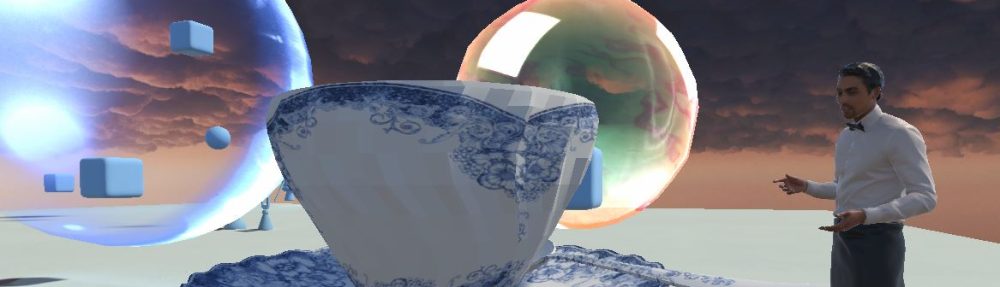

Byrne, left, and fellow members of the 12-person, gray-suited cast.
Photo Credit: Bryan Derballa for The New York Times
It was Robert Fritz who pointed me at the meaninglessness of glorifying terms like “deep”, “meaningful”, “sustainable”, etc. especially in combination with corporate common blahs like “innovation”, “disruption”, “ecosystem”, and “change”
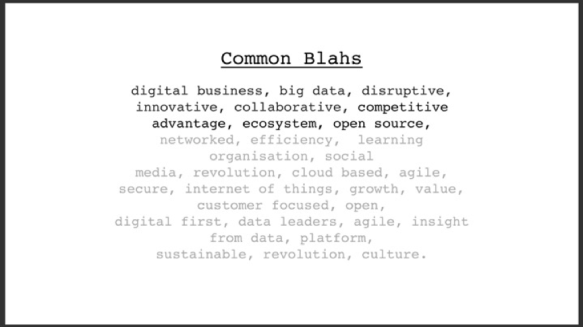
Simon Wardley's Common Blahs
Just try it: meaningful change, deep change, sustainable learning organization, etc. Utterly nonsense. But what if we would embrace another form of nonsense, another form of meaninglessness? Another form of plainness, elegance, pure joy from form?
It was this article about David Byrne’s Utopia Tour in the NYT, that lead me into the wormhole of Dada poetry, and later into the other art movement Cobra and its related Cobra Manifesto (Cobra is for a subsequent post).
“I thought plain but elegant suits would unify us and help reveal us as a tribe, a community,”
What was that song with the nonsense lyrics?The lyrics for “I Zimbra” were derived from “Gadji beri bimba,” a 1916 phonetic poem by Hugo Ball, the German author-poet and co-founder of Dada. More than a half-century after Ball strove to stop making sense, he got a writing credit for the opening track on the Talking Heads album “Fear of Music.”
Gadji beri bimba clandridi
Lauli lonni cadori gadjam
A bim beri glassala glandride
E glassala tuffm I zimbra
Bim blassa galassasa zimbrabim
Blassa glallassasa zimbrabim
A bim beri glassala grandrid
E glassala tuffm I zimbra
Gadji…
And then I found this in Peter Sloterdijk’s book “The Aesthetic Imperative”:

I éja
Alo
Myu
Ssírio
Ssa
Schuá
Ará
Niíja
Stuáz
Brorr
Schjatt
Ui ai laéla – oía ssísialu
To trésa trésa trésa mischnumi
Ia lon schtazúmato
Ango laína la
Lu liálo lu léiula
Lu léja léja hioleíolu
A túalo mýo
Myo túalo
My ángo Ina
Ango gádse la
Schia séngu ína
Séngu ína la
My ángo séngu
Séngu ángola
Mengádse
Séngu
Iná
Leíola
Kbaó
Sagór
Kadó
Kadó? Cadeau? Maybe it’s a matter of learning to be better at the art of accepting presents or pure gifts. The text above is the last ‘movement’ of the Ango laïna by Rudolf Blümner, a kind of phonetic cantata for two voices from the year 1921. Blümner described it as an ‘absolute poem’. The Ango laïna demonstrates what poetry can be after it is emancipated from the vocabulary, grammar, rhetoric, and phonetics of the German language.
It made me think about what makes me happy and unhappy. Unhappiness caused by dullness, not making the most of it, chatter, irrelevance, not being in the moment, Being distracted from what you are supposed to be, to do,…
This is not about boredom. I can be perfectly happy in full boredom. I can be perfectly happy in full silence. I can be perfectly happy in full nothingness
Happiness is about being in the perfect “bubble” or “sphere” of belonging and relevance. This is beyond Maslow’s hierarchy of needs. It is getting closer to Nitin Nohria’s four drivers of motivation (see also my 2011 post on Lipstick on Pigs):
- The drive to acquire,
- The drive to defend,
- The drive to bond, and
- The drive to learn
Without stress, fatigue, and unhappiness. These happen when:
- You cannot decide the pace of viewing (credit to my art teacher Fiorella Stinders)
- You cannot decide the pace of creating (credit to Geert Lovink)
Happiness, in essence, is about not being withheld. Withheld by tempo. Withheld by form. Withheld by meaning.
This form of meaningless joy is what attracts me to the Dada movement.
In my next post, we’ll get into the Cobra movement, and why their ideas of playfulness are relevant in today’s thinking about society.
 Petervan Studios