This trend is part of my five trends for human advancement. For an overview and background, check here:
A lot of change initiatives only scratch the surface of the systems they try to change. They are tactical, short term and full of platitudes. I would like to suggest an almost Jungian analysis of organisations and ecosystems.

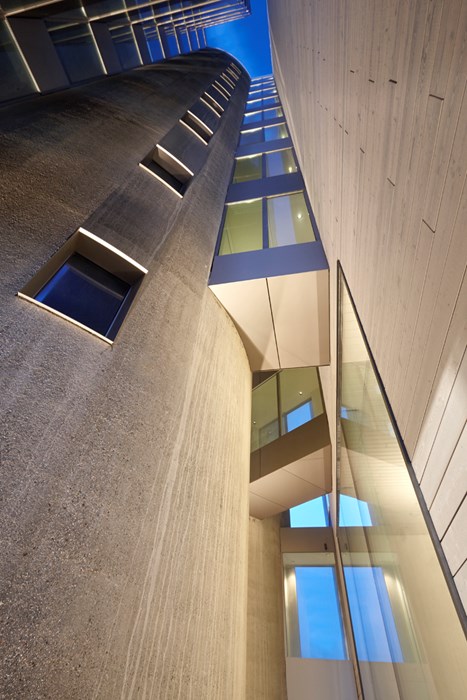
Rusty port next to Museum Modern Art Antwerp – Petervan Nov 2017
Trained as an architect, I have been (and still am) seduced by the term “Patrimony” and the respect of patrimony and the ability to combine patrimony with contemporary. Early feedback suggests that the term patrimony may not be the best. It contains the Latin “Pater” and makes people think of something “paternalistic”.
In an earlier post, I already suggested that the Dutch word “Erfgoed” maybe captures it better. “Erf” means inheritance, value that can be transmitted across generations. “Goed” stand for “good”, both as 1) something tangible, an art-i-fact and 2) something good, of value, of worth, wealth and culture to be carried forward.
Patrimony is structural memory carried forward from previous generations. Like Jungian humans, also organisations may have an ego, a conscious, a personal unconscious and a collective unconscious. Patrimony is about the collective unconscious.
To have fully humanistic organisations, we must be prepared to interrogate and influence at the level of patrimony. And combine patrimony with contemporary. Not as a shock or provocation, but more like adding milk to coffee (with thanks to Niels Pflaeging)

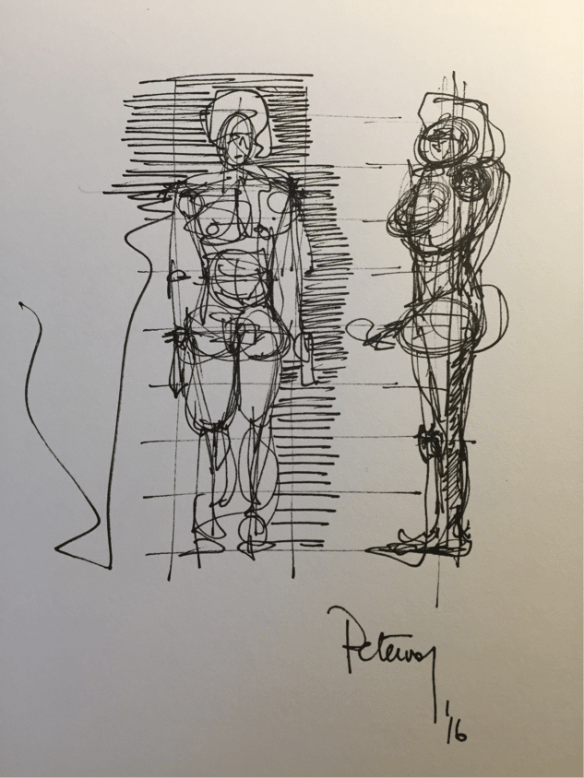
Petervan Productions 2017 - Live model - charcoal and acryl on paper
The same applies to straight and curved lines. As a non-practicing architect from the seventies, I was trained in straight lines. That’s what my hand had internalised. When later in art academy I was doing live model drawing, I could sense how unnatural natural curved lines were to my hand, and probably also to my brain. It reminds me of an intro of an art exhibition by art curator and critic Hans Theys, who described the straight lines in coffee bars along a high street in Borgerhout, an area mainly populated by Muslim immigrants: tables, chairs, lights: all were straight, hard, and women de-facto not allowed. What a nightmare it was/would be to live in a world that was only designed by men, without (internalised) curved lines.
Humanistic advancement will flourish only if we develop our ability to see, sense and share the patrimony and curved lines of our organizations, institutions, and ecosystems. It’s Jungian in the sense that the maturation happens when we are able to internalize, accept and incorporate the organizational collective unconscious of cross-generational heritage, symbols, memories and narratives. Including the suppressed shadows, memories, and femininity of our organizational patrimony.





 Petervan Studios