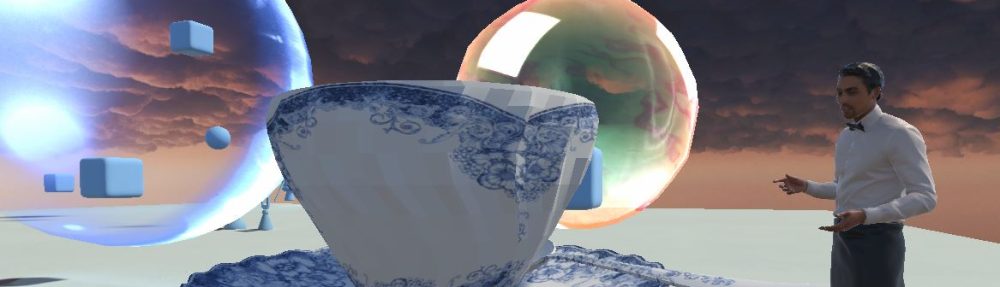
We use models and metaphors to make sense of our organisational structures, understand them, make predictions, apply change.

Bee hive - via Bridging the Gap
Some well known models are:
- Ants in colonies
- Bees in hives
- Apes in jungles
- Humans in neural networks
- Organisations as machines
- Hierarchies, wierarchies, holocracies
Models are not reality. Models are an abstraction of reality. Same for metaphors. They help us tell and understand a narrative.
We are not apes, ants, or bees. We are humans. As Jonathan Haidt explains at length in his book “The Happiness Hypothesis: Finding Modern Truth in Ancient Wisdom”, I am struck by all the noise humans put on the system: “We are all hypocrites” and “We are the rider (the conscious/the ratio) ànd the elephant (the unconscious, feelings, instincts, genes). Most models assume the rider is in charge. The rider is not in charge.”
Structural change leads to structural behaviour change. Structural change needs high quality connections and flows.
“A high quality connection is one where information transfer is rapid, reliable, and noise free” says Tom LaForge.
But in real life, this information transfer is NOT noise free. Maybe in some nirvana love relation, but usually not at/for/within work.
Noise comes from the motivations of the elephant (the unconscious), some examples:
- Reciprocity
- Prestige
- Self serving biases
- Power
- Hypocrisy
- Arrogance and entitlement
In most re-orgs, people look at the motivations and incentives for the ratio, the rider. They ignore the elephant. They forget the rider is not in charge.
High quality connections need something else than speed, reliability of noise-freedom.
There should be some dimension/ambition/alignment of “Spiritual, moral and aesthetical advancement”.
In this category, we find standards and appreciation for:
- Care
- Tradition
- Craftsmanship
- Beauty
- Proportion
- Sacredness
- Infinite games
See also my own post about Kevin Kelly’s qualities created at the transaction, which is more about qualities of resulting products and services than qualities of structure: https://petervan.wordpress.com/2017/04/19/sine-parole-19-apr-2017/
And then there is governance

Simple Google search on organisational hierarchy
The simplicity of the hierarchy works well on a slide or a hand-out. You can document it in a spreadsheet, or box-diagram and so on. But all these representations do is framing the conversation in an illusion of simplistic 2-dimensional structures. It’s the specialty of management consultants to think and present in two dimensions. It’s making it easy for executives to understand.
But if you are used to a 3-dimensional view of reality, you can’t understand why the flatlanders don’t see what you see. As long as you are primed in 2D you won’t see what the other dimension sees.
A better picture/metaphor for an organisational structure would be something like this.
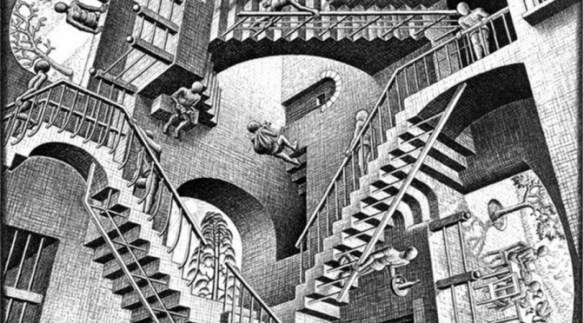
Relativity – 1953 Lithograph by M.C. Escher – 294mm x 282mm

Ricardo Bofill – La Fabrica – Old cement factory – Barcelona, Spain
It’s messy. At many moments you don’t know anymore where you stand. The perspective changes all the time. You get disoriented.
There is somewhere a general definition for Robots:
Robot = sensors + mind/computer/algorithm + body (hardware).
But humans are not just: senses + brains + body.
Computers are not like brains. Brains are not like computers. Our human models are different from machine models. Machine understanding is different from human understanding.
Humans are not just nodes on a network/grid that can be governed by coded social contracts, blockchains and AI. If you do that, humans are just cogs in another machine. Humans become cogs in a network.
The obvious case is of course Uber, which is an economy of extracting value vs. the so-called sharing economy. For Uber, all the drivers are already cogs in a network for the sole benefit of the monopoly.
Being cogs in networks is an insult for humans. But we are just getting started:
- Discover how it is to work in a Chinese mega iPhone factory
- Esko Kilpi with “Neural Networks as the Architecture of Human Work”
But does it still matter at all these days? We already are in a new world of “Alien knowledge, when machines justify knowledge”. Check out this fantastic long read by David Weinberger

Via David Weinberger - Illustrations by Todd Proctor / YouWorkForThem
“The paradigmatic failures seem to be ones in which the machine justification has not escaped its human origins enough.”
Organisations are not models/buildings/boxes. They are like rivers with information flows. Building skeletons, where the structure of the building guides traffic and connections.
David Weinberger talks about models created by machines. Models that machines can understand and we don’t. It is very much as he concludes:
“It has taken a network of machines that we ourselves created to let us see that we are the aliens.”
If we don’t want to end up as cogs in networks, we need to aim for structural advancement at a spiritual, moral, and aesthetical dimension.

I am in the business of cultivating high quality connections and flows to create immersive learning experiences and structural change. Check out: https://petervanproductions.com/
 Petervan Studios
Have you read “Raising good robots,” an essay by Regina Rini.
https://aeon.co/essays/creating-robots-capable-of-moral-reasoning-is-like-parenting