This blog post shares some more details about the Future of Big and Small Data session. This session will take place on Wednesday 31 Oct 2012 from 12:30 till 15:30 in the Innotribe Space. This Future of Data session is leading into the next session on Digital Asset Grid. The overall Innotribe Program at Sibos is here, and I try to keep that post up-to-date with the very latest speaker and program announcements.
Picking up where we left off last year with Big Data, this session will de-mystify what we think we know about data. We will hear opinions of different experts and judge together what are the hard facts, half-truths and complete unknowns about data today: big, small, broad, real time. We will dive into artificial intelligence, augmented reality and algorithms and how they impact our analysis and use of data.
This will be one of those Innotribe sessions, where we go “all the way” with super igniters (that’s how we call our speakers) and the amazing group techniques from Innotribster Mariella Atanassova and her team of designers and facilitators.
We will indeed design this session
as architects of serendipity,
creating collisions of ideas,
leading into
immersive learning experiences
The high-level design of the session is organized around debunking the myths that exist about data. We will look at this from different angles:
- Who is consuming the data: people, business, devices, applications, API’s (Application Program Interfaces)
- Technical and human aspects of data creation, data usage and data management
- The different lenses offered by our igniters
I would like to share a bit more about our igniters for this session and why we have invited them:
For the more “technical” angle on the subject:
Sean Gourley, CTO, from Quid.
Sean Gourley is originally from New Zealand and now based in San Francisco where he splits his time between Mathematical research and his venture backed startup Quid.

He has a PhD in physics from Oxford, and his academic research has taken him from Nanotechnology to Complex Systems and the Mathematics of War. Prior to Quid he worked at NASA Ames in Mountain View, Exclusive Analysis in London, and a (very) brief stint as a consultant at BCG in Chicago.
Sean started Quid back in Dec 2009, and they are doing some pretty amazing things with data, mathematics and visualization. They are building a global intelligence platform, a place where open source intelligence is collected, structured and visualized to help people understand and make better decisions about the complex world we live in.
Sean is currently CTO of Quid. Their corporate slogan of Quid is “Augmenting Our Ability to Perceive this Complex World™ ”
http://www.youtube.com/watch?v=V43a-KxLFcg&feature=youtu.be
Sean will talk about the war of algorithms, a world of machines where black-swans almost become the norm. I have already mentioned this fantastic talk in my blog post about “The Cambrian Explosion of Everything”
Amir Halfon, CTO for Financial Services , MarkLogic
It is Amir’s fourth Innotribe at Sibos.

Before Amir recently joined MarkLogic, he was with Sun/Oracle for more than 12 years, where his last position was Chief Technologist specialized in Financial Services. MarkLogic offers next-generation database technology capable of handling any data, at any volume, in any structure. So, Amir brings the enterprise perspective.
This will not be a product pitch. We specifically invited Amir for his rich background in financial services and his familiarity with the Innotribe-way of doing things, so we can tap into his broad experience to map the generic big data concepts to our specific market.
Anant Jhingran, VP, Data, Apigee
I met Anant for the first time last year during Defrag 2011, where we had breakfast with Sam Ramji, Head of Strategy at Apigee.

Anant is VP of Data at Apigee. Before he 21 years with IBM where he was VP and CTO for IBM’s Information Management Division, Co-Chair of IBM wide Cloud Computing Architecture Board and one of the “IBM Fellows”.
He is our ideal igniter to talk about data as seen by API’s. However, in the session preparation talk I had with Anant, he already highlighted that discussions about APIs are very people centric in the enterprise:
“What is the governance for publishing the APIs? Some enterprises insist on a central gatekeeper for APIs, others believe in a decentralised Darwinian model.”
Anant blogs regularly. Check-out here how his new start-up life changed his thinking. I love his quote:
“Coding is liberating”
Alexander D. Wissner-Gross, Institute Fellow, Harvard University Institute
Alex is an award-winning scientist, inventor, and entrepreneur. He serves as an Institute Fellow at the Harvard University Institute for Applied Computational Science and as a Research Affiliate at the MIT Media Laboratory.
He has received 107 major distinctions, authored 13 publications, been granted 16 issued, pending, and provisional patents, and founded, managed, and advised 4 technology companies, 1 of which has been acquired. In 1998 and 1999, respectively, he won the U.S.A. Computer Olympiad and the Intel Science Talent Search.
In 2003, he became the last person in MIT history to receive a triple major, with bachelors in Physics, Electrical Science and Engineering, and Mathematics, while graduating first in his class from the MIT School of Engineering. In 2007, he completed his Ph.D. in Physics at Harvard, where his research on smart matter, pervasive computing, and machine learning was awarded the Hertz Doctoral Thesis Prize.
His work has been featured in over 100 news outlets worldwide including The New York Times, CNN, USA Today, the Wall Street Journal, and BusinessWeek.
Alex will share how HFT is driving a latency arms race. He has a fascinating story about “Sea-Steading”, where financial institutions start building operating centers in the middle of the ocean, just to win a couple of mille-seconds in latency.

He has developed an algorithm that calculates the best geographical spot for an operating center, based on a number of criteria given by the customer.
For the more “human” angle on the subject:
Andrew Keen, Author, Andrew Keen Productions, Author Digital Vertigo
I am very proud to have Andrew Keen on board. Andrew Keen is an Anglo-American entrepreneur, writer, broadcaster and public speaker. He is particularly known for his view that the current Internet culture and the trend may be debasing culture, an opinion he shares with Jaron Lanier and Nicholas G. Carr among others.
Keen is especially concerned about the way that the current Internet culture undermines the authority of learned experts and the work of professionals.
He is sometimes called “The Anti-Christ of Silicon Valley”. He is the author of the international hit “Cult of the Amateur: How the Internet is Killing our Culture” which has been published in 17 different languages and was short-listed for the Higham’s Business Technology Book of the Year award.
Andrew just published his new book about the social media revolution, “Digital Vertigo” (Amazon Affiliates Link), a book I highly recommend, and the thinking developed in this book is the main reason why I invited Andrew to Innotribe at Sibos.
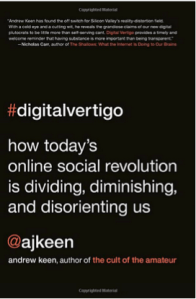
Following extract is typical Keen-speak:
“I am dreaming of a Web that caters to a person who no longer exists. A private person, a person who is a mystery, to the world and—which is more important—to herself. Person as mystery: This idea of personhood is certainly changing, perhaps has already changed.”
He is a real “contrarian” and therefore our ideal igniter to challenge all your assumptions on data and social media. The myth he would like to challenge is:
“the myth that social media
brings us closer together
and unites the human race”
Daniel Erasmus, Owner, The Digital Thinking Network
I was introduced to Daniel Erasmus by Brewster Kahle (who was critical for the Google’s book digitization) during Jerry Michalski’s retreat when he heard about the Digital Asset Grid. Because Daniel was doing some really advance scenario thinking for some clients in the financial industry, Brewster thought i should meet him.

Since then, I enjoyed numerous calls with Daniel on the importance of scenario thinking, and it was almost by accident we stumbled upon his start-up NewsConsole™, which is all about big data and the co-existence of man and machine and the world of augmented reality, in the sense of augmented information reality.
“Every day, an exabyte of information is created – an amount equivalent to half of all information created up to 2001. You will not read it, nor will any other individual, but some of it will be critical to your business.”
NewsConsole™ reads more than a million news articles per day to give its clients strategic overview of today and tomorrow’s news. The Console is in use in the Financial Services, Governmental, the Energy and other sectors.
I love the way he talks about big data:
“Big data sells the story of “the eyes of god”: sometimes it is there, sometimes is not. It’s about sort of half-truths, I would call them contingent-truths, as half-truths” has something negative”
and
“We see a computation a-symmetry. Google (for example) can do calculations on my data, but I cannot. This a-symmetry will have stunning implications on the power balances in the world. 20th century is all about “mass”. The 21st century is about the interface of one”
Daniel is a very erudite and versatile international businessman. In his scenario thinking work, he uses similar facilitation techniques as the Innotribe team, so Daniel will move between the spaces of advocacy and facilitation.
As for the other Innotribe session, you see that we put quite some effort in architecting, content curating, designing and facilitating our sessions.
We want to do more than just “events”
and listing some speakers.
We’d like to offer you
a memorable experience
In summary, this session is about debunking myths about data. What is the myth YOU would like to debunk? Let me know via the comments option of this blog post.
See you all in Osaka! Wednesday 31 Oct 2012, at 12:30 in the Innotribe Space.
 Petervan Studios