
Every now and then people ask me what incentives we have in place for encouraging innovative behavior.

The short answer is: there are no incentives other than recognition and self-esteem when your idea happens for real. For people with a specific innovation role – such as our “Megaphones” – we do have their innovation objectives as 10-15% of their NORMAL objectives. But no special deals, bonuses, etc.
From the start of Innotribe, we had this discussion about getting 20% time like Google (Btw, that myth of the 20% has been challenged and discussed already many times on the internet. For example here and here. It even leads to big failures).
Many other ways exist in other environments than SWIFT to incentivize innovation like special bonuses, shares in projects that can be turned in real bucks once the project gets critical mass and generates revenues, and much more.
From very early on in our innovation endeavors, we got a clear “no” from our top management.
We do not want a culture
where working on innovation
lead to some sort of “entitlement”
for x% of time or any other resource
In the beginning, i found this a bit harsh, but with hindsight, i think they were right. Personally, I have done some introspection on all this and have come to the conclusion that:
- I truly believe that the true innovators manifest themselves, and that any request for incentives to innovate just says a lot about the person requesting.
- What we need is people daring to stick out there neck, and acting from their true selves.
- As many of you know, I am deep believer of viral infection of the company. That will not happen through incentives.
- It will happen when we unleash the deep energy of the many hidden change-makers in this company.
Let me develop that thought a little bit.
It all has to do with the Maslow’s hierarchy of needs – where self-esteem and self-actualization are on the top of the pyramid.
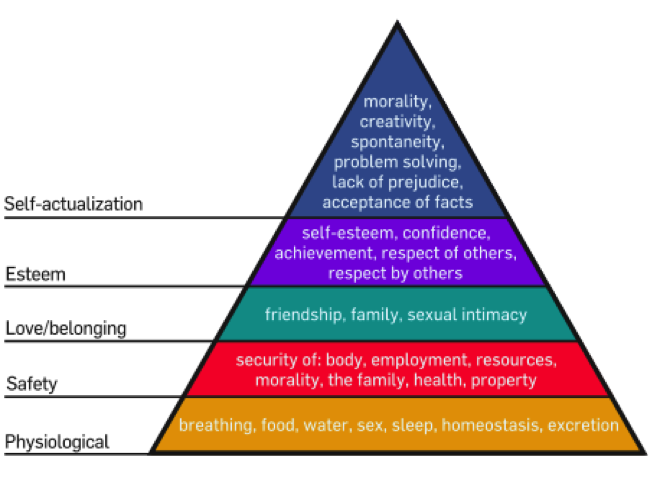
In our luxury world, most of us already have reached at least some level of self-esteem or self-actualisation.
I believe there is a lot to say to go beyond self-esteem, where the personal transformation fundamentally changes the focus from the “self” to the “others”.
This is where Richard Barrett has evolved the thinking of Maslow. Or where Don Beck did brilliant work with Spiral Dynamics, whose initial thinking was inspired by Clare W Graves who already in sixties/seventies said:
“Briefly, what I am proposing is that the psychology of the mature human being is an unfolding, emergent, oscillating, spiraling process, marked by progressive subordination of older, lower-order behavior systems to newer, higher-order systems as man’s existential problems change.”
There are other thinkers in this space, as pointed out by JP Rangaswami in his comment on my comment on his post about Thinking about the Social Enterprise and Flow
My comment:
“… me too big fan John Hagel, Geoffrey West, Brian Arthur. I love how you squeeze in Mihaly Czikszentmihalyi at the end, as I agree that organization starts more and more looking like an organism in search for flow. If you push the idea, you could add Maslow, as the organization is probably also looking for self-esteem in all its nodes (its people). Even pushing it further and beyond self-esteem, a similar flow “dynamic” is also embedded in Don Becks “Spiral Dynamics”…. the next area of competitive differentiation is in the higher layers of Spiral Dynamics, more or less the space of relationships, the space the Jerry Michalski’s REXpedition is exploring.”
JP responded:
“I am more of a fan of Nohria and Lawrence than I am of Maslow. Parallel not serial, networked not hierarchical”
I wrote about JP and Nohria, when trying to do a transcript of in my post “JP on Gamification, Lipstick and Pigs”. So I won’t repeat myself on that topic, and summarize JP as: The 4 drivers of motivation: the drive to acquire, the drive to defend, the drive to bond, and the drive to learn
In my opinion, it is about discovering your true self in the full context of all its relationships (family, work, company, country, culture, world, cosmos). As Marti Spiegelman recently said during a REXpedition call:
Awareness of the context creates meaning
And meaning creates value
Do you really believe that people will start innovating more if they get an extra bonus of 2% ? Only when people act from the power of their true self and experience meaning in what they do, only then real motivation kicks in.
I am deeply convinced that innovation and culture change will NOT happen through rolling out huge top-down innovation programs. On the contrary, I am a strong believer in “viral” innovation, where you seed the people that act from their true self throughout the company.
They will act as they believe they should act, and because their environment will feel inspired by this real motivation, they will inspire and infect others, form natural tribes with their own team dynamics and influence, become self-organizing teams that create their own meaning and value, and change the company from within.
Forever. Unstoppable. That is how real change happens.

Discovering and nurturing the hidden pearls in your organization that have the mindset to do this is the real challenge. It’s about finding the people who want to move, to challenge the status quo, dare to stick out their neck, etc and do so not because the incentive program has framed them that way, but because their true self boosts them towards the others with unlimited and eternal energy.
In the end it is about creating meaning in YOUR life.

Am I dreaming? Maybe. Am I ambitious? Maybe. Will it work? Maybe. But at least this way you know that’s where I have put the bar. So next time you see me, don’t ask for incentives, but tell we about what you want to achieve, and let’s see how I can help you.
 Petervan Studios
Awesome post!
Also makes me think of the 3Ps of innovation – the 3 characteristics many innovators have: patience, perseverance, passion.
(Pity you can’t post pics in the replies. I have a drawing on the 3Ps, see near the end of this post: http://copernicc.wordpress.com/2011/12/03/the-castle-and-the-sandbox-how-to-innovate-in-established-companies/)
Thx, Kosta. I struggle with patience. I don’t have patience 😉 Or at least i’d like it to happen in my work life-time…
This discussion runs parallel to the ideas of liberation theology (Central and South America, especially) and structural discrimination based on race, etc. (which we have a poor history of here in the USA). It often depends on one’s position in society or in a corporation whether an action is perceived as the granting of an incentive or the removal of a disincentive; or more strongly, a structural barrier to success. Dan Pink argues (I will exaggerate here for drama) that once an executive is earning waaay more than a line worker in a firm, $$$ is no longer an incentive. I posit that if one’s position in the firm does not assume one’s paycheck allows one to both feed and purchase health insurance for one’s child, the question of “incentive” is seen from a completely different mental psychology than that of the C-Suite exec making 400x the line worker.
Ed, not sure if you agree or disagree with my thesis that innovation incentives are a myth. I can read your comment in many different ways… can you please elaborate a bit ?
Really Impressed by your post Peter…. 10000 x yes to “viral innovation” and of course people “will act as they believe they should act, and because their environment will feel inspired by this real motivation, they will inspire and infect others, form natural tribes with their own team dynamics and influence, become self-organizing teams that create their own meaning and value, and change the company from within.” This is almost the definition of the Holacracy model in an evolving company….. The seed of holomidal collective intelligence at work… Brilliant !
Thank you, Claire. And thx x 2 for your rich resource sharing on FB
Peter, very good article with lot of references. I absolutely believe in the same philosophy as you. People who inspire others to bring out their best will do it just because they want to do it and not for any incentive. Passionate people will do the work just for the sake of passion.
However, I have the following question, just for argument’s sake. Don’t you think, whether a system rewards such passion says a lot about the system as well? This article talks about innovators and their attitudes but what are the responsibilities of the system itself? Who is to ask the system that question?
Peter – when you mentioned this concept in email, I immediately thought of spiral dynamics and was thinking of how to reply, with the difficulty to explain the spirals. I was so happy to see you mention Spiral Dynamics in this post!
I agree with you about incentives, but I also raise myself to the challenge of innovation providing success at the other (hierarchical) levels of the paradigm. Because (from my perspective) the transcendental “levels” of spiral dynamics, see the value of all “levels” from a non-hierarchical perspective. (And I try to view and act from this level as long as I have the energy.)
I believe or maybe I hope, that by showing success in “their language” I can get them to walk a little further along the path with me, allowing themselves to be exposed to a different way of thinking, which may lead to their own transformation into a non-hierarchical belief set. 🙂
Lovely post Peter!
I recently worked on an alternative metaphor to replace Maslow’s pyramid, as it seems there is little evidence that our needs are in fact hierarchical.
I came up with the idea of a stream of life. In a stream it doesn’t matter so much if it is contracted in the beginning, middle or end. If one of our needs is not being satisfied so much, then that is the most important limiting factor to our flow.
Here is the drawing I made (I think I actually showed this in Lisbon, but maybe not to you?)
http://ideasarenothing.posterous.com/mashlow-20-hard-vs-soft-skills
Pingback: The Innovator’s Personal Dilemma « Petervan's Blog