Last week, my Uncle Roger passed away in a car accident. He was 82.
I will always remember Uncle Roger for go-carts.

He made them himself.
When he was young and just married, he was working in a big metal factory. But he got bored by factory life and rules, and decided to start up his own business. His niche was the production of high precision metal moulds.
He started with one milling machine in his backyard. I believe he ended up with 20 or more machines when he retired 15 years ago.
The workshop and the backyard was also our play territory. I still very well remember the garden and the big sandbox he has made for children. And he could do amazing things with metal waste, such as building go-carts by welding old tubes, adding old bicycle spare parts to it, such as chains, pedals, and wheels. It was as if he could paint with waste. These go-carts were rock-solid, and if it happened that during one of the races a wheel went off, Uncle Roger was there are the technician in the pit stop to fix it immediately.
When I think about Uncle Roger, I also think about one of his daughters, about my age. She was the first girl I fell in love with. She was lovely, a bit boy-ish in her game and really taking care of me as her nephew when we were on family visit. I wanted to marry her, but unfortunately marrying your niece is not something you do. I think I was 8 or so.
We were a bit late for the funeral due to traffic jams around Brussels. The funeral was held in Flanders, about a 1 ½ hour drive from where I live. The morning was a bit grey, a bit misty, already a bit sad, with fog over the fields. It was a bit chilly when my spouse and me entered the church.
It took me some time to be in full presence during the ceremony.
It’s a long time ago I entered a church. Usually only for marriage or funeral ceremonies, and on a very rare occasion, I step in when I need silence. I sometimes do this when traveling for business.
As the ceremony went on, i looked around the church. From an architecture point of view, this church was fairly straightforward, nothing special really. But the stained glass in the main chapel of the church distracted my attention and musings.
They were beautiful paintings with glass, and each of those stained glasses was labeled with the name of the rich family that had offered this to the institution church; probably it would buy them eternal life in heaven one day.


It made me think of the stained glass artwork by Flanders artist Wim Delvoye, using x-rays of human beings as elements of eternal life. He is very intense, and an absolute innovator.
The artist is from the same region as where the funeral was held. This region of Flanders is also where some of the fiercest battles in World War I and II were fought. It’s deep in Flanders’ DNA, and we have a culture of respect for the war veterans, of which there are not many left these days.
What I did not know is that Uncle Roger was the chairman of one of the local war veterans associations. He never fought the war, but he was volunteered for the position, as known for the social work he did in that area of Flanders.

I was therefore surprised that during the funeral there was a delegation of Belgian war veterans, with flags, and a really good trumpet player honoring my Uncle Roger with the last post and the Belgian national hymn.
It was a simple and serene ceremony. With the same serenity as the family exposes: no frills, with a lot of warmth, respect, love and belonging.
In Flanders, it is the habit that after the funeral, the family relatives are invited for a cosy get together, with a bite and a drink. In some families this is a full three-course lunch, in others – like ours – it is a simple sandwich lunch with fresh soup. It is a moment where the family can re-connect.
I sat in front of my nephew Joost, about my age, which is main curator at one of the most famous art museum in Brussels. He is deeply specialized in medieval paint art, with a deep niche expertise on Rubens and Pieter Breughel the Elder.
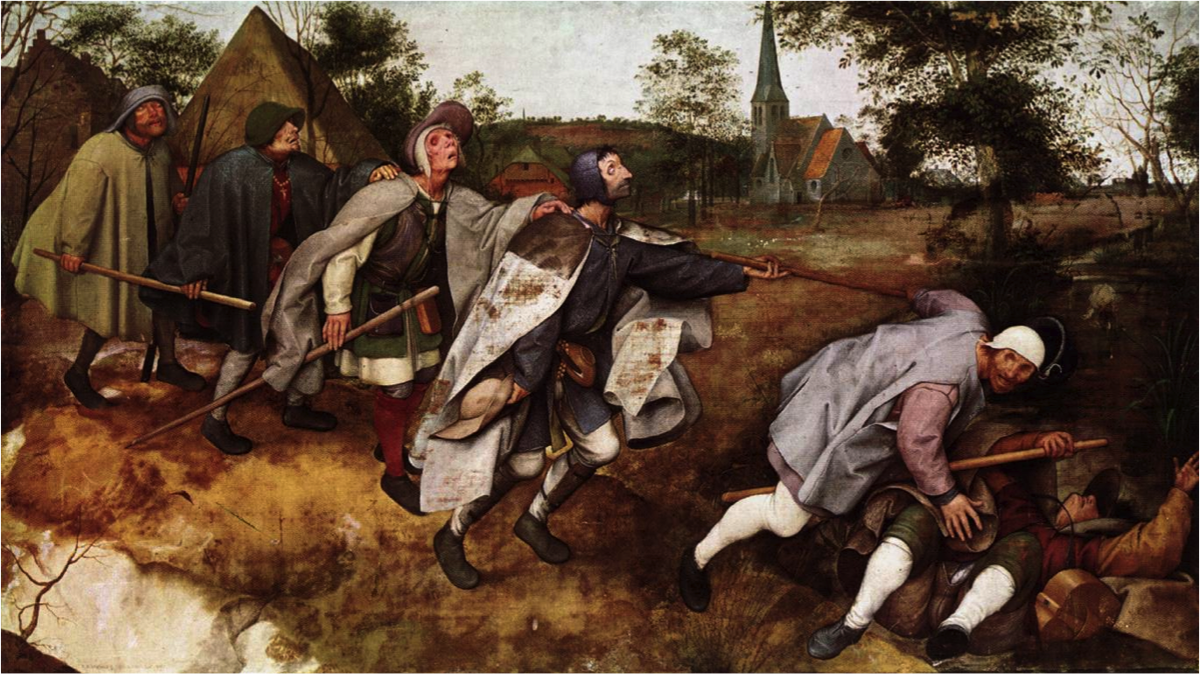
He is that much expert, that he is asked by very wealthy families and investors worldwide to do assessments on paintings to make sure they don’t buy copies etc.
The painting above is called “The Blind lead the Blind”, and I use it in a brand new upcoming presentation about innovation and the roles of rebels. The painting was made in 1568 and you can read everything about it on Wikipedia.
I asked Joost if he knew some anecdotes about the painting. I think he went on for more than an hour.
I was impressed with Breughel’s as an innovator, as a rebel and an influencer on many next generations of painters. For his technique, but also as for being one of the first who took art out of the religious context.
My Uncle Roger was not a painter. He was not a rebel. But he definitely is one of my influencers. He was a simple metal worker, self-made made. He worked with hard and steel metal, but he was a very soft man. For me he was the innovator and artist of go-carts. I will remember his soft smile and his endless caring for children playing in the backyard. I will remember him forever.
Farewell, Uncle Roger !
 Petervan Studios
Art and creation can be in anything.
No need to have the blessing of a “chair on creativity” or a stamp from “Leonardo Da Vinci college of experts”.
As Albert Einstein (probably) said: “Limiting factor is our education”,”The most important is imagination” “Intuition is everything”
I don’t remember the exact quotes – some say that many intelligent quotes attributed to Einstein are from others (not considered as “utimate brains”)
Admiration for a self made man as your Uncle Roger !
Hope that this example will ignite some useful ideas and encourage us to pursue them until they end-up uin concrete things.
Pingback: White Summer | Petervan's Blog