
Last week we had a great team off-site.


We arrived late afternoon in the fantastic location of Chateau de la Poste, close to Namur, Belgium. Built in 1895, the Château de la Poste was the residence, for more than forty years, of Princess Clementine, daughter of King Léopold II. It later was sold to the postal services, who used it as a vacation resort for the children of the employees of the Belgian Post (times have changed). It recently was refurbished completely by a French wine maker, and it houses now a wonderful hotel, meeting centre and quality restaurant.
The amazing landscape, the silence and the soft welcome on the summer terrace set us all in the right mood. We all felt our physical and mental muscles relaxing, winding down.
Don’t know where I read it anymore, but I recently found a quote: “If you are not able anymore to take some time out for an off-site team gathering, you’re cooked”
For once, we did NOT have a packed agenda, and plenty of time for real Quality Time Sessions.
We even made an acronym for it (QTS) to joke a bit with the “acronymitis” of the lean methodology.
More seriously, we invented QTS because we felt that the pure lean method was too much focused on a problem-mindset, and not enough on an opportunity-mindset, opportunities to develop some deeper quality thinking on subjects relevant to our business and team.
One of the items on the agenda was about “how to tell bad news”. In the subsequent discussion, one team member reflected on some sort of “fear” and “If I do this, then this and that may happen, and then…” thinking. Being in the acronym mode, we had a good discussion on
FEAR = Fantasy Experienced As Real
and how such behavior leads to blocking, status-quo situations.
Almost “emergent by design” our team culture principles unfolded, and we articulated them along the themes of “old” and “new” game.
- Old game = fear, tricks, manipulation, raising stinky fish, machiavelism, creating and maintaining negative energy in general

- New game = solution oriented, integrity and authenticity, fast correction (like Guy Kawasaki used to say”churn baby churn” a variation on the famous 1976 disco song “Disco Inferno” by the The Tramps), the holy fire, positive energy, who is the owner of the idea, who cares ? It’s about focusing on believers, and investing heavily in those VIP followers that will help us create a viral innovation infection/storm, like a raging holy fire that cannot be stopped anymore. Burn baby Burn…

We replaced “raising stinky fish” by regular update and feedback sessions, focusing on polishing rough idea diamonds, focusing on what works vs. what does not work, focusing solutions vs. problems.
If you think deeply about it, all this is about
the major cultural shift
from pushing towards pulling your ideas,
it’s about a strengths based society and team,
it’s about connecting ideas
and excel in making them real.
Another correction we made to lean was our understanding of a skills matrix.
We were very inspired by Venessa Miemis’ blog post “Framework for a Strengths Based Society” that included following diagram.

We decided to add these skills to our existing lean skills matrix that was too focused on identifying and solving problems and tools mastery. “We are not the tools, the builders are us” is another quote from one of Venessa’s presentations.
The subtle nuance is that we did NOT implement these skills as comparative/ competitive skills of different team members but
in terms of personal areas of
strength and potential
for each team member individually.
Our little team is SWIFT’s “Innovation Team”. Some time ago, we shared the details of the mission here and in summary it goes like this:
Build the Skills , Tools , Processes, Metrics , Values , Network , required to support collaborative innovation and transform SWIFT in an agile company, able to succeed in a changing environment.
I often make reflections on how real our innovation work really is. And although we are having lots of fun and some sizeable impact on how the company little by little opens up for innovative behavior, I always seem to be in search for that little extra in life and work.
Too many of our innovation experiments and proof-of-concepts remain just that: proof-of-concepts and prototypes. They never get into production. Worse, some outcome are just ‘filed vertically” or even never get the any executive attention.
I would like to hear from other innovators what is the secret sauce to get beyond the prototype stage. Because staying in prototype stage sometimes makes me wonder if I am in some sort of “busyness” therapy.
And I have come at an age where I cannot content myself with busyness.
I could sit here till my pension, having a good pay, and living honestly speaking in a quite luxurious working environment. But I am in search for more. I am in search for
meaning and significance
With the couple of years still to go, I still have the arrogant (?) ambition that I want to leave a legacy. On a personal level in my family. On a professional level that my passing in this company has substantially changed something. It’s about a deep sense of motivation, beyond pay and perks.
There is something heroic, even heretic about all this. That’s why the title of this post is Heretic Team Glue.
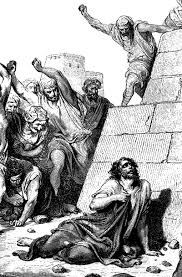
Heretics are the ones that were expulsed from the Catholic Church because they did not follow the rules and challenged faith and established dogmas.
There are several dictionary definitions of “heretic”. The one I have in mind here is “anyone who does not conform to an established attitude,doctrine, or principle”.
I think we in our team are all some sort of heretics in the castle. It’s something very special in our team, that creates a very strong bonding.
At times it even has some masochistic flavor. Why on earth do we keep on trying again and again ? Even if the odds are against us. Why are we prepared to go time after time through the innovation pains over and over again ?
I truly believe it is because we do it for the right reason. Not for the pay. Not for the glory.
Because we believe there is a chance
we can succeed
And believe we can create a tribe of followers in the same belief. It’s for some of us the only reason why we stay !
Are the above reflections caused by my age and my 3/4 life contemplations ? Don’t think so. We invited some GEN-Y colleagues to join our off-site. And see: they too are driven by honesty, they too want promises to be kept, they too look for meaning and fulfillment in their lives.
But it was shocking to hear how some of them have been seduced to join a company based on huge expectations and promises that they would work soon for 3 years in the US, and have rapid accelerated career paths, and deep young graduate immersion programs. It’s unacceptable to make such promises if you know you can’t realize them.
And this is their first contact with corporate life !
How can we ever correct this ? How on earth can we regain the trust of these young people ? Our generation has planted the seeds of suspicion in these long lives. Big mistake.
Me too I have been mislead several times in my life, and I recognize the power-less emotion of trust that was betrayed. Lessons of life ? Normal life injuries ? The way it is ? Why do we need to accept that ? Why do we repeat the same errors over and over again ? Sooner or later, these young people will present us the invoice.
These folks actually think. Think deeply. Some GEN-Y people are for example insulted when calling them “GEN-Y”. Because they see themselves as individual human beings, with their own identities and values systems, not prepared to be tagged as a category. And they have great ideas. We organized some sort of Innotribe Lab with them: more than 20 ideas on how to improve quality of work came out. I am honored that I can channel these ideas into the People & Culture “movement” team of the company.
Last but not least, we had a great discussion about “reverse mentorship”.
Instead of older experienced professionals mentoring new young people joining the company, why not letting young people mentor the already older – sometimes (mis)formatted – generation, and teach them how to use new technologies and apply 21st value systems ?
We had a fierce debate: how can one say that the young generation is the future, and five minutes later challenge reverse mentorship by not accepting that one can learn an awful lot from these fresh and well trained minds.
Maybe that’s where my future is ? In being mentored by a GEN-Y ? It will ask of course an attitude of
vulnerability
It’s also part of a give-ànd-take culture that includes transparency and openness. Especially give. Like a gift, where you don’t expect something in return.
When is the last time you made a Gift ?
How can we create an environment where we encourage learning from each other (in normal and reverse mentoring mode) ? An environment where we celebrate confidence building on your own rhythm, dare to be vulnerable, asking for feedback that is clarifying, supporting, challenging.
I am convinced I can learn something from every human being. Especially young people who have a renewed and fresh sense of civic responsibility, transparency, honesty, openness.
I have committed to take the challenge and invite one of our GEN-Y’s to monitor me during 6 months and give me feedback on my behavior and to keep me honest.
So that I walk the talk. Every manager should do this.
 Petervan Studios
What a post – there is so much to say!!!
But at first I want to focus on one point that rings very close to my heart – the point about prototyping and experimentation.
In design thinking and interaction design, prototyping is not a product, stage or a ” thing”. It is a process, attitude, a way of doing something. It is a bit like experiments and observation in science – you do them in order to think about things and design new theories, in order to ” show” your thinking and check it. You don’t feel that science is more useless when it is based on scientific observation. And the observation is part of the “deliverable” – science is about seeing, explaining, trying and testing and explaining again. It is an iterative process.
It’s the same thing with prototyping – if your thinking is that prototype is a thing, a stage in a process, a tick box after which you move on to something else, indeed it may feel like you are never getting past the baby steps.
If on the other hand you view prototyping as a process, it gets a different meaning. It becomes an end goal in itself – a communication/learning/testing tool.
It’s a process used in nature (evolution) a lot: different concepts (growing legs; getting lungs, loosing or gaining hair/feathers, etc) are tested in many versions in different circumstances, until the best design is found through gradual refinement. This is what the prototyping process is really about. And it’s hard to evaluate this process because it’s not linear – there is no direct experiment-benefit link; sometimes several versions have to be thrown away before you get to the right one; but the intermediary steps are necessary – they are “learnings”.
So, to take inspiration from nature we should prototype a lot more and all the time 🙂