
As preparation of 2010, i very strongly recommend to get familiar with Sean Park’s The Sixth Paradigm post of 28 Dec 2009.

I am a big fan of Sean and his site the Park Paradigm. He was the guy who made the famous AmazonBay2015 video.

That was 2006.
Since a couple of days the video of his Oct 2009 presentation at Amsterdam eComm Europe is available on his post above and also the Prezi presentation is here.
The video of his presentation is 20 min. It’s worth your time.
Two extracts of this presentation should get your attention, and incentivize you to read on:
– What is the difference between a bank and a telecom company really ?
– The difference between bank messaging and telcos is disappearing.


I believe this presentation is VERY VERY relevant to financial services and concepts such a marketplaces for financial services.
This presentation gives you an absolute macro-evolution view on why this is a bound to be happen, and why the inherent structures of our current – usually vertical integrated – behemoth companies will struggle very hard to get their arms around this if they even ever succeed it spotting this as a HUGE opportunity.
The essence of the story is that those
vertically integrated companies
will be replaced/challenged
by horizontally connected entities
offering themselves
to the marketplace
via APIs
The innovation will happen
at the edges of the marketplace.
The marketplace is not even
innovative anymore.
It’s an essential piece of
the plumbing.
A lot of Sean’s thinking is based on the work of Carlota Perez and her book “Technological Revolutions and Financial Capital: The Dynamics of Bubbles and Golden Ages”


Professor Carlota Perez is a Venezuelan scholar and expert on technology and socio-economic development most famous for her concept of Techno-Economic Paradigm Shifts and her theory of great surges, a further development of the Kondratieff waves.

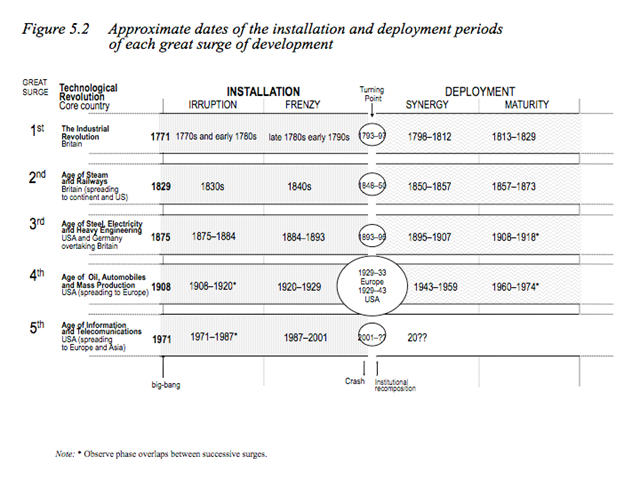
Courtesy The Park Paradigm & Carlota Perez book.
Sean Park’s claim is that we are now getting into the 6th paradigm, and this is also a switching point between 2 phases.

Sean Park believes the drivers will be 3-fold:
1) Cloud computing, with EVERYTHING as a Service
2) Exchange Ubiquity. The marketplace as plumbing, i would call this
3) Digitization
The last one “Digitization” seems “obvious”, unless you push this to the limits, as Sean Park does:

He takes the example of ISBN numbers as one of the success factors of Amazon’s book shop. Sure, there is big logistical tail to the book shop, the the core of the Amazon model is digitized, i.e the ISBN is just an identifier, linked to plenty of content and metadata, that can be accessed by an eco-system through APIs.
Where it even becomes more interesting, is where Sean mixes this up with theories of complex adaptive systems. It’s basically saying that
those horizontally integrated value chains
are chains of nearly decomposable services
And please read this in the context of nearly decomposable
financial services
And (traditional) vertically integrated companies (offering financial services) will not be able to compete successfully in rate of adaptation and fitness with these horizontally integrated “engines” or “eco-systems”.

Sean asks the question:
Where is the AppStore for Financial Services ?
here is the digital platform + API’s for the financial industry ?
Where are the decomposable financial services that can thrive on such marketplace ?

Sean has some other great disruptive statements. Like this one:

Its about the shift
from
 To
To

It looks like Sean’s company is looking to invest in companies that understand how to build and offer these decomposable services.
But who should invest in the marketplace,
the plumbing,
the “dumb” but highly secure pipes
for the financial industry ?
We could let every Bank behemoth have it’s chance at it. That may be great for lock in. But in the long term, we will need something that is highly interoperable.
With interoperability
built-in
into the DNA
of this Digital Platform.
That is run as a service for the community. And to be the “invisible engine” for financial services cloud computing.

It’s only a very personal opinion, but i believe SWIFT is quite uniquely positioned to play this role.

We are already in full prep for our 2010 SWIFT Innovation activities. It should be obvious from the above that we have Sean Park on our list of speakers to be contacted for our Innotribe event series, and who know at Sibos 2010 in Amsterdam ?
 Petervan Studios
Peter,
Great post. But do you really think that SWIFT can play a key role in innovating here. Yes, you have customers, but innovation is likely to cannibalise your model.
Best wishes
alexis richardson
RabbitMQ
Thx, Alexis.
Can you expand a bit on how you see this canibalizing our model. We can take off-line if you prefer.
Peter
Peter
I’d be happy to comment – please can you email me?
alexis
Hello Peter,
I see another domain where this paradigm shift will take place: the liberalised energy market.
The “new market model” as proposed by regulator VREG is a good illustration of the marketplace you describe.
More at http://www.vreg.be/VREG/documenten/Consultatienota/Eerste_consultatienota_Marktmodel.pdf.
Maybe there is a role for Swift there?
Alain
Alain,
I think the marketplace VREG has in mind is an energy “exchange”, like you have a stock “exchange”. What Sean was describing is something like the AppStore for iPhone, but then with apps for the financial industry. Or did i miss something ?
Peter
What I see emerging is the future ‘clearing house’ for the gas and electricity liberalised markets:
A central platform where following data is stored:
– the market players (customer, access responsible parties, transport and distribution grid operators, energy suppliers)
– the contractual relationships between them
– teh energy consumption (metering) data
This platform will be kept ‘à jour’ thanks to
EDIlike messaging sent by any market party when a change (move, new contract, new connection, …) occurs or meter readings are done.
All stakeholders (regulators, utilities, …) will access this platform (through EDI messaging today or APIs tomorrow) in order to get the information they need (and are allowed to use).
The rise of smart grid will make the data volume explode. I expect that the number of transactions will become comparable to what one sees today in the financial industry.
The first challenge is of course to get the platform up and running to levels of service comparable to banks.
In a second step, I can imagine that applications will be developed to interact with the platform in order to provide new functionality (imagine what you can do with an image in ‘real time’ of the energy consumption of one country). This is the all idea of smart grid.
The main challenge is always the same: people (and not technology).
Decisions makers in the utility industry today have been trained to make CAPEX decisions based on risk minimalisation. Their purchasing basket is/was ‘heavy metal’: switchgears, transformers, cables, meters with a proven technological stability.
How can these people now concentrate on buying IT solutions where version management, update, openesss and high MTBF have become the new main characteristics.
This is where I believe Swift can help.
Ik hoop dat dit duidelijker is 😉
Alain
Thanks for the great summary. Glad you found it interesting.
Pingback: Innotribe.com: a Lift-Off in perspective « Petervan's Blog