
Not that recent anymore: Morgan Stanley Research Europe published mid July 2009 a report on Media & Internet “How Teenagers Consume Media”.

What’s cool is they asked a 15 year old summer work intern, Matthew Robson, to describe how he and his friends consume media.
There is a lot to do about this report, as Twitter co-founder Stone does not care that teens are NOT interested in Twitter.

Also the New-York Times jumped on the bandwagon and said:
As the Web grows up, so do its users, and for many analysts, Twitter’s success represents a new model for Internet success. The notion that children are essential to a new technology’s success has proved to be largely a myth.
Adults have driven the growth of many perennially popular Web services. YouTube attracted young adults and then senior citizens before teenagers piled on. Blogger’s early user base was adults and LinkedIn has built a successful social network with professionals as its target.
That’s interesting, especially in the context of the Think Tank for Long Term Future we are putting together – starting up later this year from Flanders: in that Think Tank we want to include upfront young people between 15-25 years old today, who will be our future leaders in 20 years from now (2030 timeframe).
So what is all the fuss about in the Morgan Stanley report ? I took the pain to download the report and read it myself to have an unbiased opinion and share it with you.
I found the report via the site of the Financial Times. Download here.
First, it is important to understand that the report does not have any representation or statistical accuracy, as it is just the opinion of one 15 year old. It is also very UK centric referring to BBC services and Virgin Media as provider.
The paragraph where all the fuss is about is the following:
Most teenagers are heavily active on a combination of social networking sites. Facebook is the most common, with nearly everyone with an internet connection registered and visiting >4 times a week. Facebook is popular as one can interact with friends on a wide scale. On the other hand, teenagers do not use twitter. Most have signed up to the service, but then just leave it as they release that they are not going to update it (mostly because texting twitter uses up credit, and they would rather text friends with that credit). In addition, they realise that no one is viewing their profile, so their ‘tweets’ are pointless.
No wonder that Stone does not care very much. A lot to do about nothing.
The report contained however some other interesting elements. I am just picking a couple that surprised myself. I don’t have a 15 year old at home. My daughter is 3 1/2, so i guess all this is coming my way big time :-). Also, when reading those statements, i feel 15 again as sharing the same feelings. But for my age you have to invert the digits 
My personal top-10:
- Fast.FM: can choose the songs they want instead of listening to what the radio presenter/DJ chooses
- Online TV allows them to watch shows when they want
- Don’t read newspapers
- Teenagers never use real directories (hard copy catalogues such as yellow pages).
- Most teenagers enjoy and support viral marketing, as often it creates humorous and interesting content.
- Teenagers see adverts on websites (pop ups, banner ads) as extremely annoying and pointless, as they have never paid any attention to them and they are portrayed in such a negative light that no one follows them.
- Music: They are very reluctant to pay for it (most never having bought
a CD) and a large majority (8/10) downloading it illegally from file sharing sites. - 99% of teenagers have a mobile phone and most are quite capable phones
- Nearly all teenagers’ computers have Microsoft office installed, as it
allows them to do school work at home. Most (9/10) computers owned by teenagers are PCs, because they are much cheaper than Macs and school computers run Windows, so if a Mac is used at home compatibility issues arise. - Games Consoles: Close to 1/3 of teenagers have a new (<2 ½ years old) games console, 50% having a Wii, 40% with an Xbox 360 and 10% with a PS3.
The summary of the report says it all:
What is Hot?
•Anything with a touch screen is desirable.
•Mobile phones with large capacities for music.
•Portable devices that can connect to the internet (iPhones)
•Really big tellies
What Is Not?
•Anything with wires
•Phones with black and white screens
•Clunky ‘brick’ phones
•Devices with less than ten-hour battery life
…
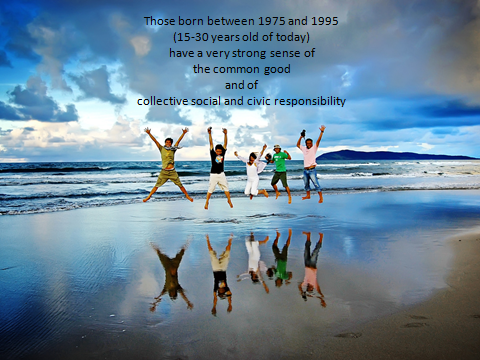
I really would be interested to find recent and statistically relevant sources of information on 15-25 years old internet behavior, and more importantly on the typical value kit of teenagers, if anything as such exists. Or are we now talking about Generation-M ?
 Petervan Studios
And the story goes on. More details at http://feedproxy.google.com/~r/Techcrunch/~3/M2TnSI2hBfQ/