
On 6 June 2013, I presented “Open Innovation Systems – Maverick Ventures in a Corporate World” during the Amplify Festival in Sydney. The Livestream of the talk is available here:
This blog post is documenting the genesis of that talk, therefore not really or only a transcript, but passing the same messages through the medium of writing rather than speaking, hopefully even improving the clarity of purpose and intention of the talk.
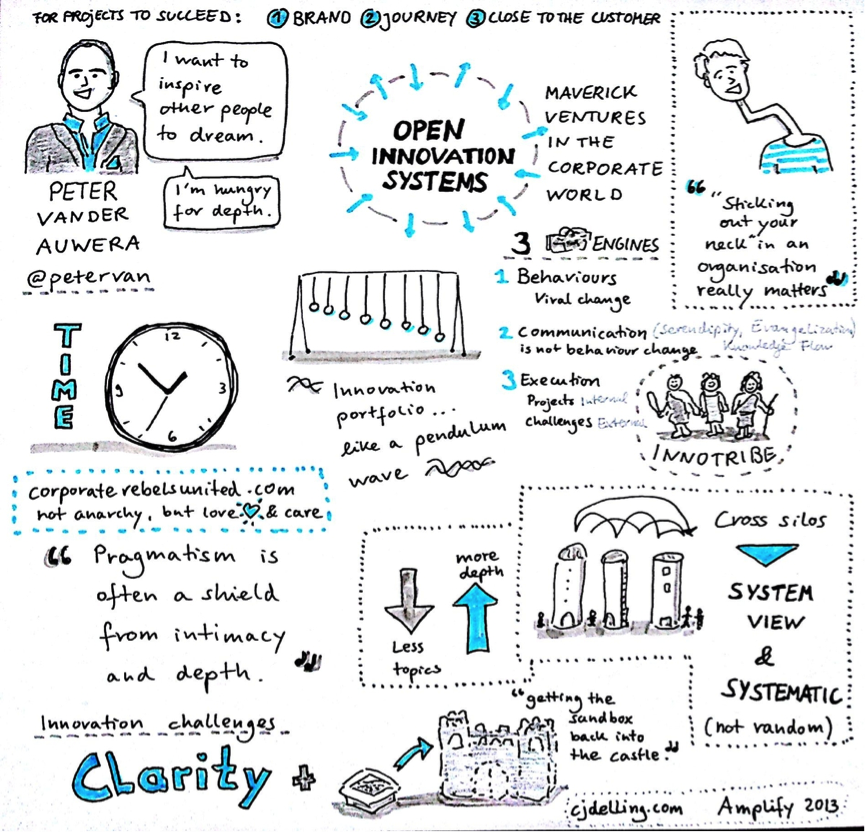
Thanks to @cjdelling for this wonderful scribe, made live during the talk.
There were many triggers for this talk, but the two most important ones were Douglas Rushkoff’s latest book “Present Shock” (Amazon Associates Link) – a book that left a deep impression on me – and a conversation with Haydn Shaughnessy, that I already somewhat documented in my blog post “The Bridge”
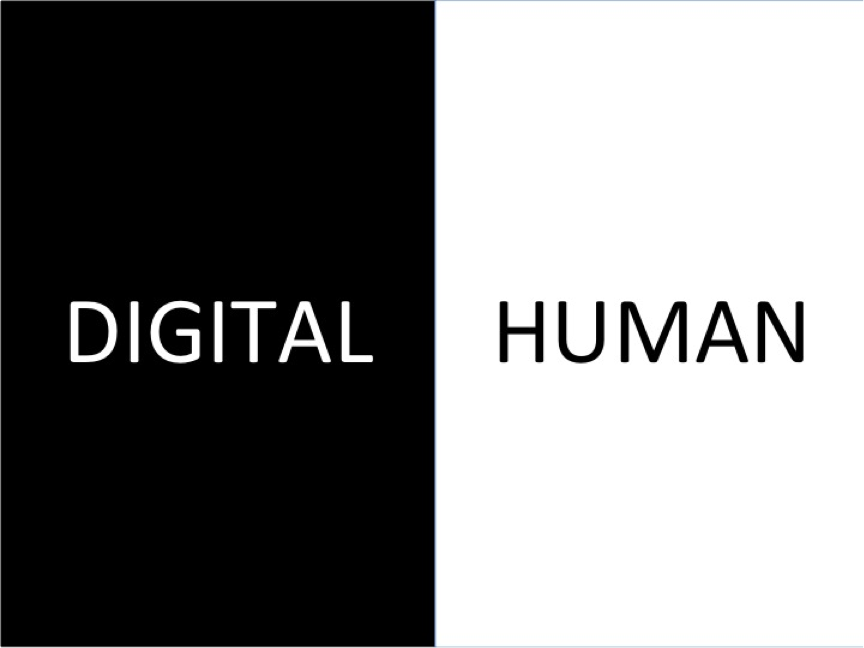
Rushkoff hits the nail when he says “Time Divides” and “Time is digital in character”. Just try to sense the different human experience when looking at 15 seconds of digital time vs. 15 sec on of analog time. In the analog world, there is flow, continuity, and formation. But we have started to accept a new normal where we have to make choices between extremes: black/white, On/Off, Digital/Human, etc. When being presented with the options left/right, we forget we can also go up and down.
“The lack of options is the opposite of freedom of choice,”
says Rune Kvist Olsen.
In an innovation context the limited choices presented are incremental/disruptive, core/non-core, internal/external, castle/sandbox.
There must be a richer better way to have conversations about innovation. I am getting sick of the 1-2 minute conversations where you have to make your case in a tweet. Sick of the 18 min TED talks, where there is no critical dialogue but only glorification of technology as the sole source for progress.
I am hungry for depth
For intimacy and human connection. I am on a quest for depth. A quality space in time and location where free deep thinking is again appreciated. Where we discuss not in limited silos about limiting options. Where life flows like water in oceans, in currents and rhythms, in waves of pendulums with different amplitudes influencing each other as Perpetua Mobile, spiralling as convergent systems into beauty and harmony with a direction of progress.
A space with doors wide open for new world-views where we create knowledge and resource flows (are they the same?), with new thinking: visual thinking, design thinking, systems thinking, and scenario thinking.
A space where bravery and maverick behaviour are not merely tolerated but accepted and encouraged as the new norm for deep viral change. You may call them whatever you want: mavericks, outliers, beyonders, rebels, catalysts of change.
With Innotribe we have created an end-to-end framework, based on the Open Innovation principles of Prof. Henry Chesbrough. That it is an end-to-end framework is not always fully appreciated. Sometimes, the work of Innotribe is reduced to its most visible component, the “events”. And also there, the superficial world with lack of depth and intimacy only sees the externalities of the events, the cheerleader-feel of the facilitators and masters of ceremony, thereby completely ignoring the deep immersive learning experiences and techniques applied and intended.
Superficiality kills depth
But even if the full breadth of the Innotribe work would be appreciated, we are not done. There is more, much more to be done. I would like to re-set the bar. I am getting convinced we have to move into systemic and systematic innovation. It was Haydn Shaughnessy who opened my eyes and gave me the first insights that there is an evolution of Open Innovation possible, way beyond corporate garages, towards a model where innovation is deeply baked-in into the fabric of the organization. Haydn has just published a report on this on GigaOm Pro titled “Rethinking innovation: how to manage ideas systematically” (registration required). There, Haydn introduces “lean innovation”, “algorithmic innovation”, and “radical adjacencies”, which we already knew from his book “The Elastic Enterprise”. (Amazon Associates Link). Haydn will be with us at Innotribe Sibos in Dubai in September to share the results of his research in the domain.
Where “systemic” assumes system-wide approach. Not only within the silo of a department, or in non-communicating black/white, internal/external innovations vessels, but across silos, across vessels. If not, failure is almost built-in, because the two camps engage in finite games, whereas we should play infinite games where we do not look for a winner (and by definition also loser), but where the journey of the whole systems towards progress is the goal (read also James Carse’s “Finite and Infinite Games” – Amazon Associates Link).
In the first case – the finite games – we may be seduced by the means, but I am for sure not attracted by the end-game. We have to move across the corporate boundaries, and become “system activists”. My next blog will describe this new form of corporate activism in more detail.

A great example is Nike’s Launch2020 Project, creating system wide transformation, in partnership with MIT, NASA, and Government.
Where “systematic” stands for planned, organized, designed, focused, and not random. Repeatable. Scalable. The best example I have seen so far is Vodaphone: they have deeply investigated the trends that impact their business; they have documented the needs (not the asks) or their (potential) customers, and made solid customer segmentation. Then they apply pattern recognition across these three layers, and are hyper-focused on where they want to spend their innovation efforts, resources, and budgets.
In general, it also seems to be that many organizations are very focused on product, service, and process innovation, or the latest buzzword “business model innovation”. Probably because that is what we know, what we feel comfortable with. It’s our comfort zone. We have been trained for years in thinking rationally about our businesses, decomposing, fragmenting every process in sub-tasks that can be mapped, followed, and measured. Up to a level that we don’t see the forest for the trees.
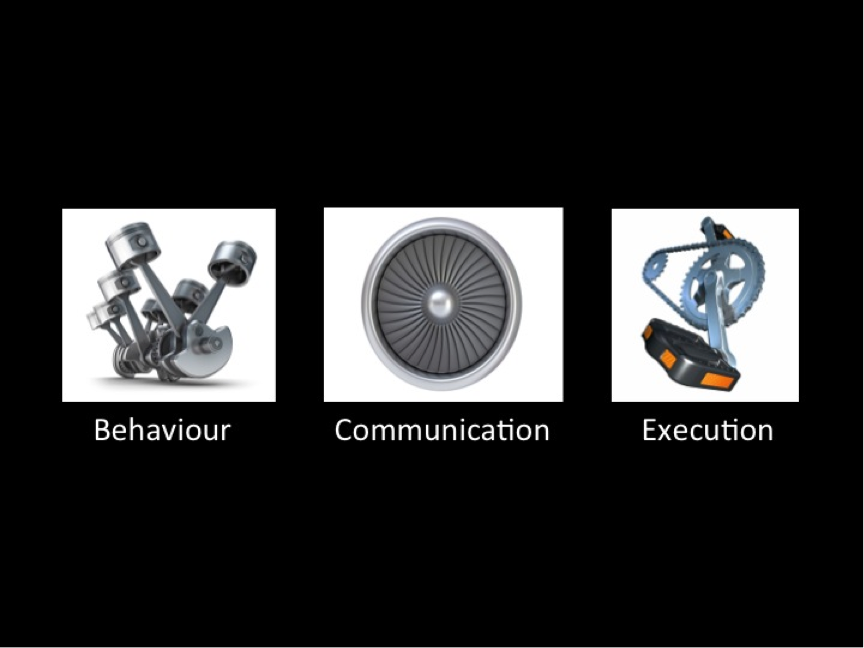
What we need are 3 type of engines:
- A communication engine, with the ultimate goal of being a serendipity machine, an evangelization machine, and a knowledge flow platform;
- An execution engine, with a good balance/portfolio/consistency between internal and external innovation
- But all those changes are lipstick on a pig, if they are not deeply embedded in sustained behavioural change in every vain of the company.
What we really need to focus on is the third engine of behaviour change. Deep viral behaviour change. Because behaviour drives culture and not the other way around. And let that change spread like a virus through our organizations and systems. So it is getting copied and amplified through our hyper-connectivity networks. Where leadership becomes leadingship, and backstage leaders act as distributed coaching nodes in the corporate grid.
In the end, it is about being human and developing and nurturing the capability to be touched by beauty, a picture, by mastery and harmony. And to develop a richer palette of judgment, choice and appreciation.
Yes, there is some form of romanticism here; shall we call ourselves business romantics? It’s the nature of this beast, to be an incurable romantic.

It’s what I am as human. I cannot and do not want to settle for the sterility of digital zeros and ones, for cogs in cubicles executing standard processes that anyway do not match anymore our fast changing world.
I want to send, propel and amplify positive vibes and frequencies to all the nodes in our grids. I want to reverb and resonate, and inspire you all to dream. To dream big and be unreasonable and go for the impossible. I want to me and you to get alive and get a life. I want us to be mavericks and rebels in a corporate world.
 Petervan Studios
Pingback: Spiral Networks | Petervan's Blog
Pingback: Innovation in Employee Based R&D: EF in Me-conomics Theory | Markets And Trading
Hi you all!
The paper “Conceptoloy of Learning and Leading at Work” is now completed and ready sharing and reviewing. The paper is available in both a short and a long version. You can access the respective versions of the paper by contacting the author directly on e-mail.
Responses will be appreciated.
Rune Kvist Olsen
rukvol@online.no