
A couple of weeks ago, I had a discussion with colleague Joe on the program for one of our upcoming main Innotribe events. My colleague is not part of the innovation team, but has shown growing interest in what we are doing: great! Joe is known in the company as rather a conservative, cautious person, making decisions on data and not feelings. So, like many human beings, when I go and see him, I already have put my projection biases on (shame on me).
Taking into account my manager’s request to start dancing with the company, I decided to use a different approach and asked Joe what sort of innovations got him excited. He was looking for innovations that were 1-2 years out at maximum, complemented the core, were easy to implement and had effect on the bottom-line right away. Joe felt that I was too much in science fiction territory, out “there”, looking at a horizon of 10-15 years, my head in the skies.
At first sight, this seems to be about different perceptions on what is important based on time-criticality of the innovations.
But then, another colleague Jamie, said it was also about being used to think in abstract concepts.
The whole discussion made me think, and I started making some notes on what was going on. I landed with the following high-level “concept” drawing:
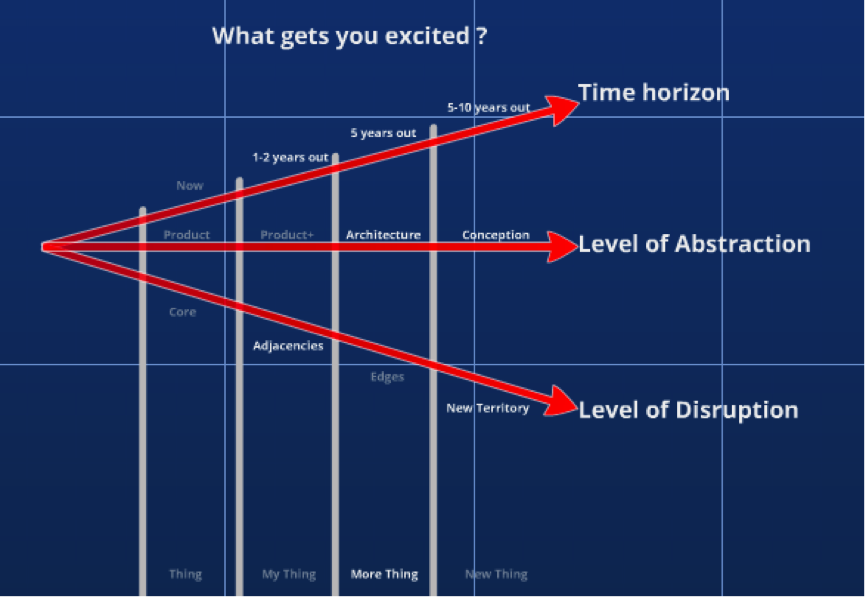
In my opinion, there are 3 forces at work, all on the same continuum, and more or less the same scale:
- Time horizon
- Level of abstraction
- Level of disruption
What I see happening all the time is that innovations start with adjacencies and evolve towards new territory:
- If the product in the core is called “thing”, then the adjacency is smelling “My thing”, the edge is trending towards “More thing”, and finally the new territory is really about the “New thing”
- In SWIFT world there are many examples of “My Thing”: MyStandards.com is the “My thing” variation of the core Standards proposition. In the same way, the EBAM Hub is like “My EBAM” variation of the EBAM Standards, and Alliance Lite is a “My messaging” variation of FIN.
The point I am trying to make is that we rarely look at the next level of abstraction or disruption. Because deemed to far away from the core. Because that was not the way it was supposed to work. Or not fixing an immediate problem: why fix if it ain’t broken?
The other point I am making is that we risk becoming complacent and happy with adjacent innovations only. Tick-box innovation.
However, there is power living on the edge.
I’d like to refer to John Hagel in one of his latest posts on The Evolution of Design to Amplify Flow.
He comments on the new book “Design in Nature” by Adrian Bejan and J. Peder Zane.

From the perspective of the authors, design is not static. It is continually evolving in a quest to find more effective ways to support flows. “This evolution occurs in one direction: Flow designs get measurably better, moving more easily and farther if possible. This evolution can be observed at all timescales. Rivers evolve at a different rate than a lightning bolt or snowflake. If a design ceases to evolve, it will quickly become a fossilized flow system, tossed aside to make way for more effective flow designs.”
And
“Now that new digital technology infrastructures are emerging globally, we are witnessing a profound and disruptive shift to from knowledge stocks to knowledge flows as the source of value creation. With the benefit of hindsight, we may come to realize that the powerful institutions that emerged in the last century and continue to govern our lives – whether companies, NGO’s, schools or government – were in fact a very brief detour in the evolution of institutional design to facilitate flow.”
It confirms my thinking that if we want to remain a powerful institution, we have to be part of this disruptive shift towards knowledge flows, and we have to create design as an institutional core value.
And who says “design” says “abstraction”.
In an older 2009 post, John Hagel talks about “How to bring the edge to the core”
“What’s the best way for companies to participate in this dynamic? Disruption theory suggests it’s by bringing the edge to the core. The approach we suggest is to instead bring the core to the edge, to expose your company to institutional innovations and new management practices that emerge on the edge.”
It’s clear from the above that I am not the first one making such reflections. And I am fully conscious that John Hagel plays in a different league that I do 😉 John seems to have landed on bringing the core to the edge, whilst I still believe in my maybe naïve enthusiasm that the result of our innovation work will lead to the edge eventually becoming the new core. Wisdom will probably come later 😉
John goes on:
“To exploit opportunities on the edge, executives must resist the temptation to prematurely integrate edge resources into the core of their operations. Instead, they should determine what resources they can offer to help SCALE the innovations being developed by edge participants. This could catalyze the development and deployment of growth platforms, platforms that edge participants can then use to more effectively design and deploy new innovations.”
“By seeking to mobilize and engage with a large number of edge participants, core players can reduce the risk of prematurely locking into edge resources or of overwhelming smaller edge players with the demands of much larger core assets.”
We at Innotribe are looking into the edges in our incubation initiative. Is it enough focus on the edges? Maybe not. In my personal opinion, incubation has to focus exclusively on the edge and the new territory. The continuous improvements to the core and the creation of “My things” should be part of the normal product evolution/enhancement cycle and should not be funded from the incubation fund.
And it’s about putting in place a well-balanced innovation portfolio, a yin/yang of core and edge, and a continuum of different types of innovation. It’s fairly “easy” to do stuff at the left side of the continuum. It is usually a stretch to work on the far right side of the continuum. Innovation is NOT about launching the next cool mobile app. Real innovation is about moving to the right. Where the edge has the potential to become the core.
Real innovation “hurts”, disturbs.
It has to disturb something: be it the core, the market, the hierarchies, the power balances, whatever… but it has to disturb. In some ways, innovation is rebellious. Rebels are needed. Not rebels as in “anarchists”, but rebels as in change makers, the ones who relentlessly challenge the status-quo.
On the other hand, innovation is about holding hands, showing different sides of the coin, and inviting each other to come and see at your end of the wall. Having empathy for the other’s opinion, for their lens on the topic. And taking them on our innovation journey from that empathic moment.
It’s not one or the other. It’s sensitive dosage on the continuum of challenge and empathy.
 Petervan Studios
Pingback: FUTURE | Pearltrees