This was my second Defrag.
I attended Defrag for the first time last year in 2010, and it helped me spot 6 excellent speakers for Innotribe at Sibos: Jeff Jonas, Mark Dowds, Laura Merling, Dion Hinchcliffe, Doc Searls, and Stowe Boyd. I contacted more Defrag speakers, but or they couldn’t make it, or I just couldn’t fit them in the already packed Innotribe agenda.
It’s a dream for me in my role as content curator for Innotribe events. But it is also one of the conferences that really helps me identifying trends in tech industry.
I tweeted the one-liner “once Defrag always Defrag”. Life permitting, I want to go every year.
Defrag is not a conference like any other. It’s a 2-day encounter of tech enthusiasts in Broomfield, close to Boulder, Colorado. It’s capped in number of participants: 325 max. The quality of the speakers, content and participants is excellent. Always a place to have great conversations.
It’s perfectly organized by Eric Norlin and his spouse Kim, and tuned for a modern tech audience: super quality video projection, awesome sound system (the organizers love playing lots of hard rock and metal music), power plugs on all tables, and a Wi-Fi system that is tuned to deal with 3 devices per participant. How good how good was Defrag’s Wi-Fi? Well, they had people downloading the new iPhone/iPAD iOS *in* the keynote room, and we did not notice any drop in quality! And everybody got a goodies bag so big that you have to buy a separate suitcase to get it all home. Eric’s super curation skills, his no-frills introductions of the speakers and his humble no-hero attitude completed the pack.
As usual, I will not make a chronological report of my impressions, but zoom into some of the highlights of this year’s conference.
- For a very detailed twitter stream, check-out the tweet tsunami with hashtag #defragcon: https://twitter.com/#!/search/%23defragcon
- or even better, Matt Groeninger (@mgroeninger) compiled tweets for hashtag #defragcon during Defrag 2011 (11-3 to 11-11), cleaned it up for double entries, time-zone adjusted them and posted the whole lot as an *.CSV file here: http://bit.ly/u8Xppi . Thx, Matt! It helped me writing this blog!
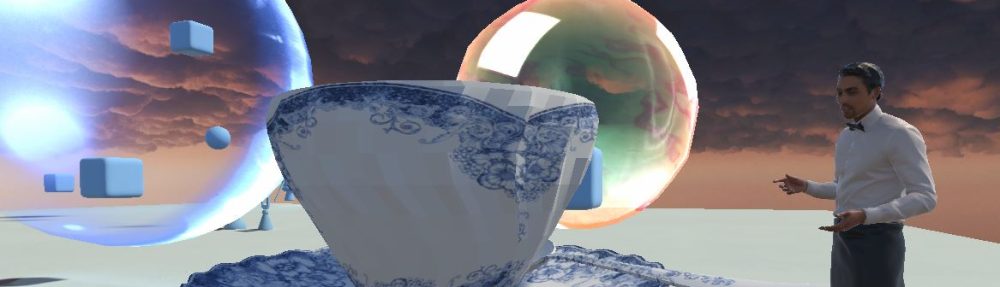
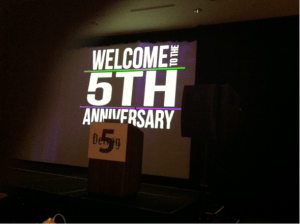
Like last year, the conference opened with an awesome energizing video trailer. This year – the 5th edition – was no different.

Defrag Video: http://vimeo.com/31903004
That was great as a kick-start. Eric and team had decided not to have a specific overall theme for the conference, and I believe that’s a good change. However, after the 2 days, I saw some themes lurking behind all the great content: big data, APIs, the race against the machine, and inspiring new ways of work were recurring.
Opening by nobody less than Tim Bray from Google with a talk on “Mysteries of the Internet”

He was one of the speakers who did live coding as part of his talk, and it was the second time in 3 weeks that I heard the message that nobody really understands the Internet (first time was at Compass11 from Danny Hills from Applied Minds). “Don’t try to predict the future from the past” and “I want to be an explorer (of unknown territories)” were typical one-liners of this talk.
I have organized this blog under following themes:
- Check your assumptions
- Machines in charge
- When presentations become art
- How to run your company like a start-up
- Philanthropy
- Great conversations
- Big Data
- Pitch Alert
Check your assumptions
Sam Arbesman from The Kauffman Foundation pointed out that most facts change over time. There are few absolute truths. He introduced the notion of “mesofacts”, warning that “your reality is out of date” and that “whatever period we are born in we view as the state of affairs”. Facts (averages of facts) obey (mathematical) rules: half of scientific data changes in about two generations. Many of our decisions are based on outdated facts. “Are your facts up-to-date?” was the appropriate call for action for this talk.
Duncan Watts, author of “Everything is obvious, once you know the answer” explained that common sense is hat we rely on to navigate concrete, everyday situations. Unfortunately, we try to apply common sense or gut feeling for complex longer-term situations. In complex systems history never really repeats, history doesn’t repeat deterministically, so generalizations based on the past have limited utility. “Is the Internet to sociology what the telescope was to physics?” is a good summary.
Aneesh Chopra, CTO to the White House gave a passionate talk. The assumption that he challenged was that government officials are boring and non-inspirational. Oh boy, I was impressed by his in-depth knowledge on a broad set of technology matters, and the contagious energy he was spreading. Governments need more people like @aneeshchopra in public service. Do, don’t talk, innovate, don’t legislate, open government using big data, API’s, and crowd sourcing to stimulate innovation and entrepreneurship. Cool stuff.
Machines in charge
Robert Stephens was founder and CEO of Geek Squad until Best Buy bought it. Robert is now CTO Best Buy. “Every company should have a Robert Scoble” and “where is the AppStore for home automation?” were some good openers. He made clear that there is a whole market out there for repairing/supporting robotics, home automation, fitness, the Internet of things. On social media, his dream is to have NO social media response team, that every employee is connected and empowered. He also showed some “wireless hygiene stats”: how much noise devices cause in a Best -Buy shop. Towards the end, he made a shutout for #singly > VRM and locker project, and defended that bringing your own device to work (BYOD) works better than giving an employee their own corporate device.
Brad Felds (managing director at Foundry Group) opened his talk with an awesome scary app on Facebook http://www.takethislollipop.com/ > try it and make sure your Facebook locations are “on”.

For Brad, the machines have already taken over: they are very patient, come in many disguises. Machines don’t have to kill us; they are patient and can wait till we die. Still, he is an optimist and thinks that machines will like us and will help us. He urged us to change our mindset about who is controlling whom. Regarding the singularity, he does not care anymore when it happens, it’s happening already, and very fast. To my question “what values to we have to give our children to prepare for the age of the machines?” he answered to my surprise “nothing”. Kids younger than 15 years have grown up symbiotically with being connected, and will solve it themselves. Therefore, Brad remains optimistic.
When presentations become art
Lili Cheng from Microsoft Research surprised everybody with a beautiful presentation inspired by architecture, going back to her education roots: why did I like this talk so much? ;-). She was using the architecture metaphors to refer to the ideal structure of a city, and how that is inspirational to build social software that is flexible and creative enough to optimize big data. “Dance like no 1’s watching. Sing like no 1’s listening. Tweet like no algorithm is coldly deciding your social worth” or a modern implementation of “Why do we loose our child’s innocence along the journey of life ?” was a fantastic quote to make the transition to a great demo of Montage, a document editing package based on search and mixing all kinds of content: pretty cool. It is the first demo in many years that I see from Microsoft where they prove they are finally getting the web.
Already last year, Paul Kedrosky seduced me with his talk on “Ladders”, a great presentation on big data correlations. With Kedrosky, you never know where he is leading you till 10 min in the talk. This year was no different. He started by live coding in game ZORK, trying to get into the White House through the backdoor. At a certain moment in the game, he hits a location that is labeled “this page is intentionally left blank”, btw also the title of his presentation. You must be brave to drop the word “vacansopapurosophobia” (fear of a blank page) into an early-afternoon keynote 😉 In essence, his talk was about transparency and about vulnerability in being open: “I want to play a game but I don’t want to be gamed”. The blank page is a way to reassure us we are missing out something.
How to run your company like a start-up
There were some really cool presentations on new methods of work.
Jay Simmons, President of Atlassian had a talk on “Hack your company”. Some salient approaches included scoring based on performance and stretch, come up with an idea and ship it in 24 hours (yes, 24 hours!) and iPads at the entrance of work to survey employee satisfaction, instead of boring long surveys.
T.A. McCann, Founder and CEO of GIST charmed everybody with “A startup Start to Finish”. In his opinion great people, aligned passions, and complementary skills are the secret sauce for startups. The HOW is as important as what: he suggested to operate your start-up like clockwork: 18 month horizon, 6 month goals, 3 month plan, 1 month themes, 2 week sprints.
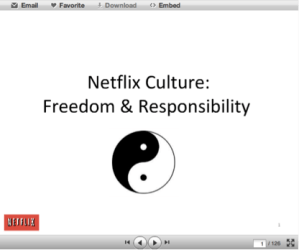
Adrian Cockcroft, Cloud Architect from Netflix blew everybody away. In essence this was a great talk on innovation and on Netflix’s corporate culture. He made clear that the one R&D or Innovation center does not work, is not taken serious by the rest of the company and how incredible hard it is to change corporate culture in a big organization: he implied it’s impossible. I loved his quote “For innovation to happen, you have to get out of its way”. His list of corporate culture attributes was mind-blowing: they only hire senior people, have no coding standards (peer pressure works fine). They don’t have a CIO and their IT staff only supports employees. They push out code, as needed, several times a day, and not “the old way”, the 2-week train like at eBay. One and the same persons now do project manager, line manager, and architect. Prima donna’s are expelled by group pressure. There are no bonuses, just flat and very competitive salaries. And they have monthly stock options at the current price with instant vesting. Fascinating. With his grand-finale “we only hire rockstars: do you want to be in the audience on part of the band on stage?”, any professional should be attracted to check out the open positions at Netflix 😉 Post event @matthixson posted a link to a slideshare about the Netflix culture. It’s great and I recommend it to all, especially if your company is reviewing motivation, appraisals, etc.
I was trying to invite Adrian to Innotribe at Sibos 2012, but could not yet convince him. A couple of days after Defrag, I had a call with Kaliya Hamlin @identitywomen on an unrelated subject, and she asked me how Defrag went. She said that the people who know Innotribe should make a invitation blurb to help us convincing folks who do not immediately see what’s in for them to talk to senior banking executives: Innotribe is different, cool, engaging, and no better ambassadors then those who experienced. Great idea, Kaliya! Thx!
Laura Merling from Alcatel-Lucent was brilliantly comparing the aspects of a business to 5″” stilettos and making a plea for women in business and tech: “it’s not about whether you’re male or female, it’s about whether you’re the right person for the job” almost got a standing ovation. “Build a culture, create a business tribe” sounded as music in my Innotribe-ears. Her presentation used a strong metaphor of boots/shoes, and it was not just a gimmick: the boots have a sole/soul, and mentioned innotribe as a role model. Slides here. http://www.slideshare.net/llm007/five-inches-of-fabulous-defrag2011

Sam Ramji was great during one of the API break-outs: “I am a mercenary, not a missionary” on question whether API intermediaries should refuse non-standard OAuth.
And Dion Hinchcliffe joined JP Rangaswami @jobsworth when he stated “design for change, design for loss of control”
Philantrophy
Matt Galligan showed how even start-ups can contribute to a better world via philanthropy.

His initiative “1% of nothing” lets start-ups engage with 1% of their equity. It is called “1% of nothing” where nothing is equity of a startup that us not (yet) worth anything
Great conversations
I had some great conversations with Sam Ramji and Anant Jhingran from Apigee. I have invited them to do a brown-bag session for all staff, next time Sam is over in Europe. This setting is btw possible for any company that has something innovative to offer that falls within our strategic objectives.
I also had some in-depth chats with digital identity folks Ian Glazer (Gartner Research), John Fontana (Ping Identity), and Drummond Reed (Connect.me). The day after, I was already invited to the Cloud Identity Summit in July 2012 to talk about our Digital Asset Grid (DAG).
And it is always fun to brainstorm with Laura Merling and Mike Maney from Alcatel Lucent. We believe there is some fertile ground to join forces, and to do something around a crazy idea of “Rebels United”. More about that for sure in one of my subsequent posts
Big Data
Last but not least, almost all talks had “big data” in them somewhere. It became almost annoying at some moment in time, especially when there was a presentation specifically trying to prove that this was the latest buzzword, and becoming as generic and meaningless as “social media”.
Pitch Alert
On a very few occasions, there was “pitch alert”. And one of the sessions on policy really could not inspire me. The last talk was – at least in my appreciation – a bit “thin” in content (speaker was ok), and I would have preferred to end on a real high, like the conference started.
Post conference, I had some great chats with Eric Norlin. Maybe I’ll get a chance myself as a Defrag speaker next year: I am working on a brand new prez on “the soul of innovation” based on the attributes of DJ’s, Painters, Pirates and Corporate Rebels”. It’s work in progress, and I am experimenting with sound, video and image landscapes as part of that presentation. Would be nice having a European flavor into the Defrag conference 😉
Two days after the conference, I saw a tweet from Eric Norlin: “had a break-thru moment last night about how to improve the defrag agenda/structure in a discussion w/ kim. can’t wait for 2012.”
Same here. Can’t wait for 2012. Already note down the dates for next year’s edition: 14-15 November 2012. If you go, you will not be disappointed. See you there!
 Petervan Studios