
This article is a cross-post of an essay that i prepared for The Fifth Conference and that was published this week.

The Fifth Conference is a forum for vision. Part publisher and part conference, The Fifth Conference tackles the ‘big issues’, the factors that drive our future. Think ten, twenty, even fifty years ahead and try to imagine how we will live and work. What will this world look like? How will we have solved the economic, social and environmental challenges that we confront today? To answer those questions we talk to entrepreneurs, policy makers and experts. We analyse the facts, the forecasts and the arguments. And most importantly, we collect vision.
As mentioned in my previous blog post “No more collateral damage”, this is so close to my idea of the Think Tank for Long Term Future that it was for me a no-brainer to passionately accept the invitation of Frank Boermeester (co-founder of The Fifth Conference) to draft an essay on Technology, with a focus on Technology Readiness in our region, and being conscientious aware of the “understream” that is driving all the changes and evolutions in Growth, Mobility, Green, Technology, Health. So here is the article:
Over the past 20 years we have witnessed a fantastic growth in and wealth of technologies. ICT technologies have started permeating our daily lives. Medical science and biotechnologies have increased longevity significantly. Other technologies (Nanotechnology, AI, Robotics, etc.) have kick-started.
However, in the last couple of years, we have witnessed the breakdown of a number of core systems:
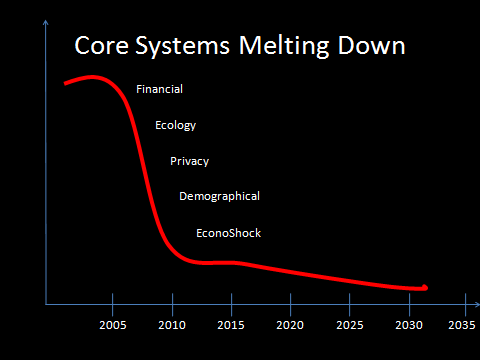
- Our worldwide financial system is going through a “meltdown”. The old game of greed is being replaced by an all important requirement: trust.
- Ecological, ethnological and demographical shocks (see also Geert Noels, author of Econoshock) are turning our systems upside-down: Green and Energy conservation thinking are now the mainstream.

- The East-West shock: economic power is shifting from the Western world to the new economies of APAC and BRIC+ countries.
- New forms of communication via the internet (blogs, wikis, social networks such as Facebook, Twitter, Netlog, etc.) propose a new paradigm in respect to privacy.
All these fundamental changes give us feelings of discomfort, disorientation, confusion and loss of control. Although our “collective intelligence” indicates that our old models do not apply anymore, our “hardware” seems not to have caught on. We have not adapted the way we are organized hierarchically; how we look at governance. Our traditional ‘system thinking’ got stuck and did not follow our ‘collective intelligence’.
On the other hand a new set of systems and tools are emerging:

- Barack Obama describes it as the ‘audacity of hope’; innovators, planners, academics and authors are referring to ‘dreamtelligence’ as a new, vital, and visionary way to use play, fantasy, dream-thinking and innovation to kick-start ideas and stimulate community engagement.
- A fantastic call for and revival of authenticity for ourselves and our leaders. Furthermore, having true leaders; with charisma, the power to attract, integrity and authenticity.
- The Net-Generation (now young adults, 15-30 years old) have grown up as ‘digital natives’. They will be tomorrow’s leaders. What THEY think will co-form our future. The future will not be invented by today’s generation. This Net-Generation lives differently. They are “wired” differently. For them multitasking (multi-window chatting, gaming at the same time as listening to music, looking up information on the internet, being mobile, etc.) is very common. They also think differently (deeper and more authentically), and have a very strong sense of the common good and of collective and civic responsibility.

Our technological revolution has just started. To illustrate:
- Today our technologists are capable of crafting a human ear in their labs. We are now in a position to create and grow cells, tissues and even bodies.
- Artificial Intelligence is back: by 2030 our computers will be able to think, be self-learning, self-healing – some will even be able to have a consciousness.
- Self-learning robots will soon be mainstream technology. Mercedes and BMW already have cars in the pipeline for 2012 that can drive entirely automatically, better than a human counterpart.
- The emergence of Google brings forth the concept of the “Global Brain”. The internet today is already a tremendous source of information. Today’s search experience will pale in comparison to the mechanisms we’ll have in 20 years. All knowledge will be available anywhere, anytime, wirelessly via brain-implants.
- Social networking is already revolutionizing the way people and companies are communicating. It is interesting to note that these technologies let us evolve from a system-to-system communication paradigm towards a human-to-human one.
- Today you can order your personal DNA genome sequence in the USA for only $399. The company doing this is a Google backed start-up. Think of DNA in the ‘cloud’, with DNA comparisons between ancestors, relationships, etc …
- Brain-wave helmets and chip-implants will give humans better sensory perception. By 2030 we will see the emergence of “super-humans”. In such a dramatically changed context, what will make us “human”?
A lot of these future scenarios are described by Ray Kurzweil’s “Singularity” concept. This is the moment when man and machine truly blend. Kurzweil claims this will happen around the year 2030.
And the pace of all these technological innovations is just increasing exponentially. In the next 20 years we will witness technological breakthroughs tenfold those of the same previous span of time.
All this evolution calls for a re-thinking of our value-compass for the future: We must carefully re- think how all this will influence the way we will work and live. What sort of quality of life should we aim for? What will be the socio-economic impact of all this? How will we want education to be structured? What areas of society will we still want (and be able to) influence?
How are we going to ensure that the
Technical and Value ‘Readiness’
of our region
are competitive in this new era?
Will we lead the change, as opposed to being mediocre followers? I believe it is time for action.
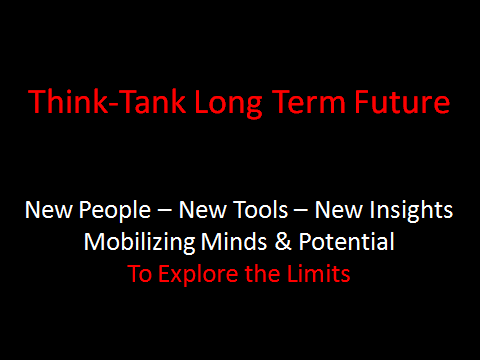
I believe The Fifth Conference and its organic network of inspiring leaders has deep within itself the embryo for a sort of “think-tank/foundation” addressing the long term future:
A movement and an energy
that prepares our Net-Generation
for the next 20 years,
with an emphasis on
our technical and value readiness
A place where “smart people” can meet. Where experts from different technological domains share their insights for 2030, cross-pollinating each other’s disciplines. Indeed, “savants” from different contexts & worldviews can act as our “eyes” and offer a perspective on how we will live and work in 2030.

How our education is best organized will also be addressed. We will investigate what our ideal value kit for that era should be, beyond traditional corporate culture. Moreover, with a culture of sharing and exploring – where we live committed to teams, groups, communities, regions and countries –a deep respect for the participating individual humanistic identities will nevertheless be maintained.
We don’t have to wait until our politicians have made up their minds as to whether or not they should invest more in innovation.
We can do this ourselves
I cannot accept that it would not be possible to raise private funding for such an organization/movement/tribe.
The resulting new models and scenarios will demand speed, creativity, dynamism, perseverance, courage, knowledge and working together in a multi-cultural context. This new society makes a plea for the respect for individuality, freedom, mobility and quality of life.
This paradigm is all about designing, exploring and organizing change, learning and fine-tuning as we go. Giving guidance to teams, organizations and leaders on how to surf these waves is part and parcel with this. Missing the first technology wave of speed and creativity will result in loss of economic relevance. Missing the wave of the new value kit will result in losing our Net-Generation; our brains for the future.
This is about preparing ourselves and our region for 2030.

Who wants to join the tribe? Who is a believer? Let’s debate this idea on- and off-line for a couple of weeks. If there is enough interest, let’s meet and make this happen.
 Petervan Studios