
This blog post is triggered by a start-up demonstration i saw at DEMOFall2009 some weeks ago.
The demo was about an iPhone application called “datecheck” aka “creepfinder”
You can find the video here.
Not that i am interested in on-line or real-life dating – i am happily married – but in essence the application allows me to do a check on my date. It basically crawls the internet, twitter, facebook, and – in the US – public data such as your real-estate tax income and even criminal records.
The end-result is that i find data about criminal records about my future fiancée, full real-estate data about what house he/she lives in, family composition, real-estate tax-income etc
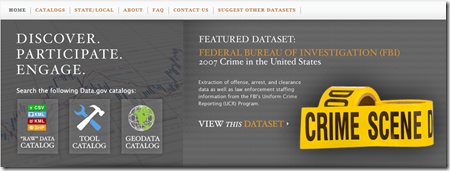
The US government also is getting quite open and transparent on its own data. Have a look at www.data.gov
And these days all these data are accessible via API’s to take data OUT of these systems. Some API’s like twitter, facebook etc also allow you to INPUT data via for example Tweetdeck, Seismic, and many others. I would love to have something that not only allows me to INPUT my Tweets, but also something that allows me to input and maintain my personal profile data, across services. See also at the end of this post.
For the US government data, you see start appearing end-consumer apps that let you search through this massive amount of for example government contractor’s data with quite advanced intelligence tools in the hand of the citizen.
In stead of FBI (Federal) it’s becoming
CBI (Citizen’s Bureau of Investigation).
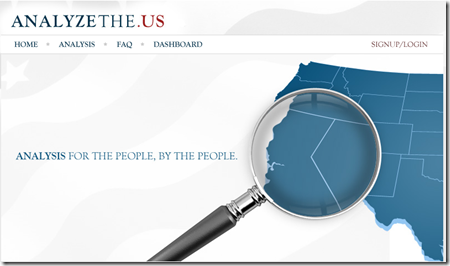
It says “analysis for the people, by the people”. I would add “"about the people”
All this is sold as “transparency” and “democracy”, and those are of course very important values.
But – and I don’t know about you – I start more and more FEELING quite uncomfortable about all this. Not that i have to hide anything, or that i have a criminal record (at least not that I am aware of ;-), but I do FEEL all this is quite intrusive.
As most of you know, in my previous life i was quite close to the Belgian eID project (electronic identity card). The card also allows you to access the on-line government database, where I can look at my OWN data and check who in the government has accessed those data.
But i believe we should make a big plea for the appliance of Law #1 of Kim Cameron’s Laws of Identity:

That’s easy said, but how do you enforce that. I took the pain to look at the privacy policy of Twitter (see http://twitter.com/privacy). In essence – as a user – i have nothing to say. I have 2 choices: to use twitter and accept the privacy policy, or not use it. But how many of the many million Twitter users have ever read the privacy policy ? How many know what sort of deep intelligence engines are crawling all these data that i released to the net WITH A DIFFERENT PURPOSE ?
This is not Twitter specific. It applies to Facebook, Friendfeed, or any other form of social network or service.
In my opinion, i would like to have something where i can control what data about myself i want to release to what service and in what context. I update my information there once, and have also guarantee that my profile information is consistent across Twitter, Facebook or even event/conference sites that these days more and more use their own social media piece of technology.
Of course you would need a highly trusted party to deal with these data. I think i would even be prepared to pay a price for my privacy.
This concept of a central digital vault comes pretty close to eMe, the winner of the Innotribe idea-contest at Sibos 2009 some weeks ago. But they started from “mydata” and information and documents related to financial services. If you start thinking privacy and putting control of data back into the user’s hands, you get a much more powerful proposition.
I would like to hear the opinion of a number of identity and privacy experts that are following this blog
UPDATE: Can’t help it, but just at the same time as i published this post, Guy Kawasaki tweeted the following URL:
http://holykaw.alltop.com/why-you-should-think-before-you-tweet
 Petervan Studios
It isn’t that privacy is dead — it never really existed. We should be working together to use technology to create privacy.
If you take something like Credentica and implement in the right framework (eg, Kim’s “Laws”) then you can deliver something entirely new to the great benefit of people everywhere.
I think the Twitter thing isn’t a real issue — you can always create a twitter pseudonym and post from web cafes — the issue is absurd laws.
CLOUD (Consortium for Local Ownership and Use of Data), Inc. agrees with you completely, Peter. Part of the privacy problem is driven by the fact that “who I am” is in same databases as “what I am.” Separating them with a ME 1.0 standard will allow the user/individual to be back in control.
Privacy will “remain dead” as long as the Internet is only about web pages, rather than people. When Vint Cerf and Bob Kahn created TCP/IP, they connected people, not web sites.
CLOUD was very intrigued by the eMe team’s presentation and have been tracking its developments. Although the eMe concept from Sibos comes very close to moving this issue forward, I don’t have ME in only one data silo. From healthcare to education to finance and beyond, ME crosses domains. It’s not about putting me into a central vault, it’s about creating a virtual vault by tethering the various parts of Me, wherever they may be, and putting ME back in charge and separating my identifying information from this personal information.
CLOUD is discussing this issue @ cloudinc.org and is pushing forward a cross-industry standard to simplify privacy compliance for companies and otherwise reduce the overhead and improve the efficiency of dealing with personal information. Just like HTML drove forward an explosion of web pages, CLOUD is developing a contextual markup language (CTML) for people, a step that will take us far beyond identity and data to a new world of ME 1.0.
CLOUD is partnering with leaders in education, healthcare and beyond. We do not propose to create new data standards but harness existing ones, like XBRL in finance. Look forward to exploring the implications with eMe, Innotribe and Swift for privacy, new money, payments and beyond.
Gary,
thx for your comments and enthusiasm !
Where can i find more about the ME 1.0 standard ?
I will put you in contact with eMe team
talk to you soon
Peter
Peter –
This is a vital issue and one worthy of global efforts to resolve. Information on CLOUD and our goals can be found at cloudinc.org.
You’ll note CLOUD Education, Finance and Healthcare. These will be the first metamodels and syntaxes of our new Contextual Markup Language (CTML). Think of ME 1.0 as the next phase of the Internet, beyond Web 2.0, as opposed to a standard unto itself.
We are engaging key foundations in the early financing of each of these value chains and will roll out CTML similarly to XBRL in the financial space across these domains. Paul Wilkinson, former Sr. Advisor to Chairman Cox at the SEC, who rolled out XBRL in the US, is CLOUD’s Chief Strategy Officer.
I, too, look forward to speaking with you soon. With my wife’s extended family still living in Belgium (Antwerp, Herfelingen and Brussels), I would be very amenable to trip over to discuss in more detail, as our conversations progress.
Thank you for the introduction to the eMe team.
Gary
Pingback: Identity Rights System 3.0 « Petervan's Blog