
Now that Innotribe @ Sibos is over, back to the real purpose of this blog: “Inspire others to dream”. For a recap, see the very first post of this blog, back in April 2009.
There is something fascinating and very profound that is going on with on-line reputation. This post is about values in the on-line world. It is very much related to the upcoming Think Tank on Long Term Future, where we want to deeply thing about the value kit needed in a transhumanistic and singularity type of world. It also relates to our on-line identity and its evolution, a theme that i often have addresses on this blog.
As Chief Executive Mixer of ideas, i would like to mix the following memes:
- The Whuffie Bank presentation at last week’s Techcrunch50
- Seth Gondin’s blog on “ClouT” (yes with a “t” and not a “d”) of a couple of weeks ago
- The Trust-Score idea presented by the crowdsourcing team at last week’s Sibos and Innotribe
- Matteo’s idea for Mindtagger
First, The Whuffie Bank. Nothing better than watching yourself the TC50 Video and comments here. Also the second part of the video is interesting: the debate and feedback session: the most important comments was that reputation is contextual. I maybe interested in the ideas of a couple of on-line friends only. My own tribe so to speak. But even in my own tribe, i may appreciate the techie knowledge of Nick for example, but not at all be interested in his political ideas or preferences.
Or have a look at The Whuffie Bank website.
The Whuffie Bank from The Whuffie Bank on Vimeo.
It is very profound what these guys are saying:
The Whuffie Bank is a nonprofit organization dedicated to building a new currency based on reputation that could be redeemed for real and virtual products and services.
The higher your reputation, the wealthier you are.
It’s in the same spirit of Creative Commons, an organization that’s changing the contract between our ideas and us; we want to build an open organization that aims to measure and enable the exchange of online reputation.
The Whuffie bank also has some crazy ideas on how they could you beyond the web into the brick & mortar world, by for ex printing money or having credit cards with whuffies on it.
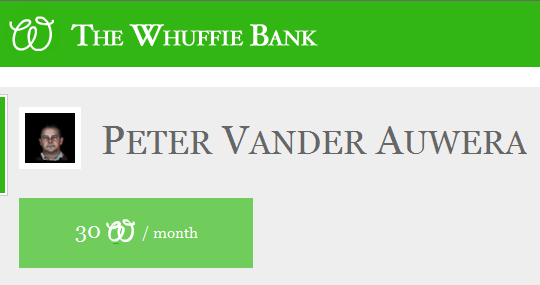
I tried myself. I do NOT tweet or RT very much, but do have a Whuffie balance:
More interesting is to see where my “Whuffies” come from, and what triggers reputation changes and endorsement ranking.


It’s all in the same spirit Creative Commons, where fundamental re-thinking was done on the relationship we have with ideas and the copyright contract.
Now we are re-thinking the relationship we have between our values and the money contract.
The Whuffie bank is based on 4 principles
- Endorses public endorsement
- Based on degree of influence on other people: if you retweet often your influence on others will be greater
- Considers existing reputation of each member: it’s different to get an endorsement from the president of the USA, than from me for example
- The message content is analyzed. If a tweet has a link, the link is more important than the couple of words before it.
Second, one of Seth Godin’s latest posts. Seth is the author of “Tribes” and the name Innotribe was based on the title of his book.
The web knows something, but it’s not telling us, at least not yet.
The web knows how many followers you have on Twitter, how many friends you have on Facebook, how many people read your blog.
It also knows how often those people retweet, amplify and spread your ideas.
It also knows how many followers your followers have…
So, what if, Google-style, someone took all this data and figured out who has clout.
Which of your readers is the one capable of making an idea break through the noise and spread? Bloggers don’t have impact because they have a lot of readers, they have a lot of impact because of who their readers are (my readers, of course, are the most sophisticated and cloutful on the entire web).
If you knew which of your followers had clout, you could invest more time and energy in personal attention. If we knew where big ideas were starting, that would be neat, and even more useful would be understanding who the key people were in bringing those new ideas to the rest of the world.
Back in the old days, we had no idea, so we defaulted to big newspapers, or magazines or the TV networks. But now we know. We just need to surface the data in a way that is useful.
So, it is really about how impactful your
followers
are.
That’s pretty profound.
Thirdly, at last week’s Innotribe @ Sibos, the crowdsourcing team pitched the idea of “Trust-Score”. What a pity this one did not get a better pitch  Because it’s also really about trust-reputation. But then in the real-world of money. And how one could spot patterns in somebody’s online money behavior and how deviations from the measured average could lead to fraud detection algorithms and alike.
Or, fourth, what would happen if we mix all the above with my colleague Matteo Rizzi’s “Mindtagger”. At this stage “just” a searchable repository of people as mind-skills, but what if we throw reputation on top of it ? And Whuffies, based on how much good somebody does for the community. And Clout to see who is helping spread our ideas ?
Maybe at next year’s Innotribe @ Sibos2010, we should have a theme on “Clout” in stead of “Cloud”. Wouldn’t it be great to tribe together smart people to brainstorm on ideas that could add value through reputation mechanism to the SWIFT eco-system. As a matter of fact,
why wait till next year ?
Who is interested ? Please comment to this posting. We’ll feed it into the Think Tank for the value bit and into Innotribe for the project bit.
 Petervan Studios