The 2009 State of the Future report, just published by the Millennium Project, a global, independent futures-research think tank.
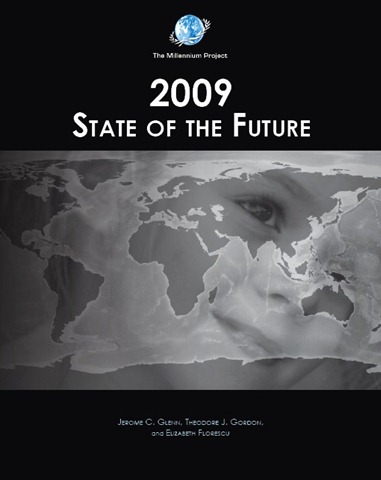
The Executive Summary can be downloaded here.
Interesting dimensions in the report:
- Two State of the Future Indexes are presented; one without the recession and one based on an extended recession
- Emerging International Environmental Security Issues
- Future Economic Elements to Improve the Human Condition
The Future Economic Elements receiving the highest average ratings from the international panel for beneficial impacts for the future of humanity were:
• Ethics a key element in most work relations and economic exchanges
• New GNP/GDP definitions that include all forms of national wealth: e.g., energy, materials, ecosystems, social and human capital
• Global commons—air, climate, oceans, biodiversity (bees necessary for agriculture, etc.)—supported by international agreements among countries for very small (less than 1%) tax on selected categories, including currency trading and international travel; the funds collected would amount to several hundred billion per year for global public goods
• Collective intelligence––global commons for the knowledge economy
• On-line and in-classroom educational systems that continually update curriculum on the evolving economic system and its elements.
Interesting quote:
In March 2009 an asteroid missed Earth by 77,000 kilometers, 80% closer to the planet than our moon is. If it had hit Earth, it would have wiped out all life on 800 square kilometers.
No one knew it was coming.
The time between its discovery and close approach was very short.
Few people knew the global financial crisis was coming; fewer still forecast its breadth and depth. We need global, national, and local systems for resilience—the capacities to anticipate, respond, and recover from disasters while identifying future technological and social innovations and opportunities.
The acceleration of change reduces the time from recognizing the need to make a decision to completing all the steps to make the right decision. The number and intricacy of choices seem to be growing beyond leaders’ abilities to analyze and make decisions.
For example, do we have the right to clone ourselves, or to rewrite genetic codes to create thousands of new life forms, or to genetically change ourselves and future generations into new species?
Some experts speculate that the world is heading for a “singularity”—a time in which technological change is so fast and significant that we today are incapable of conceiving what life might be like beyond the year 2025.
Fortunately, we have the means for many people to know the world as a whole, identify global improvement systems, and seek to improve such systems—hence accelerating the improvements of our global situation.
We are the first generation to act via Internet with like-minded individuals around the world.
We have the ability to connect the right ideas to resources and people to help address global and local challenges. This is a unique time in human history.
Mobile phones, the Internet, international trade, language translation, and jet planes are giving birth to an interdependent humanity that can create and implement global strategies to improve the prospects for humanity.
 Petervan Studios
like the Edgar Watson Howe saying: \”A man is usually more careful of his money than he is of his principles.\” – I definitely look forward to read the next one